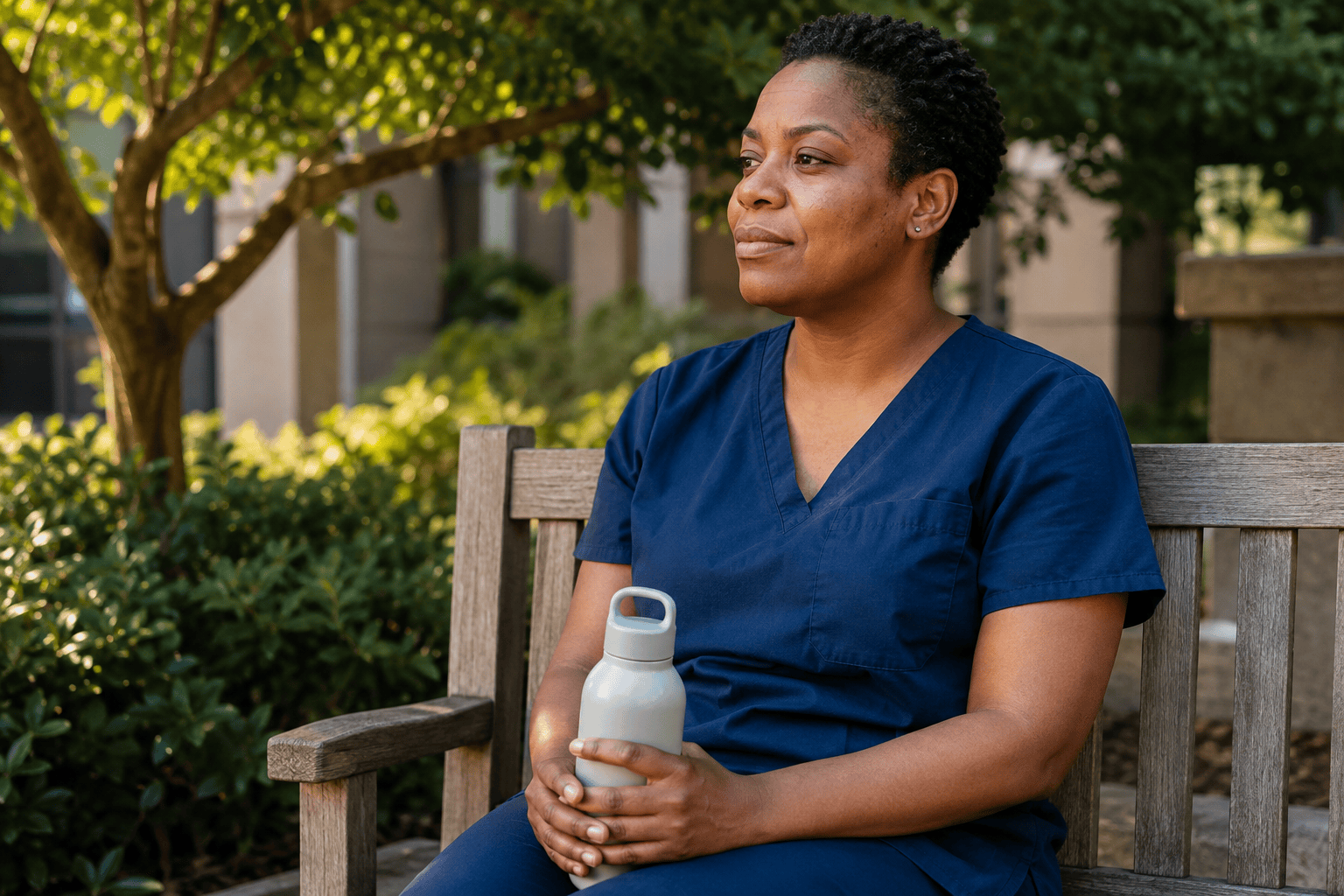
The phrase “put on your oxygen mask before helping others” is clinical advice borrowed from aviation. Nurses hear it constantly. They almost never follow it — not because they don’t want to, but because the structural reality of nursing makes self-care feel like a moral failure while a call light is on.
This guide is not about bubble baths and gratitude journals. It is about the evidence-based physiological and psychological maintenance that keeps a nurse clinically sharp, functionally present, and in the profession long enough to actually help people.
Why Nurse Self-Care Is a Patient Safety Issue
The research is unambiguous: nurse fatigue and burnout directly correlate with patient harm events.
A 2019 study in BMJ Quality & Safety found that patients cared for by nurses reporting high burnout had 30% higher rates of hospital-acquired infections and 28% higher 30-day mortality rates than patients cared for by non-burned-out nurses. These are not soft outcomes. These are mortality statistics.
The 2022 Journal of Advanced Nursing meta-analysis of 46 studies found that nurses working more than 12.5 consecutive hours had 3× the rate of near-miss medication errors compared to nurses working standard 12-hour shifts — and error rates compounded with each consecutive overtime hour.
Nurse self-care is not self-indulgence. It is patient safety infrastructure.
The Four Non-Negotiables (Evidence-Based)
1. Sleep — The Non-Negotiable You Cannot Borrow Against
Nurses on rotating or night shifts have chronically disrupted circadian rhythms. The physiological consequences are not limited to tiredness:
- Decision-making quality degrades after 17 hours of wakefulness at the same rate as a 0.05% blood alcohol level (Williamson & Feyer, Occupational and Environmental Medicine, 2000)
- After 24 hours without sleep, cognitive performance is equivalent to legal intoxication (Sleep, 2003)
- Cumulative partial sleep deprivation (6 hours/night for 2 weeks) impairs performance as severely as 48 hours without sleep — and crucially, people do not perceive themselves as impaired
What the research supports for shift nurses:
– Anchor your main sleep block at the same time each day when possible — even 30 minutes of consistency stabilizes circadian rhythm more than random catch-up sleep
– Short naps of 20–25 minutes before a night shift (not during) improve alertness for up to 4 hours (Sleep Medicine Reviews, 2014)
– Blackout curtains and white noise are not luxury items for day-sleeping nurses — they are clinical tools
Scenario: James is an ICU nurse who works three 12-hour night shifts in a row. On his last night he catches himself reading a ventilator order three times without retaining it. He knows this cognitive sign — he calls it “loop brain.” He uses his 0200 break to do a 20-minute nap in the sleep room. By 0400 he’s back. The nap didn’t fix the exhaustion — but it bought him the hours he needed to close the shift safely.
2. Nutrition and Hydration During Shifts
Nurses routinely skip meals and work dehydrated. The physiological effects are not trivial:
- Mild dehydration (1–2% body weight loss) impairs short-term memory, concentration, and psychomotor skills — exactly the capabilities required for bedside care (Nutrients, 2019)
- Blood sugar instability from skipped meals drives cortisol dysregulation, worsening stress reactivity over the course of a shift
- Nursing-specific research shows that nurses who eat a meal mid-shift (vs. snacking only) report significantly lower perceived stress at end of shift (Workplace Health & Safety, 2021)
Practical implementation:
– Pack food with protein and fat, not only carbohydrates — protein slows glucose absorption and sustains cognitive energy
– Keep a water bottle accessible during charting (most units allow this)
– Eat even when you don’t feel hungry mid-shift — hunger perception is blunted under stress
3. Micro-Recovery Between Patients (Psychological Detachment)
Research by organizational psychologist Dr. Charlotte Fritz at Portland State University established that brief periods of genuine psychological detachment — not just physical rest — are the single strongest predictor of next-shift energy and resilience in healthcare workers.
Psychological detachment means: for the 5–10 minutes of a break, your brain is not processing work problems. Not charting. Not thinking through a complex patient. Not venting to a colleague about the charge nurse.
What actually works:
– 5-minute mindfulness exercises between complex patients (there are validated single-session tools in the literature)
– Brief non-work conversations with a colleague
– Walking to a window, outside air, or a different floor
This is not about “relaxing.” It is about resetting the prefrontal cortex — the part of the brain responsible for clinical judgment — so it can sustain function across a 12-hour shift.
4. Setting Operational Limits on Extra Shifts
Mandatory overtime and chronic extra shift pickup are the mechanisms that convert normal nursing stress into clinical burnout. Individual boundary-setting helps — but the decision architecture matters:
- Use a written rule, not a case-by-case decision. “I do not work more than 3 shifts in 7 days” is a policy. “I’ll decide when they ask” is a negotiation you will lose when understaffed and guilt-tripped at 1800.
- Give yourself a 24-hour rule for non-urgent shift requests. You are never required to answer a shift text immediately. “Let me check my schedule and get back to you” buys recovery time and reduces the yes-under-pressure pattern.
- Recognize that saying no to a shift is clinical risk management, not team abandonment. A fatigued nurse taking an overtime shift increases patient risk — and you are the one who has to stand at that bedside.
When Individual Strategies Are Not Enough
If the nursing environment itself is the source of chronic stress — short staffing ratios, unsafe assignments, punitive management — individual self-care strategies will not resolve the root cause.
Signs that the environment, not your habits, is the problem:
– Your symptoms resolve entirely on days off and return the moment you clock in
– Multiple colleagues on your unit report the same symptoms
– You’ve changed your self-care behaviors significantly without improvement
Systemic responses:
– File a safe staffing concern report through your hospital’s formal reporting channel (this creates a paper trail)
– Consult your state’s nursing association — many have advocacy resources and legal protections for safe staffing complaints
– Consider whether the unit is a match for your clinical stage. Burnout in a specific high-acuity environment is not evidence you cannot nurse — it may be evidence that you need a different role, floor, or shift structure
Tools That Reduce the Cognitive Load That Drives Burnout
One of the primary drivers of nursing burnout is not the emotional weight of the work — it is the administrative and documentation burden layered on top of clinical care. Nurses spend an estimated 35–40% of their shift on documentation unrelated to direct patient care.
Reducing that overhead is burnout prevention at the structural level. NurseBrain automates shift handoff summaries, pre-populates clinical assessment templates, and organizes task lists so that the administrative overhead of each patient doesn’t compound across a 5-patient assignment.
Less cognitive friction on documentation means more cognitive reserve for clinical judgment — and for the human interactions that made nursing meaningful to you in the first place.
Summary
Taking care of yourself before taking care of others is not a slogan. It is a clinical prerequisite.
The evidence is clear: nurse sleep deprivation, malnutrition, and burnout directly cause patient harm. The evidence is equally clear on what works: consistent sleep hygiene, mid-shift nutrition, brief psychological detachment, and operational limits on overtime.
None of these are easy to implement in the current conditions of nursing. All of them are worth fighting for — because the patients who need the best version of your clinical judgment are counting on you to protect it.
Clinically reviewed by Aisha Thompson, RN, MSN, CCRN — Critical Care Nursing, 10 years. April 2026.
Sources:
– Dorrian J et al. “Psychomotor vigilance performance: neurocognitive assay sensitive to sleep loss.” Nature, 2000.
– Harrison Y, Horne JA. “The impact of sleep deprivation on decision making.” Journal of Sleep Research, 2000.
– Van Dongen HPA et al. “The cumulative cost of additional wakefulness.” Sleep, 2003.
– Williamson AM, Feyer AM. “Moderate sleep deprivation produces impairments in cognitive and motor performance equivalent to legally prescribed levels of alcohol intoxication.” Occupational and Environmental Medicine, 2000.
– Stimpfel AW, Sloane DM, Aiken LH. “The longer the shifts for hospital nurses, the higher the levels of burnout and patient dissatisfaction.” Health Affairs, 2012.
– Aiken LH et al. “Burnout and safety outcomes in hospital nursing.” BMJ Quality & Safety, 2019.
– Fritz C, Sonnentag S. “Recovery, health, and job performance.” Journal of Applied Psychology, 2006.
– Popkin BM, D’Anci KE, Rosenberg IH. “Water, hydration, and health.” Nutrition Reviews, 2010.