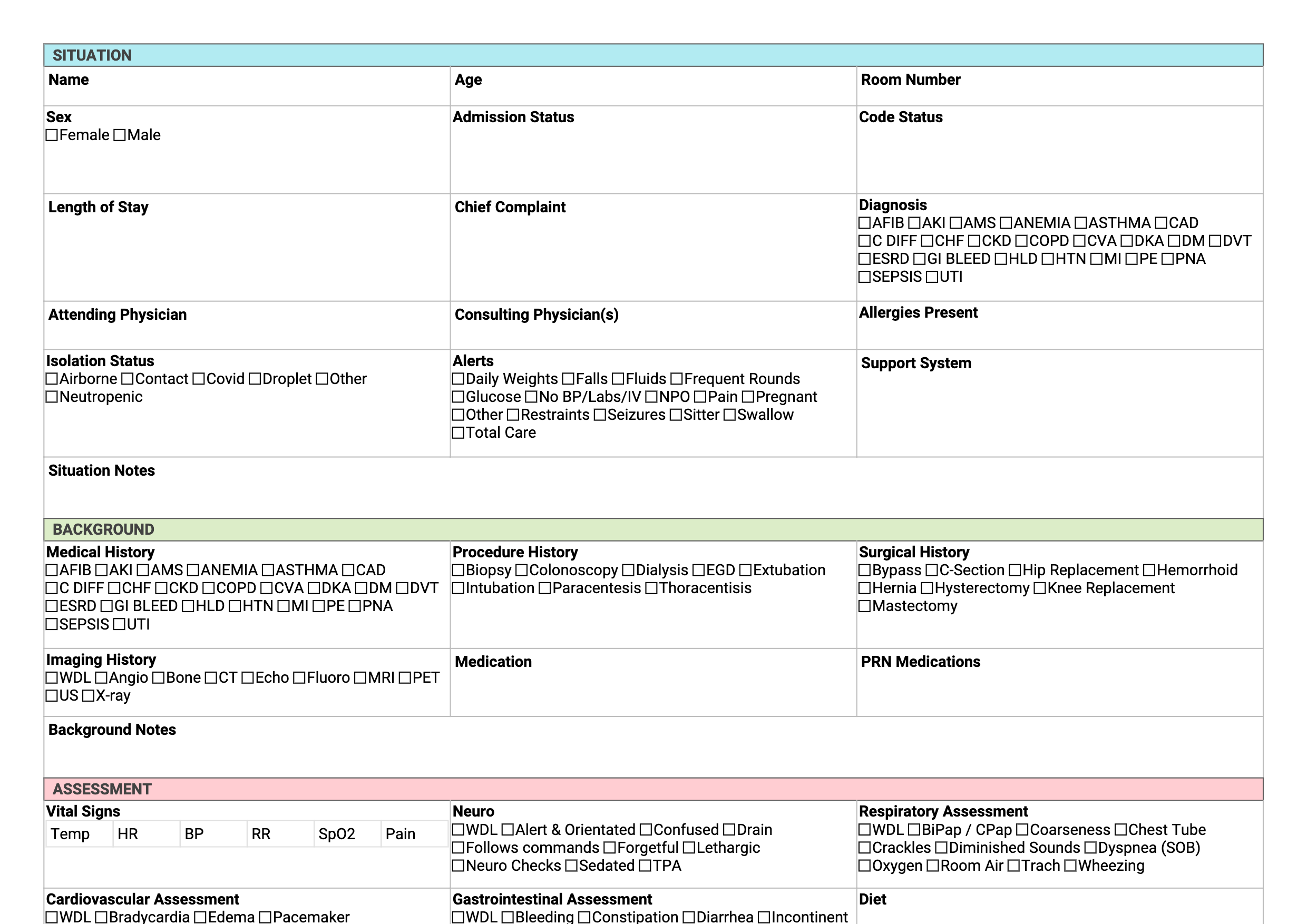
The ER doesn't run on consistent assignments. Your census changes every 20 minutes, patients pull from triage before you've finished your last assessment, and the doctor just put in orders on a room you haven't touched yet. A good ER brain sheet gives you a running snapshot of every patient in your zone — acuity, chief complaint, what's been done, what's still pending, and what they're waiting on for disposition. Download the free printable PDF below, or track your bay assignments digitally in NurseBrain Synapse so handoffs are clean even when the department is moving fast.
What is an ER brain sheet?
Emergency nurses don't manage a fixed roster of patients for 12 hours straight — they manage a rotating zone of beds where every patient is in a different phase: just triaged, mid-workup, waiting for imaging, holding for a bed upstairs, or ready to discharge. The ER brain sheet tracks that reality: a row or section per bay with enough information to give a quick verbal handoff without pulling the chart. Acuity level, chief complaint, what's been given, what's been ordered, last vital set, and what the hold-up is. Some nurses use a single sheet for the whole zone; others do one slip per patient. The format matters less than having it.
What to track on an ER brain sheet
Emergency brain sheets typically cover: room or bay number; triage acuity (ESI 1–5); chief complaint; arrival time; vitals (last set and time); interventions done (IV access, labs drawn, EKG, imaging ordered); medications given or pending; significant findings (abnormal labs, imaging results, EKG interpretation); disposition plan (admit, discharge, transfer, observation); hold status and reason; consult called and response; and any safety notes (fall risk, elopement risk, restraints, sitter needed).
ER brain sheet vs ER report sheet: same idea, ER version
Some ER nurses call it a brain sheet; others call it a report sheet, a zone sheet, or a tracking sheet. The goal is the same: a quick reference for every patient in your area that lets you give a handoff in under a minute per patient without opening the EMR. The free PDF template above works on a clipboard or folded in your pocket. NurseBrain Synapse is the digital version — update patient info on your phone as the shift moves, and when it's time for handoff, your notes are already there.
ER Nurse FAQ
What does an ER nurse do?
An emergency nurse triages, assesses, and stabilizes patients across a full spectrum of acuity — from ESI 5 ear infections to ESI 1 cardiac arrests — often simultaneously. On any shift you're placing IVs, drawing labs, administering time-sensitive medications (tPA, antivenom, push-dose pressors), interpreting EKGs, managing trauma activations, running rapid assessments on patients still in the waiting room, and coordinating discharge or admission for multiple patients at different stages. Patient assignments in the ER are rarely fixed — you manage your zone, not a static list.
How many patients does an ER nurse take?
Most emergency nurses manage 3–4 patients per zone or bay assignment at any given time, but the actual number in a shift is much higher because patients turn over throughout your 12 hours. Some fast-track sections run 5–6 lower-acuity patients. California mandates a 1:4 ratio for emergency departments (or 1:1 for critical patients). Pediatric ERs typically run 1:3 or 1:4 depending on acuity.
What makes a good ER brain sheet?
A good ER brain sheet is structured around bays or rooms, not a fixed patient list. Each row should capture: bay/room number, triage acuity (ESI), chief complaint, arrival time, current vitals, interventions done, pending orders or results, medications given, and disposition status. It should fit on one page for the whole zone so you're not flipping between pages during a trauma.
How do ER nurses do handoffs?
Most ER nurses give verbal bedside handoffs, going bay to bay with the incoming nurse. A good ER brain sheet lets you give a tight verbal summary — acuity, chief complaint, what's been done, what's pending, what they're waiting on — for each patient in under a minute. Some departments use a structured format like SBAR or IPASS; others keep it informal. What matters is that the incoming nurse leaves knowing the plan for every patient in the zone.
Can I use a digital ER brain sheet?
Yes. NurseBrain Synapse is built for bedside use and works on your phone. You can set up your zone assignments, track each patient's status as things change throughout the shift, and pull up clean handoff notes at the end without having to decipher your own handwriting at 0700. Available on iOS and Android.