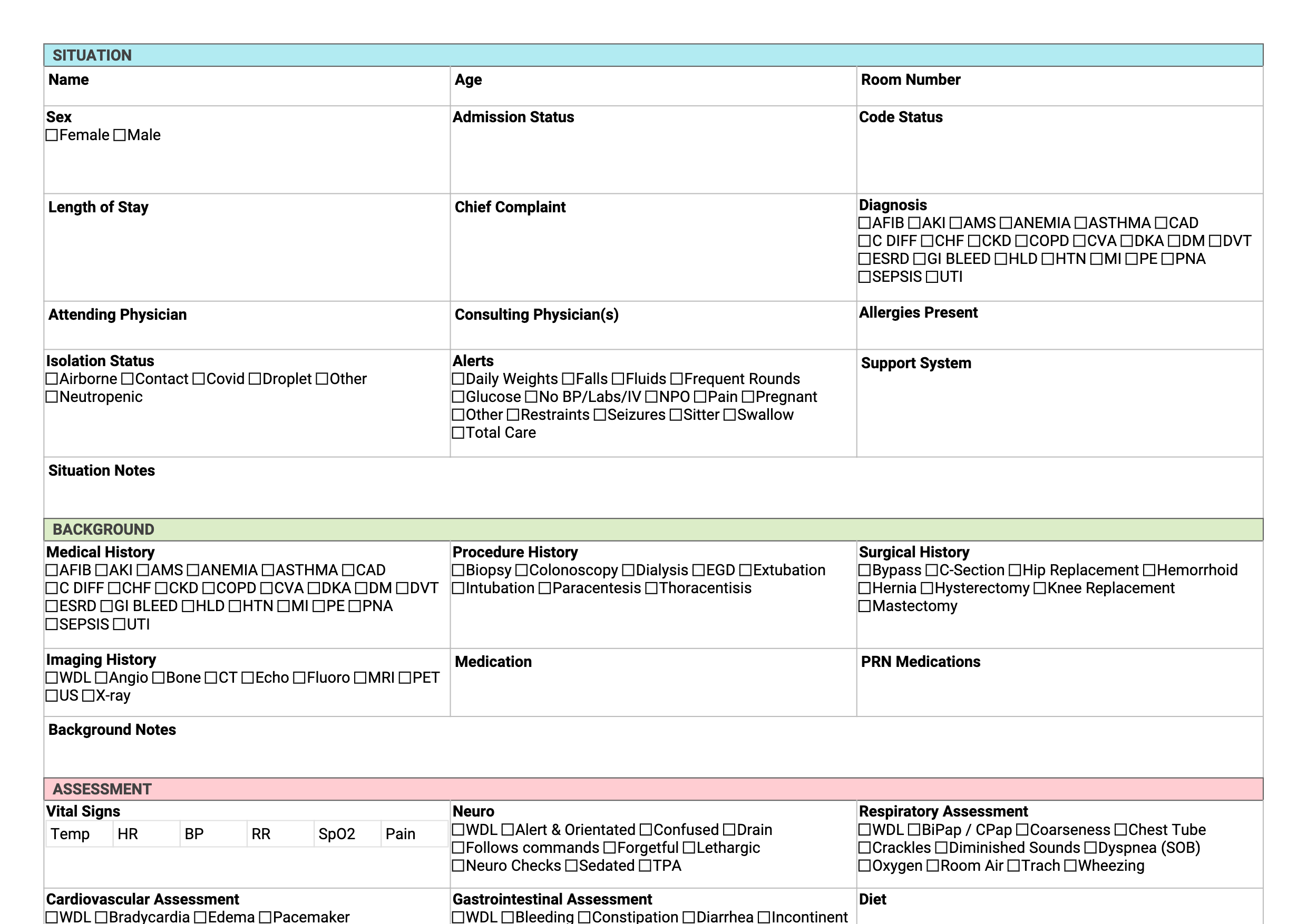
PACU nursing is all about two things: safe emergence from anesthesia and meeting discharge criteria before the patient moves to the next level of care. Your patients arrive fresh from the OR — airway secured, anesthesia still on board, vitals changing rapidly in the first 15 minutes — and your job is to monitor the emergence, manage pain and PONV, and document the Aldrete or modified Aldrete score that determines when they can leave. A good PACU brain sheet keeps those time-sensitive parameters organized. Download the free printable PDF below, or use it digitally in NurseBrain Synapse for each patient rotation through your PACU bays.
What is a PACU brain sheet?
PACU nurses manage patients in the most acute period after surgery: the first minutes to hours after general anesthesia, regional blocks, or monitored anesthesia care. Your patient's airway reflexes are returning, their temperature may be dropping, their blood pressure is responding to fluids, and their pain is waking up along with them. The PACU brain sheet tracks the parameters that matter in this window: anesthesia type and agents used, airway management, vital sign trajectory in the first 30 minutes, pain score and opioid dose administered, PONV status and treatment, temperature, and Aldrete score progression toward Phase I discharge criteria.
What to track on a PACU brain sheet
PACU brain sheets typically cover: procedure performed and surgeon; anesthesia type (general, regional, spinal/epidural, MAC) and agents used; airway on arrival (ETT, LMA, nasal airway, natural airway); vital signs on arrival and every 5–15 minutes during emergence; SpO2 and O2 delivery; temperature (warming device if applicable); IV access and fluid running; pain score on arrival and after each analgesic dose; PONV assessment and treatment given; Aldrete score components at each assessment (activity, respiration, circulation, consciousness, O2 saturation); surgical dressing or drain assessment; and transfer destination and criteria met.
PACU brain sheet vs PACU flow sheet: same concept
Some PACUs use printed flow sheets; others use EMR flow charting plus a personal brain sheet for the rapid-change emergence phase. Either way, you need a way to track vital sign trends, pain and PONV scores, and Aldrete progression at a glance without scrolling through an EMR during a busy emergence. The free PDF template gives you that one-page snapshot. NurseBrain Synapse is the digital version — track each patient from OR arrival through Phase I and Phase II discharge on your phone.
PACU Nurse FAQ
What does a PACU nurse do?
A PACU (Post-Anesthesia Care Unit) nurse manages patients in the immediate postoperative period — from when they arrive from the OR through safe emergence from anesthesia and readiness for the next level of care. You're managing airways during emergence, monitoring vital signs every 5–15 minutes, assessing and treating postoperative pain and nausea, preventing and responding to postoperative complications (airway obstruction, laryngospasm, hypotension, hypothermia, bleeding at the surgical site), scoring Aldrete criteria for Phase I discharge, and providing Phase II recovery for ambulatory patients.
What is the Aldrete score?
The Aldrete score (modified post-anesthesia recovery score) is used to determine Phase I PACU discharge readiness. It scores five parameters from 0-2 each: activity (able to move 4/4 extremities = 2), respiration (deep breath and cough = 2, dyspnea = 1, apneic = 0), circulation (BP within 20% of preoperative = 2), consciousness (fully awake = 2), and oxygen saturation (SpO2 >92% on room air = 2). A score of 9–10 indicates readiness for Phase I discharge. Some facilities use a modified Aldrete score that substitutes pain and PONV scores for the consciousness criterion.
What is PONV and how do you treat it?
PONV (postoperative nausea and vomiting) is one of the most common PACU complications, affecting 25–30% of surgical patients. Risk factors include female gender, non-smoker, history of PONV or motion sickness, opioid use, volatile anesthetic agents, and longer surgery duration. First-line PACU treatments include ondansetron 4 mg IV, dexamethasone (often given intraoperatively), promethazine, or scopolamine patch. Document the antiemetic given, time, dose, and patient response on your PACU brain sheet.
How many patients does a PACU nurse take?
Most PACU nurses manage 1–2 patients simultaneously. Phase I PACU (immediate post-anesthesia) is typically 1:1 for complex or high-acuity patients and 1:2 for stable patients. Phase II (ambulatory/step-down recovery) may allow 1:3 ratios. ASPAN (American Society of PeriAnesthesia Nurses) recommends 1:1 for Phase I patients in the first 15 minutes after arrival from the OR.
Can I use a digital PACU brain sheet?
Yes. NurseBrain Synapse works on your phone or tablet. For PACU, you can track emergence parameters, pain and PONV scores, Aldrete progression, and handoff notes digitally for each patient rotation through your bays. Available on iOS and Android.