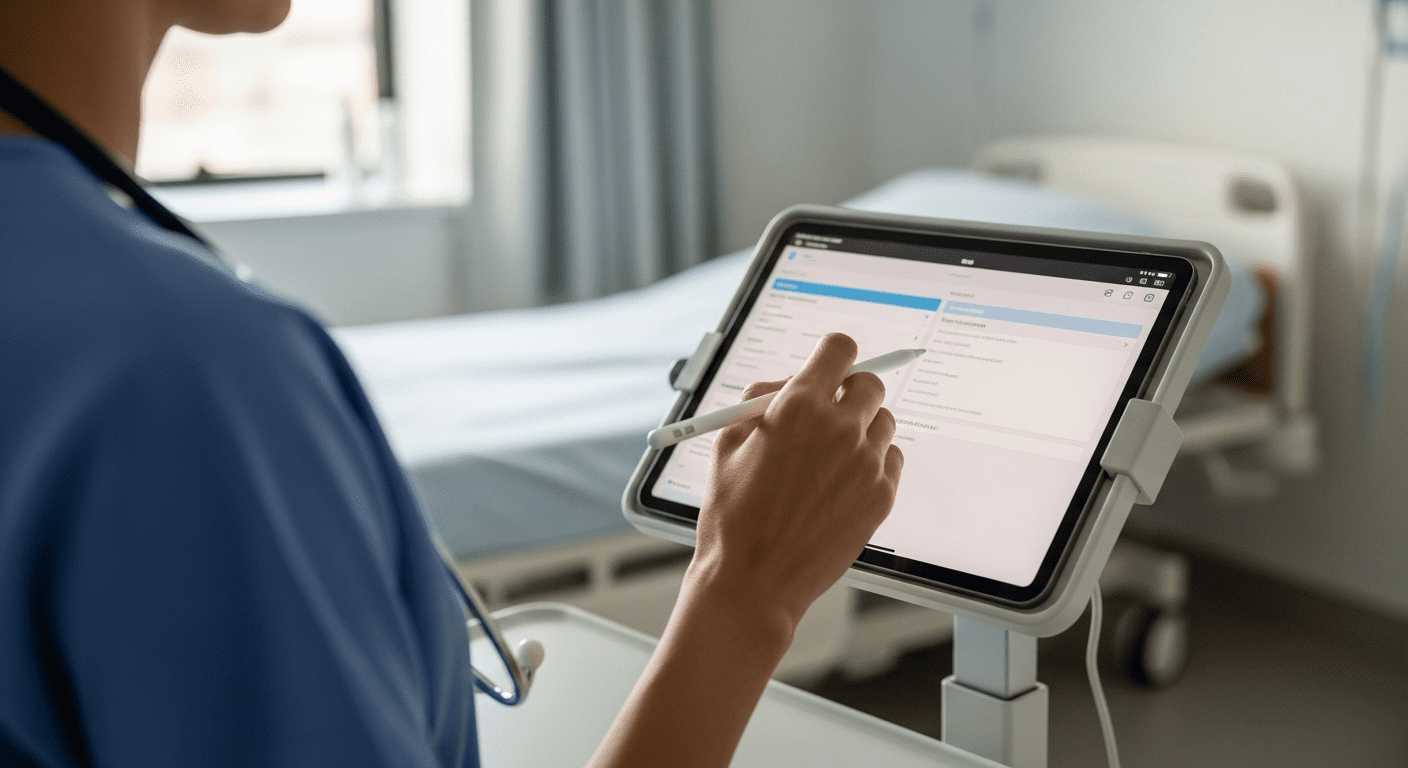
What Is Charting in Nursing?
If you’re wondering what is charting in nursing, here’s the short version: it’s how you document everything that happens with your patient. Assessments, interventions, medications, vital signs, patient responses, conversations with providers — all of it goes into the chart.
Nursing documentation is your legal record. It’s proof that you did your job. If it wasn’t charted, it wasn’t done — you’ve heard that a thousand times because it’s true. When a patient files a complaint two years from now, your chart note is what protects you.
But nurse charting goes beyond legal protection. Your documentation is how the next nurse picks up where you left off. It’s how the physician knows what happened overnight. It’s how case management tracks progress toward discharge. Bad charting doesn’t just put your license at risk — it puts your patient at risk.
The frustrating part? Most nursing programs spend maybe one lecture on documentation. Then you hit the floor and you’re expected to chart like a pro while juggling six patients, three admissions, and a rapid response. Nobody taught you how to actually do this efficiently.
That’s what this guide is for. We’ll break down every major nursing charting method, walk through real nursing notes examples, and give you concrete tips to chart faster without missing critical details.
Types of Nursing Charting Methods
Every facility picks a charting method (or some Frankenstein combination of several). Understanding the main approaches helps you adapt faster when you switch units or hospitals. Here’s what you’ll encounter.
SOAP Charting
SOAP charting nursing is probably the method you learned in school. SOAP stands for Subjective, Objective, Assessment, and Plan. It’s structured, logical, and forces you to think critically about each patient encounter.
- Subjective: What the patient tells you. “My chest feels tight.” “The pain is a 7 out of 10.” “I haven’t had a bowel movement in four days.”
- Objective: What you observe and measure. Vital signs, lung sounds, wound appearance, lab values, output totals.
- Assessment: Your clinical interpretation. This isn’t a medical diagnosis — it’s your nursing assessment. “Patient experiencing acute pain related to surgical incision, not adequately controlled with current PRN regimen.”
- Plan: What you’re going to do about it. “Notified Dr. Martinez of inadequate pain control. Order received for Dilaudid 0.5mg IV q4h PRN. Will reassess in 30 minutes post-administration.”
SOAP works great for focused assessments and problem-based charting. It keeps your notes organized and makes it easy for other providers to follow your clinical reasoning. The downside? It can feel rigid when you’re dealing with complex, multi-system patients. You end up writing multiple SOAP notes for the same patient.
Narrative Charting
Narrative charting nursing is exactly what it sounds like — you write out what happened in paragraph or sentence form, in chronological order. It’s the oldest charting method and the most flexible.
A narrative note might read: “1430 — Patient called out stating she felt dizzy when standing. Assisted back to bed. BP 88/52 lying, HR 102. IV NS bolus 500mL initiated per standing order. Dr. Chen notified, new orders received. 1500 — BP 96/60, HR 94. Patient states dizziness improving. Will continue to monitor.”
Narrative charting gives you freedom to tell the full story. That’s also its biggest weakness — without structure, notes get long, unfocused, and hard to scan. Two nurses can document the same event completely differently. If your facility uses narrative charting, discipline yourself to be concise and chronological.
Charting by Exception
Charting by exception (CBE) is a time-saver by design. The idea is simple: you only document things that deviate from normal or from established standards of care. If a finding is within normal limits, you check a box or leave it blank, and the system assumes normal.
For example, if your patient’s lung sounds are clear bilaterally, you click “WNL” on the respiratory section and move on. You only write a note if you hear crackles, wheezes, or diminished sounds. The same applies to neuro checks, skin assessments, and GI function.
CBE dramatically cuts charting time. Some studies show nurses using charting by exception save 30-45 minutes per shift compared to full narrative documentation. But there’s a catch — in a malpractice case, “no documentation” could be interpreted as “no assessment performed” rather than “assessment was normal.” Many facilities have moved away from pure CBE for this reason, but elements of it still show up in most EHR flowsheet designs.
FDAR Charting
If you’ve been searching “what is FDAR charting in nursing,” it’s a focused charting method that stands for Focus, Data, Action, and Response. It’s similar to SOAP but with a twist — the “Focus” isn’t limited to a problem. It can be a nursing diagnosis, a patient concern, a change in condition, or even a strength.
- Focus: The topic of the note. “Acute pain — right hip” or “Patient education — insulin administration” or “Fall risk.”
- Data: Subjective and objective findings related to that focus.
- Action: What you did.
- Response: How the patient responded to your intervention.
FDAR charting works well because it’s flexible enough to cover anything — not just problems — while still keeping your notes structured. Many hospitals use FDAR for their progress notes while relying on flowsheets for routine assessments.
Charting Methods Comparison
| Method | Structure | Best For | Pros | Cons |
|---|---|---|---|---|
| SOAP | Subjective, Objective, Assessment, Plan | Problem-focused encounters | Logical flow, supports critical thinking | Rigid, multiple notes needed for complex patients |
| Narrative | Free-text, chronological | Unusual events, detailed stories | Flexible, captures full context | Time-consuming, inconsistent between nurses |
| CBE | Document deviations only | Stable patients, routine assessments | Fastest method, less redundancy | Legal risk if “normal” isn’t explicitly documented |
| FDAR | Focus, Data, Action, Response | Progress notes, patient education | Flexible focus, captures interventions + outcomes | Can get lengthy with multiple foci |
Nursing Notes Examples
Reading about charting methods is one thing. Seeing nursing notes examples from actual clinical scenarios is where it clicks. Here are three real-world examples across different settings.
Med-Surg: Post-Op Day 1 Hip Replacement
SOAP format:
S: “My hip is really sore when I try to move. The pain is about a 6. I haven’t been able to get up to the chair yet today.”
O: Right hip surgical dressing clean, dry, intact. No drainage noted. Skin warm, dry, appropriate color. Right pedal pulse 2+ palpable. Sensation intact to right foot. Able to dorsiflex and plantarflex right foot. Pain 6/10 at right hip with movement, 3/10 at rest. Norco 10/325 administered PO at 0800. Last BM 2 days ago. Incentive spirometry performed x10, achieving 1500mL. Ambulated 50 feet in hallway with PT assist and rolling walker at 1030.
A: Acute pain at surgical site limiting mobility. Pain partially controlled with current regimen. Patient progressing with PT but below expected distance for POD1.
P: Continue current pain management schedule. Encourage ambulation q4h per protocol. Will request PT to see patient again this afternoon. Encourage IS q1h while awake. Monitor surgical site for signs of infection.
ICU: Sepsis Patient on Vasopressors
Narrative format:
0700 — Received report on 68 y/o male admitted from ED with urosepsis. Levophed infusing at 8 mcg/min via right IJ triple lumen. MAP 62, HR 108 sinus tachycardia, temp 38.9. Lactate drawn at 0645 pending. Foley draining dark amber urine, 30mL output last hour. Patient arousable to voice, oriented x2 (person, place). Pupils equal and reactive 3mm bilaterally.
0730 — Lactate returned at 4.2 (previous 5.8 at 0200). Dr. Patel notified, pleased with downward trend. Levophed weaned to 6 mcg/min per protocol. MAP maintained at 65. Second liter LR bolus initiated.
0800 — Meropenem 1g IV administered over 30 minutes. No adverse reaction noted. Patient asking appropriate questions about where he is. Now oriented x3.
ER: Chest Pain Workup
FDAR format:
Focus: Chest pain — new onset
Data: 52 y/o female presenting with substernal chest pressure x 2 hours, radiating to left jaw. Rates pain 8/10. Diaphoretic on arrival. BP 168/94, HR 96, SpO2 97% on RA. 12-lead ECG obtained — ST elevation in leads II, III, aVF. Troponin drawn and sent stat. Patient reports history of HTN and DM2.
Action: ASA 324mg chewed and swallowed. NTG 0.4mg SL x1 administered. 2 large-bore IVs established (18g right AC, 16g left AC). Morphine 2mg IV push given per protocol. Dr. Kim at bedside, STEMI alert activated. Cardiology notified — Dr. Reeves responding. Heparin bolus 60 units/kg administered.
Response: Pain decreased from 8/10 to 5/10 after NTG and morphine. BP 148/82. Patient verbalizes understanding of plan for cardiac catheterization. Family notified and en route. Patient transported to cath lab at 1845 with ER RN escort.
How to Chart as a Nurse: Step by Step
If you’re a new grad wondering how to chart as a nurse without drowning, here’s a practical step-by-step workflow that works regardless of your EHR system or unit.
- Get report and open your patient’s chart immediately. Before you even lay eyes on the patient, scan the last set of vitals, the most recent nursing note, the active medication list, and any new orders. You need context before you assess.
- Do your initial assessment with your charting framework in mind. Whether your facility uses SOAP, FDAR, or flowsheets, mentally organize your findings as you go. Head-to-toe isn’t just for assessment — it’s your charting structure too.
- Chart your assessment within 1-2 hours of completing it. This is where most nurses fall behind. If you wait until noon to chart your 0730 assessment, you’re reconstructing from memory. Bad idea. Chart while it’s fresh.
- Use your nursing brain sheet to track changes throughout the shift. Jot down vitals, I&Os, med times, and any notable events on your brain sheet. This becomes your charting reference later. If you’re still using paper, consider switching to a digital brain sheet builder that keeps everything organized by patient.
- Chart interventions and responses in real time when possible. Gave a PRN pain med? Chart it right then — dose, route, time, and set a reminder to reassess in 30-60 minutes. If you batch these, you’ll forget details.
- Write your end-of-shift note with the next nurse in mind. What do they need to know? What changed? What’s still pending? A good end-of-shift note paired with a solid SBAR handoff is how you keep patients safe across shift changes.
- Review your charting before you leave. Spend 5 minutes scanning each patient’s chart. Did you document that blood sugar recheck? Did you sign off on the blood transfusion? Missing documentation at the end of the shift is infinitely easier to fix than trying to do a late entry the next day.
7 Tips to Chart Faster Without Cutting Corners
Every nurse wants to know how to speed up their nursing documentation without sacrificing quality. These are nursing documentation tips that actually work on the floor — not theoretical advice from someone who hasn’t touched a patient in years.
1. Build Your Own Charting Phrases
Stop rewriting “lungs clear to auscultation bilaterally, no adventitious sounds, even and unlabored respirations” from scratch every time. Create a personal library of go-to phrases for normal findings and common abnormals. Most EHR systems let you save custom dot phrases or smart text. Use them.
2. Chart in Real Time, Not at the End
Batching your charting until the last two hours of your shift is a recipe for overtime and missed documentation. Carry your workstation on wheels (WOW) into the room during assessments. Chart vitals and assessment findings while you’re still with the patient. It’s faster and more accurate.
3. Use Voice-to-Text Instead of Typing
If your EHR supports dictation, use it. If it doesn’t, tools like NurseBrain Synapse let you dictate your charting notes by voice and get a clean, structured note back in seconds. Talking is three to four times faster than typing, especially on a tiny WOW keyboard. Some nurses save 30+ minutes per shift just by switching from typing to dictation.
4. Chart by Exception Where Allowed
If your facility supports charting by exception, use it strategically. Don’t write paragraphs about normal findings that your flowsheet already captures. Save your narrative documentation for changes in condition, interventions, and anything that deviates from the plan of care.
5. Use Your Brain Sheet as a Charting Cheat Sheet
Your brain sheet should be more than a scrap of paper with scribbled vitals. Use it as a running log that maps directly to what you need to chart. Every time you do something — hang a med, call a doctor, reposition a patient — note the time on your brain sheet. When you sit down to chart, everything is right there.
6. Don’t Duplicate Documentation
If you documented a blood sugar of 245 in the flowsheet and administered insulin in the MAR, you don’t need to write a separate narrative note about it — unless something unusual happened (patient refused, you held the dose, you needed to call the provider). Know what your flowsheets capture automatically and only write notes for what they don’t.
7. Use Technology That Works With You
This isn’t a generic “use technology” tip. Specifically: use a charting companion app that captures information during your shift and helps you draft notes. NurseBrain Synapse has an ambient listening feature — during assessments, it can listen to your patient interaction and auto-draft a charting note from what was said. You review it, tweak it, and drop it into your EHR. That’s a real workflow change, not a gimmick. It’s available on iOS and Android, HIPAA compliant with end-to-end encryption, and has a free plan so you can try it before committing.
How Much Time Do Nurses Actually Spend Charting?
If you’ve ever wondered how much time do nurses spend charting, the research is pretty grim. Multiple studies consistently show that nurses spend 25-35% of their shift on documentation. On a 12-hour shift, that’s 3 to 4 hours with your face in a computer screen instead of at the bedside.
A 2023 study published in the Journal of Nursing Administration found that medical-surgical nurses averaged 3.2 hours of documentation per 12-hour shift. ICU nurses? Even higher — up to 4.5 hours, thanks to hourly neuro checks, vent settings, drip titrations, and I&O calculations.
That’s not just frustrating — it’s a patient safety issue. Every minute you spend on documentation is a minute you’re not assessing, educating, or responding to changes. It contributes to burnout, job dissatisfaction, and moral injury. Nurses didn’t go into healthcare to type. They went in to take care of people.
This is exactly why documentation tools matter. Even saving 15 minutes per shift through better templates, voice charting, or ambient documentation adds up to 7.5 hours per month. That’s almost a full shift back. Tools like NurseBrain Synapse’s AI-assisted charting exist specifically to close this gap — not by replacing your clinical judgment, but by handling the transcription and formatting so you can focus on the thinking.
Nursing Notes Templates
Having a nursing notes template for common scenarios saves enormous time. You’re not reinventing the wheel every shift — you’re filling in patient-specific details within a proven structure. Here are templates you can adapt to your unit.
General Assessment Note Template
Neuro: Alert and oriented x[_]. GCS [_]. Pupils [size/reactivity]. Speech [clear/slurred]. Follows commands [yes/no]. MAE [equal/unequal — specify].
Cardiovascular: HR [_] [rhythm]. BP [_]. Peripheral pulses [present/absent — specify]. Edema [location/severity]. Capillary refill [ 3 sec].
Respiratory: RR [_]. SpO2 [_]% on [RA/O2 delivery]. Lung sounds [clear/adventitious — specify location]. Work of breathing [normal/labored]. Cough [productive/nonproductive].
GI: Abdomen [soft/distended/rigid]. Bowel sounds [present/absent] x4 quadrants. Last BM [date]. Diet [type], tolerated [yes/no]. Nausea/vomiting [yes/no].
GU: Voiding [independently/via Foley]. Urine [color/clarity]. Output [_]mL this shift.
Skin: [Intact/impaired — specify location, size, stage]. IV sites [location, gauge, appearance]. Dressing [clean/dry/intact or specify drainage].
Pain: [_]/10 at [location]. Character: [sharp/dull/aching/burning]. Intervention: [med/repositioning/ice]. Reassessment: [_]/10 at [time].
SBAR Communication Template
When you need to call a provider, your documentation should reflect a structured SBAR format:
S (Situation): “Calling about [patient name] in [room]. They are [brief problem statement].”
B (Background): “Admitted [date] for [diagnosis]. Relevant history includes [pertinent PMH]. Current meds include [relevant medications].”
A (Assessment): “Current vitals are [VS]. My assessment shows [key findings]. I’m concerned because [clinical reasoning].”
R (Recommendation): “I’m requesting [specific order/action]. Would you like to [come evaluate / order labs / change medication]?”
Document the time of the call, who you spoke to, what was communicated, and what orders were received. NurseBrain Synapse’s Patient Hub keeps your SBAR notes, tasks, and handoffs connected to each patient — so when you need to call, your data is already organized and ready to go.
Shift Handoff Documentation Template
Your end-of-shift documentation should cover:
- Summary of shift: Key events, changes in condition, procedures performed.
- Pending items: Labs due, imaging scheduled, consults not yet seen.
- Medication notes: PRN effectiveness, upcoming scheduled meds, drip rates.
- Patient/family concerns: Questions asked, education provided, emotional state.
- Plan for next shift: Anticipated discharges, procedures, diet changes.
If you’re building your own templates from scratch, the NurseBrain brain sheet builder lets you create custom templates with exactly the fields you need — then access them on your phone during your shift. Nursing students get Premium free for a full year, which includes all templates and unlimited AI charting assistance.
Why Is Documentation Important in Nursing?
Let’s be real — you already know documentation is important. But it helps to understand why documentation is important in nursing beyond “because my charge nurse told me so.”
- Legal protection. Your chart is a legal document. In a lawsuit, your note from three years ago is your defense. Vague or missing documentation leaves you exposed. Specific, timely, objective notes are your best protection.
- Continuity of care. Your patient doesn’t start over every 12 hours. Your documentation is how the next nurse, the physician, the respiratory therapist, and the case manager understand what’s happened and what needs to happen next.
- Reimbursement. Hospitals get paid based on documentation. Accurate charting of severity of illness and intensity of service directly affects reimbursement. Underdocumented care = underpaid care = budget cuts = fewer nurses. It’s a cycle.
- Quality metrics. Falls, pressure injuries, CAUTI rates, CLABSI rates — these are all tracked through documentation. Your charting feeds into the data that determines your unit’s performance scores, Magnet status, and CMS reimbursement.
- Communication. When a specialist opens the chart at 2 AM, your note is your voice. Clear documentation reduces phone calls, prevents errors, and keeps everyone on the same page.
Frequently Asked Questions About Nursing Documentation
What is the most common charting method used in hospitals?
Most hospitals use a combination of electronic flowsheets (which incorporate elements of charting by exception) and narrative or SOAP-style progress notes. The specific method varies by facility and unit. EHR systems like Epic and Cerner have built-in charting frameworks that blend multiple approaches. Ask your charge nurse or preceptor which format your unit expects.
Can I use abbreviations in nursing documentation?
You can use approved abbreviations, but you must follow your facility’s approved abbreviation list. The Joint Commission maintains a “Do Not Use” list that prohibits abbreviations like U (for units), QD/QOD, trailing zeros, and MS (which could mean morphine sulfate or magnesium sulfate). When in doubt, write it out. A misread abbreviation can lead to a medication error.
How do I document a late entry in nursing notes?
Label it clearly as a “Late Entry” and include the current date/time along with the date/time of the event you’re documenting. For example: “Late entry for 03/28/2026 at 1400 — Patient reported left calf pain. Assessed: left calf warm, tender to palpation, mild erythema noted. Homan’s sign positive. Dr. Rivera notified, venous duplex ordered.” Most EHR systems have a specific function for late entries — use it rather than backdating a note.
How can I chart faster without missing important details?
Three strategies make the biggest difference: First, build reusable charting phrases (dot phrases or smart text) for your most common assessments. Second, chart in real time instead of batching at the end of your shift. Third, use voice dictation — talking is significantly faster than typing on a small keyboard. Apps like NurseBrain Synapse offer voice charting designed specifically for nurses, turning your spoken notes into structured documentation in seconds.
What should I never write in a nursing note?
Never include opinions or judgments (“Patient is being difficult”), blame (“Medication error caused by night shift”), personal feelings, or references to incident reports. Stick to objective, factual observations. Don’t chart “Patient fell” — chart “Patient found on floor beside bed at 0300. No witnessed fall. States ‘I was trying to get to the bathroom.’ Neuro assessment performed…” Also, never chart for someone else or alter documentation after the fact.
Is there a free nursing notes template I can use?
Yes. You can find free nursing notes templates and brain sheets at nursebrain.com/sheets, or build your own custom template using the digital brain sheet builder. NurseBrain’s free plan includes unlimited patient tracking, SBAR templates, tasks, and handoffs — no credit card required. If you want AI-powered charting assistance and voice dictation, the Premium plan is $12.50/month, and nursing students get it free for a full year.
The Bottom Line
Nursing charting doesn’t have to eat your entire shift. The key is picking the right method for the situation, using templates that match your workflow, and charting in real time instead of trying to reconstruct four hours of care from memory at 1830.
Whether you’re a new grad still figuring out how to chart as a nurse or a seasoned nurse looking to shave time off your nursing documentation, the fundamentals don’t change: be specific, be timely, be objective, and document what matters.
Your chart is your professional voice. Make it count — then get back to the bedside where you actually want to be.
Related Free Resources
Put it into practice: build a free brain sheet at nursebrain.com/sheets, or work through a fully written example with our free nursing care plans (25+ conditions with pathophysiology, nursing diagnoses, labs, meds, and red flags).