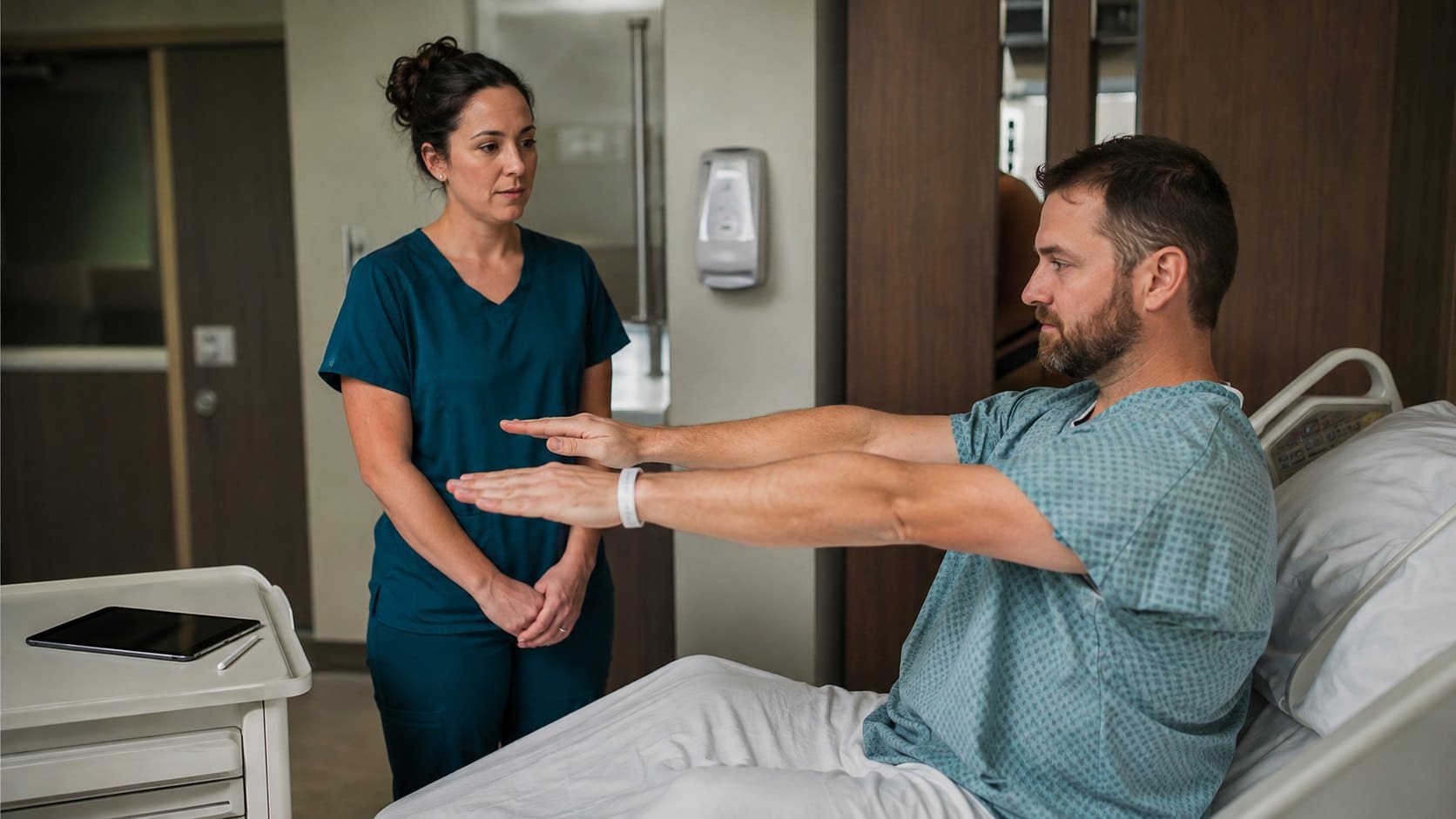
Stroke assessment for nurses starts with recognizing a sudden neurological change and activating the appropriate response. Do not wait to finish a detailed assessment before asking for help. This guide covers adult nursing assessment and communication; use your facility’s stroke protocol for treatment and monitoring.
Recognize sudden changes with BE-FAST
The American Stroke Association’s 2026 guideline overview highlights BE-FAST as a recognition aid:
- Balance: sudden difficulty with balance or coordination.
- Eyes: a sudden change in vision.
- Face: new facial asymmetry.
- Arms: new arm weakness.
- Speech: new difficulty speaking or a change in speech.
- Time: activate the hospital response, or call emergency services outside the hospital.
Changes may be subtle. The absence of a dramatic facial droop does not make a concerning new symptom unimportant. Tell the responding team what you observed and when, including information from anyone who knows the patient’s baseline.
Separate last known well from symptom discovery
Ask when the person was last known to be at their usual neurological baseline. Record that time separately from when symptoms were first noticed. For someone who woke with symptoms, these may be very different times.
Identify the source of the history, such as the patient, a family member, or the previous nurse. If the time is uncertain, document the uncertainty rather than guessing. A useful handoff distinguishes confirmed information from information still being checked.
Use a standardized assessment within your training
The National Institute of Neurological Disorders and Stroke describes the NIH Stroke Scale as a standardized assessment of neurological function and deficits. It includes questions and tasks, giving clinicians a common way to describe severity.
Use the official scale and your required training when performing an NIHSS. Communicate the actual findings as well as the score. A scale supports the assessment; it does not replace the urgent evaluation or the treating team’s interpretation of imaging and other information.
Document changes with a time stamp. At handoff, explain what the patient could do earlier, what they can do now, and whether a change has already been reported. A copied score without a new assessment can obscure a change.
Support the urgent stroke pathway
Follow the protocol for vital signs, glucose measurement, neurological reassessment, and preparation for urgent imaging. Communicate relevant medications and history to the responding team. Treatment choices depend on the stroke type, timing, imaging, and individual clinical factors.
The 2026 AHA/ASA guidance includes thrombolytic medicines and endovascular thrombectomy among treatments for eligible patients with ischemic stroke. The stroke team determines eligibility. Do not decide that assessment is no longer urgent because onset was unwitnessed or seems late.
Protect swallowing safety
Follow the stroke pathway’s nothing-by-mouth precautions until swallowing has been screened by an appropriately trained professional. This includes oral medicines as well as food and drinks. Canadian Stroke Best Practices recommends screening before oral intake with a valid tool.
If the screen indicates difficulty, communicate the result and follow the prescribed plan for further assessment, nutrition, fluids, and medication routes. Do not improvise a water trial or use the absence of coughing as proof that swallowing is unaffected. The American Stroke Association explains silent aspiration, which may occur without an obvious cough.
Close the communication loop
A concise report includes the new deficit, last known well, symptom discovery time, current findings, completed actions, and pending needs. Our SBAR guide offers a structure. For additional educational context, see the stroke nursing care plan.