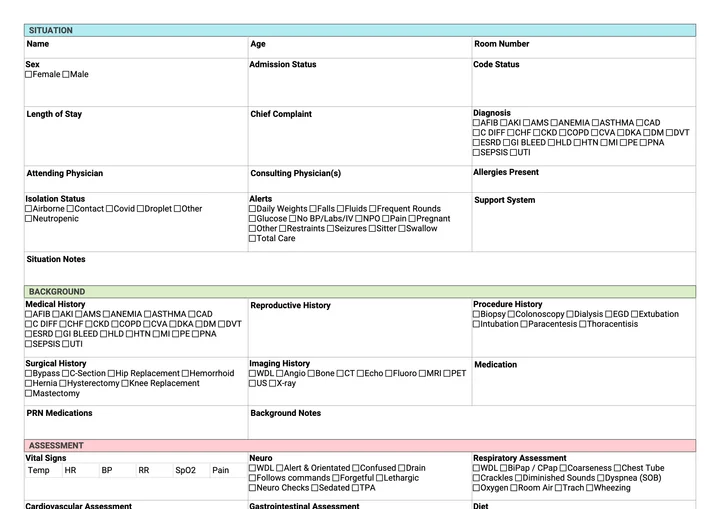
An L&D shift moves at two speeds: long stretches of monitoring and then everything happening at once. A good L&D brain sheet tracks labor progress, fetal heart rate status, oxytocin titration, maternal vitals, and delivery milestones so you can give a complete verbal handoff in under two minutes and have everything documented when the baby comes. Download the free printable PDF below, or use the same template digitally in NurseBrain Synapse so your notes are organized whether you're doing cervical checks or catching babies.
What is an L&D brain sheet?
Labor and delivery nursing is one part pattern recognition and one part rapid response. You're watching a strip for Category II variables, titrating Pitocin toward an adequate contraction pattern, checking cervical exams, managing epidurals, and staying ready for a crash C-section at any point. The L&D brain sheet keeps that picture organized: GBS status, gestational age, last cervical check and dilation, oxytocin dose and contractions, last maternal vitals, fetal heart rate baseline and variability, and any obstetric history flags. Not the chart — just your shift snapshot.
What to track on an L&D brain sheet
L&D brain sheets typically start with gestational age, estimated due date, and GBS status with any prophylaxis given. They track ROM status (spontaneous, AROM, or PROM, with color and time) and every cervical exam (dilation, effacement, station, and time). They log the contraction pattern (frequency, duration, intensity) and the fetal heart rate (baseline, variability, accelerations, decelerations, and category). They note the oxytocin dose and titration parameters, maternal vitals (BP especially for hypertension watch, temp, pulse, SpO2), epidural or pain management status, and IV access with the fluid running. Last come the delivery milestones: pushing start, delivery of infant and placenta, Apgar scores, and cord blood drawn.
L&D brain sheet vs labor report sheet: same tool
Whether you call it a brain sheet, a labor report sheet, or just your paper, every L&D nurse has some version of this during a shift. The terminology differs by hospital; the need doesn't. The free PDF template above covers a standard labor progress and delivery summary on one page. NurseBrain Synapse is the digital version — it keeps your Pitocin titration log, contraction tracking, and delivery notes organized so your postpartum transfer handoff is complete without trying to reconstruct events from memory.
L&D Nurse FAQ
What does a labor and delivery nurse do?
An L&D nurse monitors and supports laboring patients from admission through delivery. That means interpreting electronic fetal monitoring strips, titrating oxytocin, and performing cervical exams. You manage epidural placement with anesthesia. You anticipate and respond to obstetric emergencies such as shoulder dystocia, cord prolapse, uterine rupture, and hemorrhage. You assist with delivery, perform immediate newborn resuscitation if needed, and start skin-to-skin and breastfeeding support. After delivery, you complete the postpartum transfer handoff to the mother-baby unit.
How many patients does an L&D nurse take?
Most L&D nurses manage 1–3 laboring patients per assignment depending on acuity. Active labor patients — especially those on Pitocin — are often 1:1 or 1:2. Triage patients and antepartum holds may add to the load. Cesarean sections are typically 1:1 from admission through recovery. AWHONN recommends 1:1 for active labor patients on oxytocin and 1:1 for immediate postpartum recovery.
What should I include on an L&D brain sheet for a Pitocin induction?
For a Pitocin induction, start with admission vitals, the baseline strip category, and the cervical exam on admission. Note GBS status and when antibiotics were given, because timing matters for prophylaxis. Record the oxytocin starting dose and titration schedule, plus the contraction pattern at each dose change. Track the FHR category and any non-reassuring features, IV access and fluid, and epidural placement timing. Log every cervical exam with dilation, effacement, and station.
What is a Category II fetal heart rate strip?
Category II is the middle category in the NICHD three-tier system for fetal heart rate tracings. Category I tracings are normal: a baseline of 110 to 160 bpm, moderate variability, and no late or variable decelerations. Category II tracings are indeterminate. They are neither normal nor clearly abnormal, so they need ongoing surveillance and clinical judgment. Examples include minimal variability, absent accelerations, recurrent variable decelerations, prolonged decelerations, or tachycardia. Category III tracings are abnormal and need immediate evaluation and intervention.
Can I use a digital L&D brain sheet?
Yes. NurseBrain Synapse works on your phone or tablet. For L&D, you can track labor progress, oxytocin titrations, cervical exams, and delivery events digitally, then generate a complete handoff for the postpartum nurse without reconstructing the whole labor from memory. Available on iOS and Android.