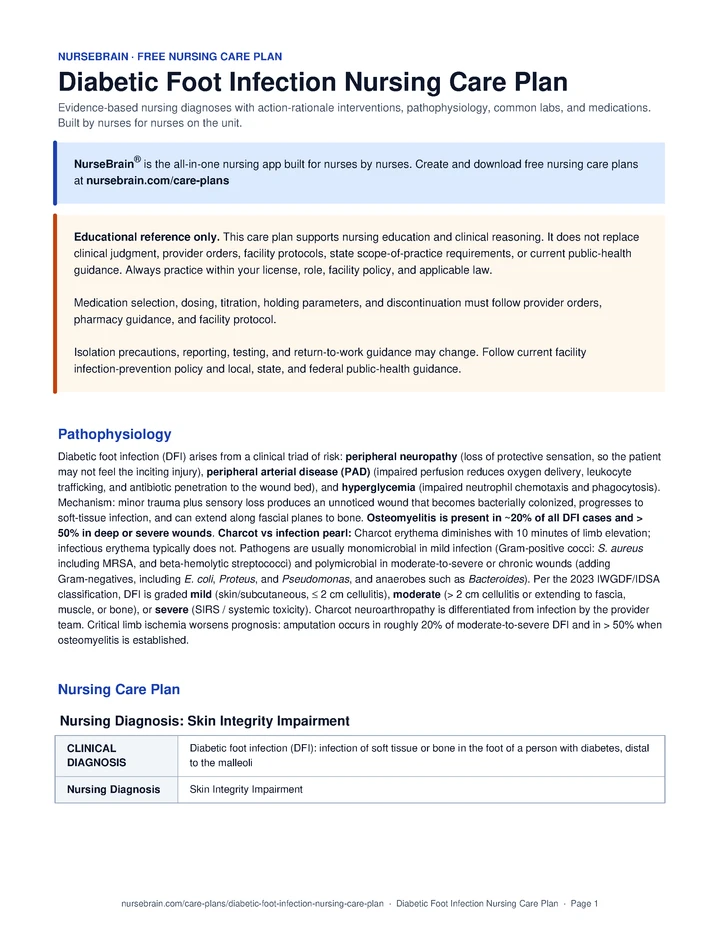
Diabetic Foot Infections Nursing Care Plan
Diabetic foot infection nursing care plan: wound care, glycemic control, infection management, and a printable PDF.
Nursing Care Plan
Nursing Diagnosis 1: Impaired Skin Integrity
Skin Integrity Impairment related to Diabetic foot infection (DFI): infection of soft tissue or bone in the foot of a person with diabetes, distal to the malleoli as evidenced by Open foot wound with surrounding cellulitis; Purulent or malodorous drainage from ulcer bed; Visible eschar, slough, or necrotic tissue; Probe-to-bone test positive; Wound > 2 cm with undermining or tunneling.
Interventions
- Measure wound length, width, and depth in centimeters every dressing change and photograph at admission and weekly per facility policy.
- Document wound bed composition (% granulation, slough, eschar, exposed bone or tendon) and presence of undermining or tunneling.
- Assess drainage volume, color, consistency, and odor at every dressing change.
- Inspect periwound skin for maceration, erythema, induration, warmth, and satellite lesions every shift.
- Perform the probe-to-bone (PTB) test at admission and as ordered.
- Examine the contralateral foot and pressure points (heels, MTP heads, between toes) every shift.
- Perform dressing changes using aseptic technique on the schedule prescribed by the wound team.
- Apply the prescribed wound product (alginate, hydrofiber, hydrogel, or NPWT) per wound-care order.
- Coordinate sharp debridement of non-viable tissue with the wound clinician per facility protocol.
- Support non-weight-bearing on the affected limb or use of the prescribed offloading device (TCC, walker boot) during activity per provider order.
- Pad and protect heels and bony prominences; keep heels off the bed with offloading boots per facility pressure-injury-prevention protocol.
- Teach the patient and family aseptic dressing-change technique with return demonstration before discharge.
- Teach daily foot inspection, including soles using a hand mirror, for cuts, blisters, color change, swelling, or warmth.
- Educate on foot-care basics: lukewarm water (test with elbow rather than foot), avoid soaking, dry thoroughly especially between toes, moisturize tops and soles but not between toes.
- Reinforce that nail and callus care is commonly performed by a podiatrist or trained clinician rather than the patient at home.
- Educate the patient to avoid going barefoot, including indoors and at the beach, and to check inside shoes for foreign objects before donning.
- Coordinate referral to wound clinic, podiatry, and, when PAD is suspected, vascular surgery before discharge.
Outcome: Wound bed shows progressive granulation on serial assessment per facility protocol; Wound surface area is measured and reported, with reduction monitored per provider order; Drainage, odor, and surrounding cellulitis are monitored and changes reported promptly.
Nursing Diagnosis 2: Infection Risk (Spread / Osteomyelitis)
Infection Risk (Spread / Osteomyelitis) related to Diabetic foot infection (DFI): infection of soft tissue or bone in the foot of a person with diabetes, distal to the malleoli as evidenced by Open wound in a host with hyperglycemia and impaired neutrophil function; Polymicrobial colonization typical in chronic DFI; PAD with impaired antibiotic delivery to the wound bed; Possible osteomyelitis (PTB+ or MRI-positive); Indwelling lines or recent surgical debridement.
Interventions
- Monitor temperature, HR, RR, BP, and SpO2 every 4 hours or per facility protocol; escalate findings consistent with SIRS / qSOFA criteria.
- Outline the leading edge of cellulitis with a skin-safe marker at admission; reassess and re-mark every shift.
- Trend serial CBC (WBC with differential), CRP, ESR, and procalcitonin as ordered.
- Inspect IV sites, central lines, and recent surgical or debridement sites every shift for redness, drainage, or pain.
- Monitor blood glucose per facility protocol; report values > 250 mg/dL or persistent values < 70 mg/dL.
- Coordinate deep-tissue or curettage wound cultures before the first dose of empiric antibiotic when feasible and when directed by the provider team.
- Administer empiric IV antibiotics on schedule per provider order and facility severe-sepsis or DFI protocol; first dose ≤ 1 hour if sepsis criteria are met.
- For vancomycin, support AUC-guided (preferred) or trough monitoring per pharmacy protocol per 2020 ASHP/IDSA consensus; monitor daily Cr.
- Support inpatient glucose targets (commonly 140–180 mg/dL) with insulin per provider order and facility protocol.
- Apply contact precautions for MRSA-positive or ESBL-positive wounds per facility infection-prevention policy; perform hand hygiene before and after every patient contact.
- Teach the patient and family signs of worsening infection: fever, chills, spreading redness, increased drainage, severe pain or numbness change, mental status change.
- Educate on completing the full antibiotic course as ordered, even when symptoms improve.
- Reinforce when to call 911 vs the wound clinic (red streaking, high fever, confusion can warrant 911; gradual increase in drainage can warrant same-day clinic contact).
- Coordinate Infectious Disease consult for severe DFI, osteomyelitis, recurrent infection, or resistant organisms per facility protocol.
- Notify the provider and activate the facility sepsis pathway for SIRS criteria with hypotension, AMS, or lactate > 2 mmol/L.
- Coordinate surgical consult for source control (debridement, abscess drainage, or amputation discussion) per provider order when infection does not respond to medical therapy.
Outcome: Temperature, HR, RR, BP, and WBC are monitored and reported within ordered parameters; CRP and ESR trend is documented and reported on serial labs per provider order; Cellulitis margins are monitored and progression reported promptly.
Nursing Diagnosis 3: Acute Pain
Acute Pain related to Diabetic foot infection (DFI): infection of soft tissue or bone in the foot of a person with diabetes, distal to the malleoli as evidenced by Wound debridement, dressing changes, and procedural pain; Inflammatory pain from infection and cellulitis; Ischemic rest pain from underlying PAD; Paradoxical pain pattern: neuropathy can mask wound pain while ischemic pain is severe; Paresthesias and dysesthesias from diabetic peripheral neuropathy.
Interventions
- Assess pain location, character, intensity (0–10), onset, and aggravating/relieving factors every 4 hours and before/after interventions.
- Specifically ask about pain at rest, at night, and when the foot is elevated.
- Test for peripheral neuropathy with the 10-g Semmes-Weinstein monofilament at 4 plantar sites and document insensate areas when within scope and competency.
- Observe non-verbal pain indicators (facial grimacing, guarding, withdrawal, autonomic changes), especially in patients with neuropathy or cognitive impairment.
- Reassess pain 30 minutes after IV or 60 minutes after PO analgesic administration per facility protocol.
- Administer scheduled and PRN analgesics as ordered; pre-medicate 30–60 minutes before dressing changes per provider order.
- Support a stepwise approach as ordered: acetaminophen and topical/regional adjuncts first, with opioid added per provider order for procedural and breakthrough pain.
- For neuropathic pain, anticipate gabapentinoids or duloxetine per provider order; nurses do not initiate or titrate these independently.
- Position the affected limb to support patient comfort, slightly dependent for ischemic pain and elevated only when edema dominates and perfusion is adequate per provider direction.
- Use non-pharmacologic adjuncts: distraction, music, guided breathing, repositioning, and environmental quiet during procedures.
- Teach the patient to report new or worsening pain at rest, especially at night with the foot elevated.
- Educate on the difference between expected post-debridement soreness and red-flag pain (sudden severe pain, color change, coldness).
- Teach diaphragmatic breathing and counting techniques the patient can self-deploy during dressing changes.
- Notify the provider for pain unrelieved by the prescribed regimen, new rest pain, or pain with new pallor or coldness of the foot.
- Coordinate pain-service or palliative-care consult for refractory pain per facility protocol.
Outcome: Patient reports pain at or below ordered target within 30 minutes of intervention; Patient participates in dressing changes and offloading without distress; Vital signs and behavior are consistent with reported pain rating.
Nursing Diagnosis 4: Impaired Peripheral Tissue Perfusion
Peripheral Alteration related to Diabetic foot infection (DFI): infection of soft tissue or bone in the foot of a person with diabetes, distal to the malleoli as evidenced by ABI < 0.9 or TBI < 0.7 documenting PAD; Cool extremity with hair loss and shiny atrophic skin; Diminished or absent dorsalis pedis and posterior tibial pulses; Capillary refill > 3 seconds at the toes; Dependent rubor with elevation pallor.
Interventions
- Palpate and document dorsalis pedis and posterior tibial pulses bilaterally every shift; if non-palpable, use handheld Doppler per facility protocol.
- Assess skin temperature (compare bilaterally), color, capillary refill, and presence of hair on the dorsum of the foot.
- Inspect for dependent rubor and elevation pallor (Buerger’s test) when ordered and within scope.
- Review ABI / TBI results and any vascular imaging (duplex, CTA, angiography) and report findings.
- Monitor for the ‘six Ps’ of acute limb ischemia: pain, pallor, pulselessness, paresthesia, paralysis, poikilothermia (coldness).
- Keep the affected foot warm with a loose blanket; avoid external heat sources (heating pads, hot water bottles).
- Avoid constrictive clothing, tight TED hose, and crossing the legs.
- Position the limb in a slightly dependent or neutral position rather than elevated unless edema dominates per provider direction.
- Encourage progressive walking exercise as tolerated within a supervised plan per provider order when ischemic rest pain is absent.
- Administer prescribed antiplatelet (aspirin, clopidogrel) and statin therapy as ordered; monitor for adverse effects.
- Provide smoking-cessation counseling at every interaction; coordinate referral to a structured program and offer pharmacologic support per provider order.
- Educate on glycemic control, blood-pressure control (commonly < 130/80 for many adults), and lipid management as long-term limb-preservation strategies per provider direction.
- Teach the patient to inspect the foot daily for color change, coolness, or new pain and to seek urgent care for sudden pallor or coldness.
- Coordinate vascular surgery evaluation when ABI < 0.6, persistent rest pain, or non-healing wound despite local care, per provider order and facility protocol.
- Notify the provider immediately for new pulselessness, sudden pallor, severe rest pain, or cold limb (acute limb ischemia).
Outcome: Distal perfusion indicators (pulses, temperature, refill) are monitored and reported per facility protocol; Capillary refill is monitored and findings reported; Wound granulation, as a clinical marker of perfusion adequacy, is monitored and documented.
Nursing Diagnosis 5: Knowledge Deficit
Knowledge Deficit related to Diabetic foot infection (DFI): infection of soft tissue or bone in the foot of a person with diabetes, distal to the malleoli as evidenced by Newly diagnosed DFI or first hospitalization for foot wound; Patient verbalizes uncertainty about foot care, footwear, and glycemic targets; Limited prior diabetes education; Visual impairment from diabetic retinopathy limiting self-inspection; Low health literacy or language/cultural barriers.
Interventions
- Assess baseline knowledge of diabetes, foot care, neuropathy, and PAD using teach-back at admission.
- Identify learning barriers: visual impairment, hearing loss, language, cognition, literacy, and family/caregiver availability.
- Identify the patient’s primary caregiver or family member who will support post-discharge care.
- Provide written and visual diabetes-foot-care materials at approximately 6th-grade reading level in the patient’s preferred language per facility resources.
- Demonstrate dressing change, offloading device application, and foot inspection; have the patient and family return-demonstrate.
- Provide a hand mirror or selfie-stick mirror for plantar surface inspection at discharge per facility resources.
- Teach daily foot inspection: tops, soles (with mirror), between toes, and inside both shoes before donning.
- Teach foot-hygiene rules: lukewarm water (test with elbow), avoid soaking, pat dry between toes, lotion on tops and soles but not between toes.
- Educate on footwear: properly fitted, closed-toe shoes; soft seamless socks (avoiding tight elastic); avoid going barefoot, including indoors and at the beach.
- Teach that nail trimming and callus debridement is commonly performed by a podiatrist rather than the patient at home.
- Educate on the monofilament test and support the patient’s understanding that protective sensation can be lost in marked sites.
- Reinforce glycemic targets as set by the provider team: HbA1c < 7% chronic is common for many adults; inpatient commonly 140–180 mg/dL; review medication and insulin regimen.
- Provide smoking-cessation counseling and coordinate referral to a cessation program at every interaction per facility protocol.
- Teach red-flag symptoms requiring action: new redness, warmth, swelling, drainage, odor, fever, color change, or new rest pain.
- Coordinate follow-up before discharge with primary care, podiatry, wound clinic, and vascular (when indicated by the provider team).
- Coordinate referral to diabetes self-management education and a certified diabetes educator (CDE) program per facility resources.
- Coordinate home health for post-discharge dressing changes, medication reconciliation, and surveillance per provider order.
Outcome: Patient and family verbalize a daily foot-inspection routine before discharge; Patient demonstrates dressing change and offloading device use; Patient states blood glucose and HbA1c targets as set by the provider team.
Pathophysiology
Diabetic foot infection (DFI) arises from a clinical triad of risk: peripheral neuropathy (loss of protective sensation, so the patient may not feel the inciting injury), peripheral arterial disease (PAD) (impaired perfusion reduces oxygen delivery, leukocyte trafficking, and antibiotic penetration to the wound bed), and hyperglycemia (impaired neutrophil chemotaxis and phagocytosis). Mechanism: minor trauma plus sensory loss produces an unnoticed wound that becomes bacterially colonized, progresses to soft-tissue infection, and can extend along fascial planes to bone. Osteomyelitis is present in ~20% of all DFI cases and > 50% in deep or severe wounds. Charcot vs infection pearl: Charcot erythema diminishes with 10 minutes of limb elevation; infectious erythema typically does not. Pathogens are usually monomicrobial in mild infection (Gram-positive cocci: S. aureus including MRSA, and beta-hemolytic streptococci) and polymicrobial in moderate-to-severe or chronic wounds (adding Gram-negatives, including E. coli, Proteus, and Pseudomonas, and anaerobes such as Bacteroides). Per the 2023 IWGDF/IDSA classification, DFI is graded mild (skin/subcutaneous, ≤ 2 cm cellulitis), moderate (> 2 cm cellulitis or extending to fascia, muscle, or bone), or severe (SIRS / systemic toxicity). Charcot neuroarthropathy is differentiated from infection by the provider team. Critical limb ischemia worsens prognosis: amputation occurs in roughly 20% of moderate-to-severe DFI and in > 50% when osteomyelitis is established.
Quick Reference
- Probe-to-bone test: PTB+ → osteomyelitis suspected
- IWGDF severity: Mild PO · Mod IV · Severe hospitalize
- Amputation risk: 20% mod-sev · > 50% with osteo
- Glucose target: 140–180 mg/dL inpatient · HbA1c < 7% chronic
- Offloading: Total contact cast commonly preferred (plantar)
Common Labs
| Lab | Normal range | Significance in Diabetic Foot Infection |
|---|---|---|
| WBC (CBC) | 4.5–11 × 109/L | WBC can be normal in DFI despite active infection; left shift is more sensitive. Nurses trend serial values and report findings to the provider team. |
| CRP / ESR | CRP < 10 mg/L; ESR < 20 mm/hr | Trended during therapy per provider order; ESR > 70 mm/hr can suggest osteomyelitis. Failure of inflammatory markers to fall during treatment supports provider-team reassessment for retained nidus or resistant organisms. |
| HbA1c | < 7% chronic target for many adults | Long-term glycemic control marker; values > 8% are associated with poorer wound healing. Inpatient glycemic targets are set by the provider team per facility protocol. |
| BMP (BUN/Cr, K+) | Cr 0.6–1.2 mg/dL | Renal function supports provider-team decisions on antibiotic dosing and IV contrast for imaging. Nurses report values outside reference range. |
| Deep tissue / bone culture | No growth | Debrided deep-tissue or curettage sample. Surface swabs reflect skin flora and typically do not guide therapy. Nurses coordinate culture collection with the wound clinician per facility protocol. |
| Blood cultures × 2 | No growth | Commonly obtained in severe/systemic DFI before the first IV antibiotic dose when feasible. In suspected sepsis, antibiotic timing is the priority and is directed by the provider team. |
| Bone biopsy | No organisms on histopathology | Commonly considered the reference standard for osteomyelitis diagnosis and targeted antibiotic selection. Holding antibiotics ≥ 2 weeks pre-biopsy when clinically safe can maximize culture yield; the decision to hold antibiotics is provider-directed. |
| Imaging | Plain X-ray normal | Plain film is commonly first; MRI is most sensitive for osteomyelitis; 3-phase bone scan or labeled-WBC scan can be considered if MRI is contraindicated. Imaging selection is the provider team’s. |
| ABI / TBI | ABI 0.9–1.3; TBI > 0.7 | < 0.9 can indicate PAD; > 1.4 suggests non-compressible vessels from calcification and the provider team may use TBI instead. Nurses report results and trend findings. |
| Procalcitonin | < 0.5 ng/mL | Adjunct for severe systemic infection; trends with bacterial sepsis. Procalcitonin alone is not used to start or stop antibiotics; antibiotic decisions are provider-directed per facility protocol. |
Common Medications
| Class | Examples | Mechanism of action | Key side effects | Nursing considerations |
|---|---|---|---|---|
| Mild DFI antibiotic (commonly outpatient PO) | Cephalexin, amoxicillin-clavulanate, dicloxacillin | Covers MSSA + β-hemolytic strep (the usual monomicrobial flora in mild infection); typical course 1–2 weeks per IDSA/IWGDF 2019 guideline. | Rash, GI upset, C. difficile, beta-lactam allergy. | Administer as ordered per provider direction, pharmacy guidance, and facility protocol. Nurses confirm allergy history before the first dose, monitor for response and adverse effects, and support provider-team reassessment at 48–72 hours if no clinical improvement. |
| Moderate DFI antibiotic (commonly IV) | Ampicillin-sulbactam, ertapenem, ceftriaxone + metronidazole | Broadens to Gram-negatives and anaerobes; typical course 1–3 weeks depending on response per IDSA/IWGDF 2019 guideline. | Diarrhea, ↑ LFTs, hypersensitivity, seizure risk with carbapenems at high dose. | Administer as ordered per provider direction and facility protocol. Renal dose adjustment is provider-directed; nurses monitor LFTs and report findings, and support de-escalation conversations with the provider team as cultures return. |
| Severe DFI antibiotic (commonly broad IV ± MRSA coverage) | Piperacillin-tazobactam ± vancomycin; carbapenem may be considered with ESBL risk | Empiric coverage for Gram-positives (including MRSA when risk factors are present), Gram-negatives (including Pseudomonas), and anaerobes, per IDSA/IWGDF 2019 guideline. | AKI (vancomycin + piperacillin-tazobactam), infusion reactions, thrombocytopenia, ototoxicity. | Administer as ordered. Per the 2020 ASHP/IDSA consensus, vancomycin can be monitored with AUC-guided (preferred) or trough dosing per pharmacy protocol; nurses monitor daily Cr and report findings. MRSA coverage may be added when: recent MRSA isolation, IVDU, hospital-associated infection, recent antibiotic exposure, severe sepsis, or locally validated MRSA prevalence > 30%. The decision to add or remove MRSA coverage is provider-directed per facility protocol. |
| Osteomyelitis regimen | Clindamycin, fluoroquinolones, rifampin combinations (per Infectious Disease) | Commonly 4–6 weeks IV-to-PO step-down with bone-penetrating agents; targeted to the bone-biopsy organism when available, per IDSA/IWGDF 2019 guideline. | QT prolongation (FQ), tendon rupture risk (can be higher in diabetics), dysglycemia in diabetics on insulin or sulfonylureas (FQ), C. difficile, hepatotoxicity (rifampin), drug interactions. | Administer as ordered per Infectious Disease and facility protocol. Nurses support baseline ECG for FQ when ordered, monitor LFTs on rifampin, and monitor glucose closely on FQ. Rifampin monotherapy is provider-managed and is not initiated independently by nursing. |
| Insulin infusion (severe) | Regular insulin IV drip | Inpatient glycemic control toward 140–180 mg/dL can support neutrophil function and wound healing. | Hypoglycemia, hypokalemia. | Administer as ordered per facility insulin-infusion protocol. Nurses perform hourly point-of-care glucose, monitor potassium per protocol, and support transition to subcutaneous basal-bolus before discharge per provider direction. |
| Advanced wound care products | Alginates, hydrogels, hydrofibers, NPWT (wound vac) | Maintains a moist wound bed and manages exudate; NPWT can be considered for cavitary or post-debridement wounds. | Maceration of periwound skin, bleeding, pain at dressing change. | Apply as ordered by the wound team. Sharp debridement of nonviable tissue is coordinated by the wound clinician; nurses reassess product selection weekly with the wound clinic per facility protocol. |
| Offloading device | Total contact cast (TCC), removable cast walker, knee scooter, crutches | TCC is commonly described as the gold standard for plantar ulcers in the IWGDF guideline; redistributes pressure to support healing. | Skin breakdown at cast edges, falls, non-adherence with removable devices. | Device selection is provider- and wound-team directed. Nurses coordinate cast inspection per facility protocol, teach non-weight-bearing technique, and assess fall risk. |
| Revascularization referral | Vascular surgery consult (endovascular or bypass) | Commonly considered for ABI < 0.6, non-healing wound, or critical limb ischemia; restoring perfusion can be required for healing. | Procedural bleeding, contrast nephropathy, restenosis. | Coordinate vascular consult per provider order and facility protocol. Pre-contrast metformin handling, renal protection, and smoking-cessation counseling are coordinated with the provider team. |
References
- Makic, M. B. F., & Martinez-Kratz, M. R. (Eds.). (2023). Ackley and Ladwig’s Nursing Diagnosis Handbook: An Evidence-Based Guide to Planning Care (13th ed.). Elsevier.
- Senneville, É., Albalawi, Z., van Asten, S. A., et al. (2024). IWGDF/IDSA Guidelines on the Diagnosis and Treatment of Foot Infection in Persons with Diabetes. Diabetes/Metabolism Research and Reviews, 40(3), e3687.
- Lipsky, B. A., Senneville, É., Abbas, Z. G., et al. (2020). Guidelines on the diagnosis and treatment of foot infection in persons with diabetes (IWGDF 2019 update). Diabetes/Metabolism Research and Reviews, 36(S1), e3280.
Frequently Asked Questions
What is the nursing care plan for DFI?
A DFI nursing care plan organizes the assessment, nursing diagnoses, goals, interventions, and evaluation criteria for a patient with Diabetic Foot Infections. Diagnoses are ordered by what is currently most destabilizing for the patient.
What are the priority nursing diagnoses for DFI?
Priority diagnoses for DFI appear in the Nursing Diagnoses section above, ordered by clinical acuity. The top diagnosis should reflect what is currently most destabilizing for this specific patient.
What is the priority nursing intervention for DFI?
Priority interventions for DFI are listed in the care plan above, organized by diagnosis. The most critical actions address airway, circulation, and the highest-acuity problem first.
What complications should the nurse monitor for in DFI?
Complications to monitor for in DFI are listed within each diagnosis section above. Trend vitals, mental status, and the condition-specific red flags described in the assessment section.