Build a nursing care plan and understand why each part matters
You learned ADPIE. Now see how Assessment, Diagnosis, Planning, Implementation and Evaluation turn into one connected plan for your patient.
NurseBrain Synapse helps you move from what you assessed to a nursing diagnosis, the evidence supporting it, your expected outcome, nursing interventions and evaluation.
Its Care Plan Builder uses the Clinical Care Classification (CCC) System as its standardized nursing terminology foundation, with additional fields designed to make care plan construction more useful for nursing students.
Free to try in your browser. No account required to start.
See a care plan built, start to finish
What does a nursing care plan actually look like?
A care plan connects the things you already do in the nursing process.
-
Assess
What did I find?
-
Diagnose
What nursing problem does the assessment support?
-
Plan
What do I want to happen?
-
Implement
What nursing interventions will support that goal?
-
Evaluate
How did the patient respond?
Reassess
The patient changes, so the plan changes with them.
A care plan is the clinical story connecting those decisions.
How to build a nursing care plan
Let's turn ADPIE into an actual care plan. The screenshots below are the NurseBrain Synapse Care Plan Builder with one example patient: an adult admitted with pneumonia.
-
1. Start with what you know about your patient
Every care plan begins with assessment. Before choosing a nursing diagnosis, ask:
What am I seeing, hearing, measuring or learning about this patient?
Assessment findings give you the evidence you need to identify the nursing problem. Examples might include:
- shortness of breath
- abnormal vital signs
- pain
- weakness
- confusion
- edema
- abnormal intake or output
- difficulty performing activities
Don't start by hunting for a diagnosis. Start with the patient.
-
2. What nursing problem does your assessment point to?
A nursing diagnosis describes a patient response, problem or need that nursing care can address.
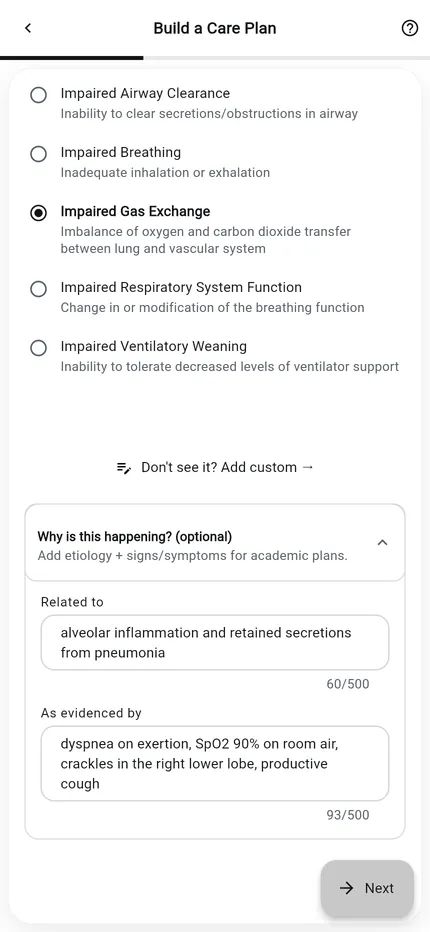
In the Care Plan Builder you pick the focus area, then browse or search the standardized nursing diagnoses and select the one that best fits your patient. For our pneumonia patient, the assessment points to Impaired Gas Exchange.
Once the diagnosis is chosen, the builder offers two optional fields that nursing students are usually asked for: related to, and as evidenced by.
-
3. Why is this happening?
Related to
"Related to" connects the nursing diagnosis to the factor or condition contributing to the problem.
Student mental model Problem, because of what?
Impaired Gas Exchange related to alveolar inflammation and retained secretions from pneumoniaYour diagnosis names the nursing problem. Related to explains what is contributing to it.
-
4. What evidence supports your diagnosis?
As evidenced by
"As evidenced by" connects the diagnosis back to your assessment findings.
Student mental model How do I know this problem is present?
Impaired Gas Exchange related to alveolar inflammation and retained secretions from pneumonia as evidenced by dyspnea on exertion, SpO2 90% on room air, crackles in the right lower lobe, productive coughAssessment Diagnosis EvidenceYour assessment should support your diagnosis.
One exception: risk diagnoses. When the problem has not happened yet, you describe the risk factors instead of signs and symptoms. Follow the format your program asks for.
-
5. What are you trying to accomplish?
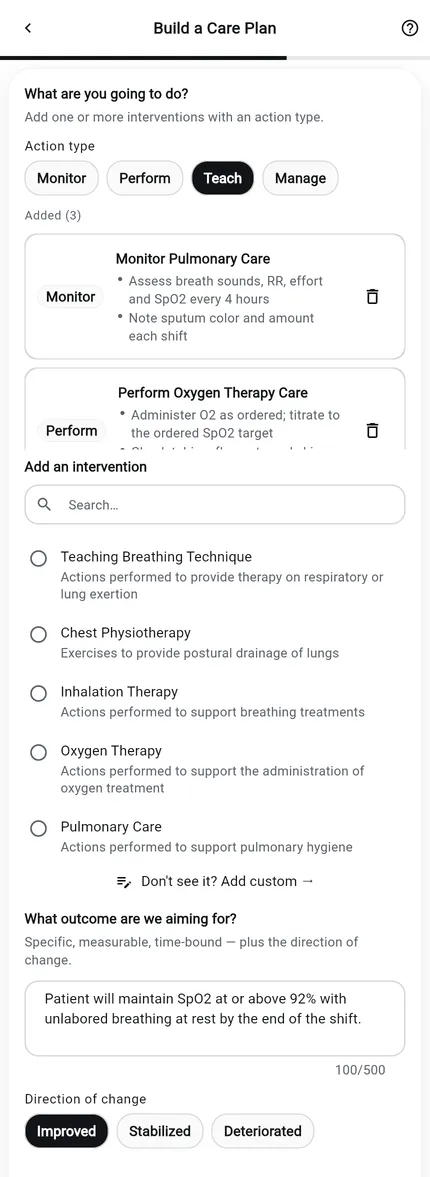
Once you know the nursing problem, decide what improvement or change you want to see. The builder gives you space to write a specific outcome.
Student mental model If my care works, what should be different?
Patient will maintain SpO2 at or above 92% with unlabored breathing at rest by the end of the shift.
Strong outcomes are as specific, measurable, realistic, patient-centered and time-bound as the situation allows.
The builder also asks for a standardized direction of change:
- Improved
- Stabilized
- Deteriorated
Your written goal gives the plan clinical and academic specificity. The direction of change gives the expected result a standardized representation. You set both.
-
6. What will nursing actually do?
Now connect the diagnosis and outcome to nursing actions. Ask:
What can nursing assess, perform, teach or manage to help move this patient toward the desired outcome?
Each intervention carries an action type. You do not need to memorize these. They simply organize what nursing does:
-
Monitor
Assess or observe what is happening.
-
Perform
Provide or carry out nursing care.
-
Teach
Educate the patient or caregiver.
-
Manage
Coordinate or manage aspects of care.
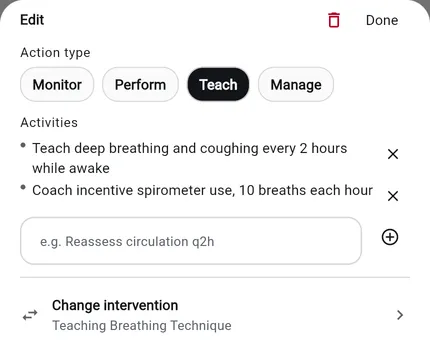
For the pneumonia patient, here are the three interventions with the specifics a student would add. The label is the standardized name. The specifics are what you will actually do.
- Monitor
Pulmonary Care
Keep watch on the lungs: how the patient is breathing, what you hear, the oxygen saturation, and what the cough brings up.
- Assess breath sounds, RR, effort and SpO2 every 4 hours
- Note sputum color and amount each shift
- Perform
Oxygen Therapy Care
Give the oxygen the provider ordered and make sure it is actually reaching the patient.
- Administer O2 as ordered; titrate to the ordered SpO2 target
- Check tubing, flow rate and skin under the device
- Teach
Breathing Exercises
Show the patient how to open the lungs and clear secretions, then check that they can do it.
- Teach deep breathing and coughing every 2 hours while awake
- Coach incentive spirometer use, 10 breaths each hour
Diagnosis = the problemOutcome = where you want to goInterventions = what nursing does to help get there
-
-
7. Put the whole clinical story together
Reviewed together, the plan reads as one connected story:
- Assessment findings
- Nursing diagnosis
- Related to
- As evidenced by
- Expected outcome
- Nursing interventions
- Evaluation
When these pieces are viewed together, the care plan stops looking like a school worksheet and starts showing the logic of nursing care. When you evaluate, you record the actual direction of change next to the one you expected.
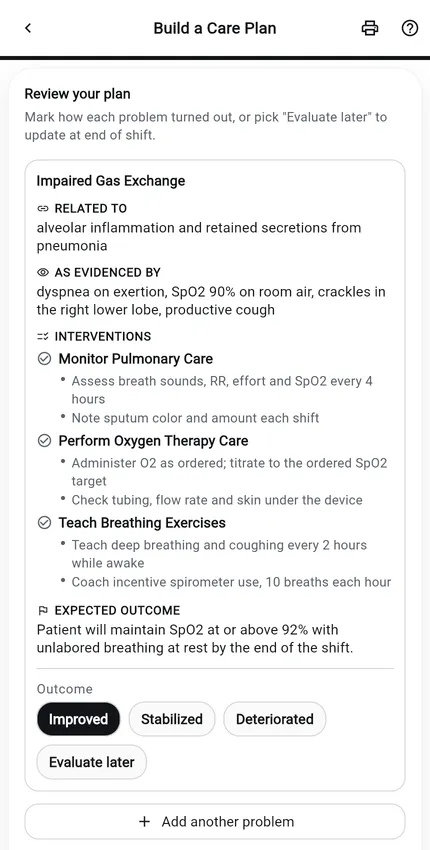
The Care Plan Builder is part of NurseBrain Synapse, where your care plan can stay connected to the same patient's information, tasks, notes, and handoff, helping you experience the nursing process beyond the assignment and in real time.
This is ADPIE in action
-
Assessment
What is happening with the patient?
-
Diagnosis
What nursing problem does the evidence support?
-
Planning
What outcome are we working toward?
-
Implementation
What nursing interventions will we perform?
-
Evaluation
How did the patient respond?
Evaluation leads back to assessment.
Patient condition changes. You reassess. The diagnosis or priorities may change. The plan changes with the patient.
ADPIE isn't five boxes. It's a cycle.
So, what is the Clinical Care Classification System?
At this point you understand the care plan. Here is the terminology underneath NurseBrain.
The Clinical Care Classification (CCC) System is a standardized nursing terminology developed by Dr. Virginia K. Saba and colleagues to represent nursing care in a structured way. It is one of the nursing terminologies recognized by the American Nurses Association.
CCC organizes nursing concepts into care components and includes standardized nursing diagnoses and interventions, along with qualifiers used to represent expected and actual outcomes.
CCC gives the different parts of nursing care a consistent language so they can connect.
A nursing problem can be connected to what nursing does about it and how the patient's condition changes. That integrated structure is why NurseBrain Synapse uses CCC as the standardized foundation of its Care Plan Builder.
Built around how students learn to write care plans
CCC provides the standardized foundation.
NurseBrain Synapse adds an educational layer designed around the way nursing students are commonly taught to construct and explain care plans.
-
Related to
Explain the factor or condition contributing to the nursing problem.
-
As evidenced by
Connect the diagnosis to the assessment findings that support it, when appropriate.
-
Student-written outcome
Turn the desired patient change into a specific, measurable clinical goal.
-
Standardized direction of change
Connect that goal to the standardized improved, stabilized or deteriorated outcome structure.
-
Custom additions
If the standardized options do not capture what you need for an academic plan, the builder accepts your own wording where that is supported.
The goal isn't to choose answers for the student. The goal is to make the relationships visible enough that the student understands why each part belongs in the plan.
CCC vs. NANDA-I, NIC and NOC
Nursing has several standardized terminology and classification systems. Students may encounter different ones depending on their school, textbook or clinical setting.
| System | Primarily represents |
|---|---|
| NANDA-I | Nursing diagnoses |
| NIC | Nursing interventions |
| NOC | Nursing outcomes |
| CCC | Nursing diagnoses, interventions and outcome qualifiers within an integrated classification framework |
NANDA-I, NIC and NOC are commonly encountered in nursing education and are often used together.
CCC provides its own nursing diagnoses and interventions, with outcome qualifiers, within an integrated classification framework. NurseBrain Synapse uses CCC as the standardized terminology foundation for its Care Plan Builder.
NANDA-I, NIC and NOC are associated with their respective rights holders. NurseBrain is not affiliated with or endorsed by those organizations.
See nursing care plans in practice
Want to see how these pieces come together for common patient conditions? Explore complete examples, then use the builder to create your own.
-
CHF Nursing Care Plan
Complete CHF nursing care plan with nursing diagnoses, prioritized interventions, and a free printable PDF. Built by nurses for nurses on the unit.
Read the care plan → -
Pneumonia Nursing Care Plan
Pneumonia nursing care plan: airway clearance, oxygenation, and a printable PDF. Built by nurses for nurses.
Read the care plan → -
Sepsis and Septic Shock Nursing Care Plan
Sepsis and septic shock nursing care plan: infection management, hemodynamic monitoring, and a printable PDF. Built by nurses for nurses.
Read the care plan → -
COPD Exacerbation Nursing Care Plan
COPD exacerbation nursing care plan with prioritized diagnoses, airway clearance, gas exchange, and a printable PDF. Built by nurses for nurses.
Read the care plan → -
Diabetic Ketoacidosis (DKA) Nursing Care Plan
DKA nursing care plan: insulin protocols, fluid resuscitation, electrolyte management, and a printable PDF. Built by nurses for nurses.
Read the care plan → -
Stroke (CVA) / TIA Nursing Care Plan
Stroke (CVA/TIA) nursing care plan with prioritized diagnoses, interventions, NIHSS assessment, and a printable PDF. Built by nurses for nurses.
Read the care plan →
Nursing care plan and CCC FAQs
What is a nursing care plan?
A nursing care plan organizes the patient's nursing problems, desired outcomes, nursing interventions and evaluation into a connected plan of care. It starts with assessment findings and ends with how the patient responded.
How does ADPIE relate to a nursing care plan?
ADPIE describes the nursing process: Assessment, Diagnosis, Planning, Implementation and Evaluation. A care plan helps document and organize the clinical reasoning and nursing care that occur through that process. Evaluation leads back to reassessment, so the plan changes as the patient changes.
What does "related to" mean in a nursing diagnosis?
"Related to" names the contributing factor or etiology: the condition or circumstance that is causing or sustaining the nursing problem. Your diagnosis says what the problem is; related to says why it is happening.
What does "as evidenced by" mean?
"As evidenced by" lists the assessment findings that support the diagnosis, sometimes called defining characteristics. It links the problem back to what you observed, heard or measured, so a reader can see why you chose that diagnosis.
Do risk nursing diagnoses use "as evidenced by"?
Generally, no. A risk diagnosis describes a problem that has not occurred yet, so there are no signs and symptoms to cite. Risk diagnoses usually list the risk factors that make the problem likely instead. Follow your program or instructor's required format.
What is CCC in nursing?
CCC stands for Clinical Care Classification, a standardized nursing terminology developed by Dr. Virginia K. Saba and colleagues. It organizes nursing care into care components with standardized nursing diagnoses and interventions, plus qualifiers for expected and actual outcomes. It is recognized by the American Nurses Association.
How is CCC different from NANDA-I?
NANDA-I is a classification of nursing diagnoses. CCC provides its own nursing diagnoses and interventions, with outcome qualifiers, inside one integrated classification framework. They are separate systems; CCC does not contain or combine NANDA-I, NIC or NOC.
Can I build a care plan without an account?
Yes. The Care Plan Builder opens in your browser and you can build a plan as a guest. Sign in to save the plan to a patient or export it.
Can I use NurseBrain Synapse for nursing school assignments?
NurseBrain Synapse can help you practice organizing nursing diagnoses, contributing factors, assessment evidence, outcomes and interventions. Requirements vary by nursing program, so follow your instructor's required terminology and care plan format for graded work.
Ready to build one yourself?
You don't have to memorize another diagram.Start with the patient.Follow the evidence.Connect the diagnosis to the outcome and nursing interventions.Then evaluate what happened.
That's the nursing process.
Free to start in your browser.