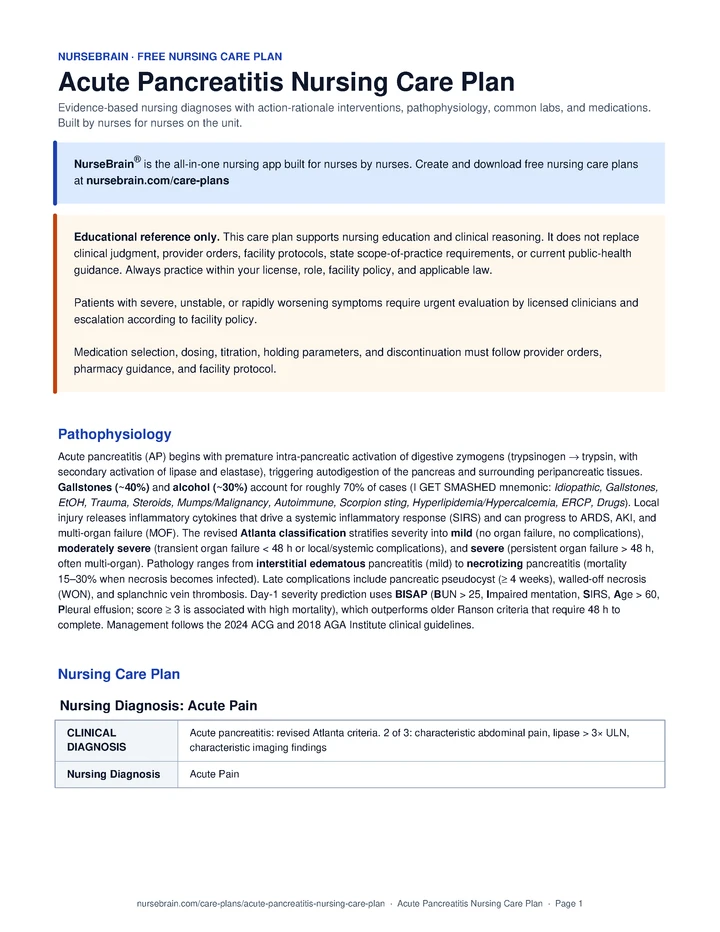
Acute Pancreatitis Nursing Care Plan
Acute pancreatitis nursing care plan: pain management, fluid balance, and a printable PDF. Built by nurses for nurses on the unit.
Nursing Care Plan
Nursing Diagnosis 1: Acute Pain
Acute Pain related to Acute pancreatitis: revised Atlanta criteria. 2 of 3: characteristic abdominal pain, lipase > 3× ULN, characteristic imaging findings as evidenced by Severe epigastric pain radiating to the back; Pain rated > 7/10 on a 0–10 scale; Facial grimacing, guarding, fetal positioning; Tachycardia, hypertension, diaphoresis (autonomic response); Pain worsened by eating; sometimes relieved by leaning forward.
Interventions
- Assess pain using a 0–10 numeric scale at intervals matched to clinical acuity (commonly every 1–2 hours) and approximately 30 minutes after each intervention, per facility protocol.
- Characterize pain: location, radiation to the back, quality, onset, duration, and aggravating or relieving factors.
- Monitor vital signs (HR, BP, RR) and autonomic signs (diaphoresis, pallor) at intervals matched to clinical acuity.
- Assess for nonverbal pain indicators (grimacing, guarding, restlessness), especially when the patient is sedated or unable to verbalize.
- Reassess pain control adequacy at each handoff and before activity (turning, ambulation, deep breathing).
- Administer prescribed opioid analgesia (commonly hydromorphone, fentanyl PCA, or morphine) on the ordered schedule; titrate within provider parameters.
- Set up and educate the patient on PCA pump use when ordered; verify lockout interval and loading dose with a second RN per facility high-alert-medication policy.
- Position the patient in semi-Fowler with knees flexed, or support leaning forward when the patient prefers.
- Maintain NPO status when ordered for vomiting or ileus; coordinate advancement to clear liquids and a soft low-fat diet per provider order and facility protocol in mild AP.
- Provide non-pharmacologic adjuncts: dim lighting, a quiet environment, guided imagery, repositioning support.
- Coordinate with the provider team on antiemetic scheduling (commonly ondansetron) to support vomiting prevention and reduce vomiting-induced pain spikes.
- Teach the patient to report pain early (around 3–4/10) rather than waiting until it is severe.
- Educate on PCA safety when PCA is ordered: only the patient presses the button; no family-controlled dosing.
- Teach deep breathing and splinting techniques to support pulmonary toilet with cough and ambulation.
- Notify the provider for pain unresponsive to ordered PCA and adjuncts, a sudden change in pain character, or new peritoneal signs.
- Coordinate a pain-management or palliative-care consult per facility protocol for refractory pain.
Outcome: Patient reports pain at a patient-defined comfort-function goal (commonly ≤ 4/10) on ordered analgesia within 24 hours; Patient demonstrates a relaxed facial expression and posture when clinical state allows; Vital signs return toward baseline after ordered analgesia.
Nursing Diagnosis 2: Fluid Volume Deficit
Fluid Volume Deficit related to Acute pancreatitis: revised Atlanta criteria. 2 of 3: characteristic abdominal pain, lipase > 3× ULN, characteristic imaging findings as evidenced by Persistent vomiting and NPO status; Third-spacing into the retroperitoneum from capillary leak; Tachycardia and orthostatic hypotension; Dry mucous membranes; decreased skin turgor; Urine output < 0.5 mL/kg/hr.
Interventions
- Monitor vital signs (HR, BP, including orthostatics when feasible) at intervals matched to clinical acuity during the first 24 hours.
- Maintain strict hourly I&O; notify the provider for UOP < 0.5 mL/kg/hr sustained for 2 consecutive hours.
- Trend Hct, BUN, Cr, and lactate per provider order during initial resuscitation.
- Assess mucous membranes, skin turgor, capillary refill, and mental status at intervals matched to clinical acuity.
- Auscultate lungs at intervals matched to clinical acuity during resuscitation.
- Weigh the patient daily on the same scale at the same time when clinical state allows.
- Administer prescribed Lactated Ringers at the provider-ordered, goal-directed rate (commonly around 1.5 mL/kg/hr maintenance in mild-to-moderate AP; higher rates such as up to ~3 mL/kg/hr or 250–500 mL/hr reserved for severe disease or documented hypovolemia per provider order and facility protocol). Reassess every 4–6 h and titrate to UOP, HR, MAP, and Hct/BUN trends.
- Reassess volume status every 4–6 h and coordinate de-escalation of the fluid rate with the provider team once UOP ≥ 0.5 mL/kg/hr, HR and MAP are within ordered parameters, and Hct and BUN are trending toward baseline.
- Adjust IV fluid rate per provider order based on UOP, HR, BP, and Hct/BUN trends; avoid running a flat rate without reassessment, per facility protocol.
- Maintain a Foley catheter per provider order when hourly UOP measurement is required in severe AP.
- Administer ordered electrolyte replacement (K+, Mg2+, Ca2+, PO43-) per facility protocol.
- Maintain two large-bore peripheral IVs or central access in severe AP per provider order and facility protocol.
- Teach the patient and family the rationale for IV fluids and the daily weight protocol.
- Educate on signs of dehydration to report at home post-discharge: dizziness, dry mouth, dark urine, weakness.
- Reinforce the ordered NPO status or dietary advancement plan and the reasoning behind it.
- Notify the provider for UOP < 0.5 mL/kg/hr for 2 consecutive hours, MAP < 65 mmHg, HR > 120, or a rising lactate.
- Coordinate ICU transfer per facility protocol for persistent organ failure or refractory hypotension.
Outcome: Urine output is monitored and reported within ordered parameters (commonly ≥ 0.5 mL/kg/hr) within 12 hours; HR and BP are monitored and reported within ordered parameters; Hct and BUN trend is documented and reported toward baseline.
Nursing Diagnosis 3: Impaired Nutritional Status
Body Nutrition Deficit related to Acute pancreatitis: revised Atlanta criteria. 2 of 3: characteristic abdominal pain, lipase > 3× ULN, characteristic imaging findings as evidenced by Prolonged NPO status in moderately severe or severe AP; Pain with eating; food fear; Nausea and vomiting limiting oral intake; Hypermetabolic state from systemic inflammation; Increased protein-calorie requirements during recovery.
Interventions
- Assess baseline nutrition status: weight, BMI, recent weight loss, albumin, prealbumin, and dietary history.
- Assess for nausea, vomiting, abdominal distention, bowel sounds, and passage of flatus or stool each shift.
- Reassess pain response to diet advancement at each meal in mild AP per facility protocol.
- Monitor for refeeding syndrome (low K+, Mg2+, PO43-) when nutrition is initiated after prolonged NPO.
- Assess for alcohol withdrawal using CIWA-Ar per facility protocol in patients with alcohol-related AP.
- Coordinate with the provider team and dietitian on early enteral nutrition (commonly within 24–72 hours) in moderately severe and severe AP, per provider order and facility protocol.
- Coordinate NJ tube feeding past the Ligament of Treitz over TPN when oral intake is not tolerated, per provider order.
- Advance mild-AP patients to oral feeding (soft, low-fat diet) within 24–48 hours when pain improves and the provider team orders advancement, even without complete pain resolution, per facility protocol.
- Administer ordered antiemetics and pre-meal analgesia in patients with food fear, per facility protocol.
- Administer ordered electrolyte replacement (K+, Mg2+, PO43-) before and during refeeding per facility protocol.
- Coordinate with the registered dietitian for individualized calorie and protein targets (commonly 25–35 kcal/kg/day in critically ill patients), per facility protocol.
- Educate the patient on a low-fat diet (commonly < 30% calories from fat) during recovery and the rationale.
- Reinforce the importance of complete alcohol cessation as a key step to support recurrence prevention in alcohol-related AP.
- Teach NJ tube care (flushing, securing, signs of dislodgment) if the patient is discharged with home enteral nutrition.
- Coordinate referral to dietitian for outpatient follow-up and to social work or addiction services for alcohol use disorder when applicable, per facility protocol.
- Notify the provider for inability to tolerate diet advancement, recurrent vomiting, or signs of refeeding syndrome.
- Coordinate same-admission cholecystectomy for mild gallstone pancreatitis per provider order and facility protocol when the patient is medically appropriate.
Outcome: Patient tolerates ordered oral or enteral nutrition without pain escalation within 72 hours; Patient maintains weight within ~5% of admission weight when clinical state allows; Albumin and prealbumin trend is documented and reported as stable or improving.
Nursing Diagnosis 4: Risk For Infection
Infection Risk related to Acute pancreatitis: revised Atlanta criteria. 2 of 3: characteristic abdominal pain, lipase > 3× ULN, characteristic imaging findings as evidenced by Necrotizing pancreatitis on imaging (sterile necrosis at risk of becoming infected); Translocation of gut bacteria into necrotic tissue; Invasive lines (central, arterial, Foley, NG/NJ); Prolonged ICU stay and immobility; Hyperglycemia from stress or pancreatic injury.
Interventions
- Monitor temperature at intervals matched to clinical acuity (commonly every 4 hours); notify the provider for > 38.3°C (101°F) or < 36°C.
- Monitor WBC, CRP, and procalcitonin trend per provider order.
- Assess invasive lines (central, arterial, Foley, NJ) daily for signs of infection and ongoing necessity per facility protocol.
- Monitor for signs of sepsis: HR > 90, RR > 20, hypotension, new mental-status change, hyperglycemia.
- Assess surgical, ERCP, and drain sites for erythema, drainage, warmth, and dehiscence each shift.
- Trend glucose every 4–6 hours; commonly target 140–180 mg/dL per facility glycemic-control protocol.
- Do not administer prophylactic antibiotics in sterile necrosis; coordinate with the provider team to administer antibiotics only when ordered for confirmed or strongly suspected infected necrosis, per facility protocol.
- When ordered for infected necrosis, administer carbapenems (commonly imipenem or meropenem) on schedule per provider order and facility protocol.
- Implement strict hand hygiene before and after every patient contact.
- Perform daily CHG bathing in ICU per facility protocol; maintain CLABSI and CAUTI prevention bundles.
- Maintain head-of-bed elevation at 30–45° for ventilated or sedated patients with NG or NJ tubes, per facility VAP-prevention protocol.
- Provide oral care with chlorhexidine every 4 hours for ventilated patients per facility VAP-prevention protocol.
- Teach patient and family the signs of infection to report: fever, chills, redness or drainage at any site, increased pain, confusion.
- Educate visitors on hand hygiene and the importance of limiting bedside contact when the patient is immunocompromised.
- Educate the patient and family on the rationale for the step-up approach (percutaneous drainage, then endoscopic or minimally invasive necrosectomy) when infected necrosis is identified, per provider plan.
- Notify the provider promptly for new fever after day 7, hemodynamic instability, or rising inflammatory markers.
- Coordinate IR, endoscopy, or surgery consultation per provider order for image-guided drainage of confirmed infected necrosis or WON.
- Coordinate urgent ERCP within ~24 hours per provider order and facility protocol for gallstone pancreatitis with concurrent acute cholangitis or persistent biliary obstruction; routine urgent ERCP is not used in all gallstone AP.
Outcome: Temperature is monitored and reported within ordered parameters (commonly 36.5–37.5°C); WBC trend is documented and reported toward baseline; No new fever, chills, or hemodynamic instability after 48 hours.
Nursing Diagnosis 5: Anxiety
Anxiety related to Acute pancreatitis: revised Atlanta criteria. 2 of 3: characteristic abdominal pain, lipase > 3× ULN, characteristic imaging findings as evidenced by Severe abdominal pain with autonomic activation; Fear of unknown diagnosis, complications, or death; Unfamiliarity with hospital procedures (ERCP, CT, central lines, possible ICU transfer); Prolonged NPO status and food fear; Concerns about alcohol use disorder, recurrence, and lifestyle change (when applicable).
Interventions
- Assess anxiety level using a 0–10 scale at the start of every shift and PRN.
- Identify the patient’s stated triggers (pain, NPO status, fear of complications, ICU transfer, alcohol use concerns).
- Observe for physical signs of anxiety: tachycardia out of proportion to clinical state, restlessness, hand-wringing, hypervigilance.
- Assess sleep quality and contributors (pain, alarms, lighting, frequent interventions) daily.
- Provide a calm, reassuring presence; speak clearly and at a measured pace.
- Explain procedures and findings in plain, patient-friendly terms before performing them.
- Cluster cares to allow uninterrupted rest periods when clinical state allows.
- Limit non-essential nighttime stimuli (overhead lights, loud conversations, unnecessary alarms) per facility protocol.
- Facilitate family presence within facility visitation policy, including video or phone visits when in-person is restricted.
- Coordinate with chaplaincy, social work, or interpreter services per patient preference and facility policy.
- Teach diaphragmatic breathing and grounding techniques the patient can use independently.
- Educate the patient and family on acute pancreatitis: common causes, why fluids and NPO are ordered, what early feeding looks like, and the typical recovery trajectory.
- When alcohol use is a contributing factor, frame cessation in plain, non-judgmental language and offer referral to social work or addiction services per facility policy.
- Coordinate with chaplaincy, social work, or psychiatric services per facility protocol if anxiety persists or worsens despite non-pharmacologic measures.
- Notify the provider for severe or persistent anxiety unresponsive to non-pharmacologic measures.
Outcome: Patient verbalizes decreased anxiety; Patient demonstrates at least one coping strategy (diaphragmatic breathing, grounding, music); Patient sleeps in approximately 4-hour blocks when clinical state allows.
Pathophysiology
Acute pancreatitis (AP) begins with premature intra-pancreatic activation of digestive zymogens (trypsinogen → trypsin, with secondary activation of lipase and elastase), triggering autodigestion of the pancreas and surrounding peripancreatic tissues. Gallstones (~40%) and alcohol (~30%) account for roughly 70% of cases (I GET SMASHED mnemonic: Idiopathic, Gallstones, EtOH, Trauma, Steroids, Mumps/Malignancy, Autoimmune, Scorpion sting, Hyperlipidemia/Hypercalcemia, ERCP, Drugs). Local injury releases inflammatory cytokines that drive a systemic inflammatory response (SIRS) and can progress to ARDS, AKI, and multi-organ failure (MOF). The revised Atlanta classification stratifies severity into mild (no organ failure, no complications), moderately severe (transient organ failure < 48 h or local/systemic complications), and severe (persistent organ failure > 48 h, often multi-organ). Pathology ranges from interstitial edematous pancreatitis (mild) to necrotizing pancreatitis (mortality 15–30% when necrosis becomes infected). Late complications include pancreatic pseudocyst (≥ 4 weeks), walled-off necrosis (WON), and splanchnic vein thrombosis. Day-1 severity prediction uses BISAP (BUN > 25, Impaired mentation, SIRS, Age > 60, Pleural effusion; score ≥ 3 is associated with high mortality), which outperforms older Ranson criteria that require 48 h to complete. Management follows the 2024 ACG and 2018 AGA Institute clinical guidelines.
Quick Reference
- Pain control: Opioid PCA commonly used; morphine acceptable
- IV fluids (0–24 h): Lactated Ringers, goal-directed (WATERFALL 2022)
- Enteral nutrition: Commonly initiated within 24–72 h when tolerated
- Mild AP, tolerating: Early oral feed (soft, low-fat) per provider order
- CT timing: 72–96 h for necrosis (earlier scans may miss it)
Common Labs
| Lab | Normal range | Significance in Pancreatitis |
|---|---|---|
| Lipase | < 60 U/L (typical institutional) | > 3× ULN supports the diagnosis per revised Atlanta criteria; more specific and longer-lived than amylase. Assay-dependent range; nurses report value and trend. |
| Amylase | 30–110 U/L | Less specific (also salivary/GI); rises early and falls fast. Nurses report value and trend; provider interprets in clinical context. |
| ALT / LFTs | ALT < 35 U/L | ALT > 150 U/L can suggest gallstone etiology; the provider team interprets the pattern alongside imaging and clinical findings. |
| Triglycerides | < 150 mg/dL | > 1000 mg/dL can be consistent with hypertriglyceridemic pancreatitis. Nurses report values outside reference range. |
| Calcium (consider corrected) | 8.5–10.5 mg/dL | A low value can predict severity (fat saponification). Correct for albumin or use ionized calcium when ordered; symptomatic hypocalcemia (Trousseau, Chvostek, tetany, prolonged QT) is reported promptly. |
| Hematocrit | 36–48% | A rising Hct can reflect hemoconcentration from capillary leak and may suggest severity. Nurses trend serial values and report concerning patterns. |
| BUN / Cr | BUN 7–20 mg/dL / Cr 0.6–1.2 mg/dL | Per ACG, a rising BUN at 24–48 h is one of the strongest lab predictors of mortality in AP. Nurses trend serial values and report the pattern. |
| CRP | < 10 mg/L | > 150 mg/L at 48 h is commonly associated with severe disease. Nurses report value and trend; provider team interprets. |
| ABG / lactate | pH 7.35–7.45 / lactate < 2 mmol/L | Supports severity and perfusion assessment; metabolic acidosis can signal shock. Nurses report values outside ordered parameters and trend during resuscitation. |
| CT with contrast | (imaging) | Commonly performed at 72–96 h to assess necrosis when indicated by the provider team; earlier scans may miss it. Timing is a provider-team decision. |
Common Medications
| Class | Examples | Mechanism of action | Key side effects | Nursing considerations |
|---|---|---|---|---|
| IV fluids | Lactated Ringers (LR) | Isotonic crystalloid; LR is often preferred over NS in AP and has been associated with less SIRS and less metabolic acidosis in randomized data. | Volume overload, pulmonary edema, dilutional electrolyte changes. | Administer as ordered. Per the 2024 ACG guideline and WATERFALL 2022, resuscitation is goal-directed: a moderate maintenance rate (commonly around 1.5 mL/kg/hr) is used for mild-to-moderate AP; higher rates (up to ~3 mL/kg/hr or 250–500 mL/hr bolus) are reserved for severe disease or documented hypovolemia, per provider order and facility protocol. Nurses reassess every 4–6 h with UOP, HR, MAP, Hct, and BUN trend, and support de-escalation with the provider team once perfusion targets are met. |
| Opioid analgesia | Hydromorphone, Fentanyl PCA, Morphine | Mu-opioid receptor agonism; central analgesia. | Respiratory depression, sedation, ileus, hypotension, nausea. | Administer as ordered per provider direction, pharmacy guidance, and facility protocol. Severe AP pain commonly warrants strong analgesia; morphine is not contraindicated in AP despite older teaching, as sphincter-of-Oddi spasm has not been shown to be clinically significant. Nurses monitor pain score, RR, sedation level, and bowel function, and escalate per provider parameters. |
| Antiemetic | Ondansetron | 5-HT3 receptor antagonist; blocks central and peripheral vomiting reflex. | QT prolongation, headache, constipation. | Administer as ordered. Nurses verify baseline QTc when other QT-prolonging medications are on board, and monitor for relief of nausea, headache, and bowel function. Scheduled and PRN dosing are provider-team decisions. |
| Antibiotics (only for infected necrosis) | Imipenem, Meropenem | Carbapenem; broad-spectrum β-lactam with good pancreatic tissue penetration. | C. difficile, seizures (imipenem at higher doses or in renal impairment), resistance with overuse. | Administer as ordered per provider direction and facility protocol. Per ACG 2024 and AGA 2018, antibiotics are not used prophylactically in sterile necrosis; they are reserved for confirmed or strongly suspected infected necrosis (clinical deterioration, gas on CT, positive FNA culture). Nurses monitor for response, allergy, adverse effects, and C. difficile emergence, and support de-escalation with the provider team. |
| PPI | Pantoprazole, Esomeprazole | Irreversibly blocks H+/K+-ATPase; suppresses gastric acid. | Hypomagnesemia, C. difficile risk, B12 deficiency with long-term use. | Administer as ordered. Commonly used for stress-ulcer prophylaxis in severe AP or ICU patients per facility protocol; not routine in mild AP. Nurses monitor magnesium and bowel pattern on prolonged therapy. |
| Insulin | Regular insulin (IV or SQ) | Activates insulin receptors; supports cellular glucose uptake. | Hypoglycemia, hypokalemia. | Administer as ordered per facility glycemic-control protocol. A common target range in critically ill patients is 140–180 mg/dL; transient hyperglycemia is common in AP. Nurses monitor point-of-care glucose, potassium, and signs of hypoglycemia per facility protocol. |
| Calcium replacement | Calcium gluconate IV | Replaces ionized Ca2+ consumed by fat saponification. | Tissue necrosis with extravasation, bradycardia, hypotension with rapid administration. | Administer as ordered when the provider team orders replacement for symptomatic or biochemically significant hypocalcemia (Trousseau, Chvostek, tetany, prolonged QT). Nurses monitor rhythm and IV site, infuse at the ordered rate, and report response. |
| Pancreatic enzymes | Pancrelipase (chronic only) | Replaces exocrine lipase, amylase, and protease. | GI upset; fibrosing colonopathy can occur with very high doses in cystic fibrosis. | Not routinely used in acute pancreatitis; commonly reserved for chronic pancreatitis with exocrine insufficiency per provider direction. Nurses administer as ordered when prescribed. |
References
- Makic, M. B. F., & Martinez-Kratz, M. R. (Eds.). (2023). Ackley and Ladwig’s Nursing Diagnosis Handbook: An Evidence-Based Guide to Planning Care (13th ed.). Elsevier.
- Tenner, S., Vege, S. S., Sheth, S. G., Sauer, B., Yang, A., Conwell, D. L., Yadlapati, R. H., & Gardner, T. B. (2024). ACG Clinical Guideline: Management of Acute Pancreatitis. American Journal of Gastroenterology, 119(3), 419–437.
- Crockett, S. D., Wani, S., Gardner, T. B., Falck-Ytter, Y., & Barkun, A. N. (2018). American Gastroenterological Association Institute Guideline on Initial Management of Acute Pancreatitis. Gastroenterology, 154(4), 1096–1101.
- de-Madaria, E., Buxbaum, J. L., Maisonneuve, P., et al. (2022). Aggressive or Moderate Fluid Resuscitation in Acute Pancreatitis (WATERFALL). New England Journal of Medicine, 387(11), 989–1000.
- Banks, P. A., Bollen, T. L., Dervenis, C., et al. (2013). Classification of acute pancreatitis 2012: revision of the Atlanta classification and definitions by international consensus. Gut, 62(1), 102–111.
Frequently Asked Questions
What is the nursing care plan for Acute Pancreatitis?
A Acute Pancreatitis nursing care plan organizes the assessment, nursing diagnoses, goals, interventions, and evaluation criteria for a patient with Acute Pancreatitis. Diagnoses are ordered by what is currently most destabilizing for the patient.
What are the priority nursing diagnoses for Acute Pancreatitis?
Priority diagnoses for Acute Pancreatitis appear in the Nursing Diagnoses section above, ordered by clinical acuity. The top diagnosis should reflect what is currently most destabilizing for this specific patient.
What is the priority nursing intervention for Acute Pancreatitis?
Priority interventions for Acute Pancreatitis are listed in the care plan above, organized by diagnosis. The most critical actions address airway, circulation, and the highest-acuity problem first.
What complications should the nurse monitor for in Acute Pancreatitis?
Complications to monitor for in Acute Pancreatitis are listed within each diagnosis section above. Trend vitals, mental status, and the condition-specific red flags described in the assessment section.
Learn how NurseBrain Synapse uses the Clinical Care Classification System for nursing care plans.