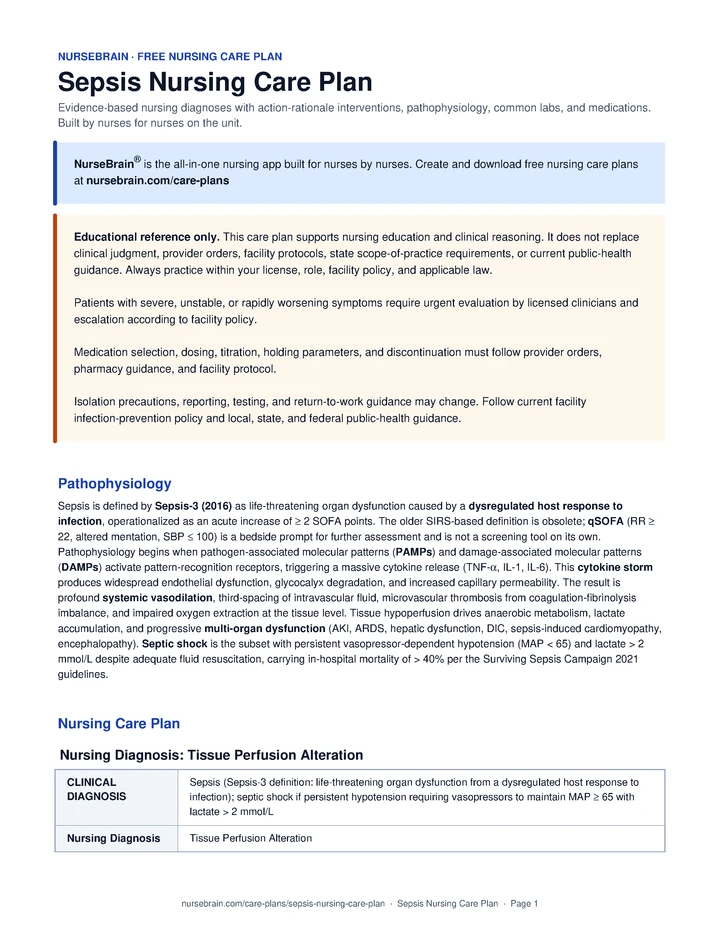
Sepsis and Septic Shock Nursing Care Plan
Sepsis and septic shock nursing care plan: infection management, hemodynamic monitoring, and a printable PDF. Built by nurses for nurses.
Nursing Care Plan
Nursing Diagnosis 1: Ineffective Tissue Perfusion
Tissue Perfusion Alteration related to Sepsis (Sepsis-3 definition: life-threatening organ dysfunction from a dysregulated host response to infection); septic shock if persistent hypotension requiring vasopressors to maintain MAP ≥ 65 with lactate > 2 mmol/L as evidenced by MAP < 65 mmHg despite ordered crystalloid resuscitation; Serum lactate > 2 mmol/L (initial 4.2 mmol/L); Mottled, cool extremities with capillary refill > 3 sec; Urine output < 0.5 mL/kg/hr × 2 consecutive hours; Altered level of consciousness, new confusion.
Interventions
- Monitor MAP continuously via arterial line per facility protocol; document at intervals matched to titration activity.
- Draw serum lactate on recognition and repeat at 2–4 hours per provider order; trend until within ordered parameters.
- Measure urine output hourly via indwelling catheter; notify the provider for UOP < 0.5 mL/kg/hr for 2 consecutive hours. Sustained UOP < 0.5 mL/kg/hr for ≥ 6 h can meet KDIGO Stage 1 AKI by urine-output criterion.
- Assess capillary refill, skin mottling (mottling score 0–5), and peripheral temperature at intervals matched to clinical acuity.
- Assess level of consciousness, orientation, and behavior every 1–2 hours using GCS or A&O × 4 per facility protocol.
- Monitor central venous pressure (CVP) and dynamic measures (PPV, SVV, passive leg raise) when available to support fluid-responsiveness assessment.
- Administer ordered crystalloid (commonly an initial 30 mL/kg of balanced solution within 3 hours per SSC 2021) per provider direction and facility protocol; monitor MAP, lactate, lung exam, and urine output after each bolus.
- Administer norepinephrine as ordered through central access when available; per SSC 2021, vasopressor initiation should not be delayed while central access is being obtained. Short-term peripheral administration through an appropriate large-bore IV in a proximal upper-extremity vein is acceptable per facility policy with active monitoring for extravasation.
- Administer vasopressin as ordered when added to a norepinephrine regimen (a common trigger range is norepinephrine approximately 0.1–0.5 mcg/kg/min, institution-specific) as a fixed (non-titrated) infusion.
- Monitor vasopressor infusion sites continuously for blanching, pain, or coolness; escalate per facility protocol and administer phentolamine as ordered for extravasation.
- Maintain head of bed at 30° unless contraindicated and reposition per facility protocol.
- Orient the patient and family to the ICU environment, monitors, and vasopressor lines; explain in plain language what common alarms mean.
- Educate the family on the goal of MAP within ordered parameters, the role of vasopressor support, and what ‘weaning the pressor’ means.
- Teach the patient (when awake) to report dizziness, chest pain, palpitations, or new visual changes promptly.
- Findings such as MAP below ordered parameters despite multiple vasopressors, lactate failing to clear, or new vasopressor-refractory shock should prompt urgent provider notification. Refractory shock may support consideration of hydrocortisone per SSC 2021.
- Coordinate with the provider team for source control (drainage, debridement, line removal) as soon as medically and logistically feasible.
- Notify the provider for sustained lactate > 4 mmol/L, anuria, or new altered mental status. Coordinate transfer to a higher level of monitoring or care per facility protocol when indicated.
Outcome: MAP is monitored and reported within ordered parameters on titrated vasopressor support; Lactate trend is documented and reported to the provider team; Urine output is monitored and reported per facility protocol.
Nursing Diagnosis 2: Impaired Breathing
Hyperthermia related to Sepsis (Sepsis-3 definition: life-threatening organ dysfunction from a dysregulated host response to infection); septic shock if persistent hypotension requiring vasopressors to maintain MAP ≥ 65 with lactate > 2 mmol/L as evidenced by Temperature > 38.3 °C (101 °F) or < 36 °C (96.8 °F); Rigors, diaphoresis, or shivering; Skin warm and flushed (hyperthermic phase) or cool and clammy (hypothermic phase); Tachycardia disproportionate to temperature; Patient-reported chills, malaise, or ‘feeling cold to the bone’.
Interventions
- Measure core temperature (bladder, esophageal, or rectal) at intervals matched to clinical acuity and facility protocol during active resuscitation.
- Identify and document the suspected infectious source on admission (lungs, urine, abdomen, skin/soft tissue, BSI, CNS, line).
- Assess for rigors, shivering, diaphoresis, and patient-reported chills.
- Monitor HR, RR, and SpO2 in relation to temperature.
- Recognize hypothermic (cold) sepsis as a higher-mortality phenotype and escalate per facility protocol.
- Coordinate ≥ 2 sets of blood cultures from 2 separate sites (peripheral plus line, or 2 peripheral) before antibiotics when no significant delay is expected, per SSC 2021 and facility protocol.
- Administer broad-spectrum empirical antibiotics as ordered within the provider-directed window (commonly within 1 hour of recognition for septic shock or probable sepsis per the hour-1 bundle; within 3 hours for possible sepsis without shock if work-up is pending) per facility protocol.
- Apply tepid sponging, cooling blankets, or targeted temperature management as ordered for T > 39.5 °C; warmed blankets or a forced-air warmer as ordered for T < 36 °C.
- Administer scheduled acetaminophen as ordered for febrile comfort; clarify with the provider when NSAIDs are considered in the setting of AKI or GI bleed risk.
- Replace fluids as ordered during defervescence sweats; document insensible losses.
- Explain the rationale for drawing cultures before antibiotics and the importance of completing the ordered antibiotic course.
- Educate the family on the difference between fever as a defensive response and dangerously high temperature; reassure that fever alone does not equal worsening.
- Teach the patient (when awake) to report new chills, rigors, or feeling colder despite warming blankets promptly.
- Notify the provider for failure to defervesce by 48–72 h on appropriate antibiotics or for a new cold-sepsis presentation.
- Coordinate with infectious disease and pharmacy for antibiotic de-escalation at 48–72 h based on culture results and PCT trend per facility protocol.
Outcome: Core temperature is monitored and reported within ordered parameters; Rigors, shivering, and new diaphoresis are assessed and reported; HR is monitored as temperature trends; changes are reported per facility protocol.
Nursing Diagnosis 3: Fluid Volume Deficit
Fluid Volume Deficit related to Sepsis (Sepsis-3 definition: life-threatening organ dysfunction from a dysregulated host response to infection); septic shock if persistent hypotension requiring vasopressors to maintain MAP ≥ 65 with lactate > 2 mmol/L as evidenced by MAP < 65 mmHg before resuscitation; HR > 110 bpm with narrow pulse pressure; Capillary leak with bilateral peripheral and pulmonary edema (paradoxical); Third-spacing: anasarca, ascites, dependent edema; Dry mucous membranes, decreased skin turgor (early).
Interventions
- Maintain strict hourly intake and output; calculate cumulative balance per shift and over 24/48/72 hours per facility protocol.
- Report dynamic measures of fluid responsiveness (passive leg raise, pulse pressure variation, stroke volume variation) before each additional fluid bolus when available.
- Monitor for capillary leak: rapidly developing peripheral edema, anasarca, conjunctival edema, scrotal or labial edema.
- Auscultate lung sounds at intervals matched to clinical acuity during resuscitation; report new crackles or worsening oxygen requirement.
- Trend BUN, creatinine, sodium, chloride, and bicarbonate per provider order during active resuscitation.
- Administer ordered crystalloid (commonly an initial 30 mL/kg of balanced solution within 3 hours per SSC 2021) per provider direction and facility protocol.
- After the initial bolus, administer further fluid as ordered when dynamic assessment supports fluid responsiveness.
- Coordinate with the provider team when MAP is not responding to fluid alone; vasopressor initiation may be considered rather than continuing repeated boluses.
- Ensure adequate IV access (commonly two large-bore peripheral lines or central access for vasopressors) per facility protocol.
- Administer albumin 5% as ordered for patients receiving large-volume crystalloid (commonly > 4–6 L) per SSC 2021 weak recommendation and provider direction.
- Educate the patient and family on the dual goals of restoring perfusion and avoiding fluid overload; explain why edema does not always mean ‘too much fluid.’
- Teach the patient (when awake) to report new shortness of breath, chest tightness, or a feeling of drowning.
- Explain the role of daily weights and I&O once stable, particularly during the de-resuscitation phase.
- Notify the provider for net positive balance > 10% of body weight, new pulmonary edema, or worsening oxygenation despite ongoing hypotension.
- Coordinate de-resuscitation (diuresis or ultrafiltration) per provider order once perfusion is restored and source is controlled.
Outcome: MAP is monitored and reported within ordered parameters after ordered crystalloid resuscitation; HR is monitored as trends improve; pulse pressure is assessed and reported; Urine output is monitored and reported per facility protocol.
Nursing Diagnosis 4: Impaired Gas Exchange
Gas Exchange Impairment related to Sepsis (Sepsis-3 definition: life-threatening organ dysfunction from a dysregulated host response to infection); septic shock if persistent hypotension requiring vasopressors to maintain MAP ≥ 65 with lactate > 2 mmol/L as evidenced by Tachypnea > 22/min (qSOFA criterion); Increasing oxygen requirement (for example, NC → HFNC); PaO2/FiO2 ratio < 300 (mild ARDS < 300, moderate < 200, severe < 100); Bilateral infiltrates on CXR not explained by cardiac failure; Use of accessory muscles, intercostal retractions.
Interventions
- Monitor SpO2 continuously and document RR, depth, effort, and accessory-muscle use at intervals matched to clinical acuity and facility protocol.
- Calculate and trend PaO2/FiO2 ratio with each ABG; report worsening trend to the provider team.
- Auscultate lung sounds at intervals matched to clinical acuity; document distribution of crackles, wheezes, or absent sounds.
- Review serial chest imaging for bilateral infiltrates not explained by cardiac failure when available.
- Monitor ABG per provider order during active respiratory failure; report pH, PaO2, PaCO2, and base deficit.
- Administer supplemental oxygen as ordered and titrate within provider parameters to support SpO2 in the ordered range (commonly 92–96% to avoid liberal hyperoxia).
- Escalate stepwise (NC → high-flow nasal cannula → NIV → intubation) as ordered, based on response and work of breathing per facility protocol.
- Position the patient in high-Fowler’s when tolerated; prepare for and assist with prone positioning per facility protocol when ordered for moderate-to-severe ARDS (commonly considered at P/F < 150 once intubated).
- Coordinate with respiratory therapy and the provider team to support lung-protective ventilation per ARDSnet protocol and provider orders (commonly VT 4–8 mL/kg predicted body weight, Pplat < 30, driving pressure < 15).
- Maintain HOB at 30° when supine, provide oral care with chlorhexidine per facility VAP-prevention protocol, support daily SAT/SBT per provider order, and ensure DVT and stress-ulcer prophylaxis are administered as ordered.
- Teach the patient and family the meaning of escalating oxygen devices and the goals of each step.
- Educate the patient (when awake) on pursed-lip and diaphragmatic breathing as a self-management tool while on NC or HFNC.
- Educate the family on what intubation involves, the expected ICU course, and signs of recovery to anticipate.
- Notify the provider for SpO2 below ordered parameters on > 6 L NC, RR > 30 with retractions, or P/F dropping below 200.
- Coordinate with respiratory therapy and the intensivist for prone positioning, neuromuscular blockade per facility protocol in severe ARDS, or ECMO consultation when refractory hypoxemia is the dominant problem.
Outcome: SpO2 is monitored and reported within ordered parameters on the lowest support that meets the goal; PaO2/FiO2 ratio is monitored and trend is reported per facility protocol; Respiratory rate is monitored and accessory-muscle use is reported.
Nursing Diagnosis 5: Impaired Kidney Function
Renal Alteration related to Sepsis (Sepsis-3 definition: life-threatening organ dysfunction from a dysregulated host response to infection); septic shock if persistent hypotension requiring vasopressors to maintain MAP ≥ 65 with lactate > 2 mmol/L as evidenced by Pre-resuscitation hypotension with MAP < 65; Lactate > 4 mmol/L on presentation; Rising creatinine ≥ 0.3 mg/dL within 48 h or 1.5× baseline; Urine output < 0.5 mL/kg/hr for ≥ 6 h; Nephrotoxic exposures: aminoglycosides, vancomycin trough, IV contrast.
Interventions
- Measure urine output hourly; calculate per kilogram per facility protocol.
- Trend serum creatinine and BUN at least daily; compare to baseline when available (commonly look back 7–365 days).
- Monitor potassium, phosphate, bicarbonate, calcium, and magnesium per provider order in evolving AKI.
- Review the medication list daily with the provider team or pharmacy for nephrotoxic agents and renal dosing.
- Evaluate for AEIOU indications for RRT: Acidosis, Electrolyte derangement, Ingestion (toxic), Overload (fluid), Uremia.
- Support MAP within ordered parameters with ordered fluid resuscitation and vasopressor administration per facility protocol.
- Administer ordered balanced crystalloid (LR or Plasma-Lyte) per provider direction when large-volume resuscitation is needed.
- Coordinate with pharmacy for renal dose adjustment of antibiotics per facility protocol; alert the provider when nephrotoxic alternatives exist.
- Hold ACE-I, ARB, and NSAIDs per provider order during acute illness.
- Prepare the patient and family for possible RRT (CRRT in ICU; IHD on the floor) when AKI progresses, per provider direction.
- Educate the patient and family on the role of the kidneys in sepsis and what AKI may mean for hospital course and recovery.
- Teach the patient and family the importance of avoiding NSAIDs and contrast after discharge until renal recovery is confirmed by the provider.
- Educate on long-term implications: outpatient nephrology follow-up, repeat creatinine, blood pressure control per facility discharge protocol.
- Notify the provider for UOP < 0.5 mL/kg/hr for 6 h, rising creatinine, hyperkalemia > 5.5, or worsening acidosis.
- Coordinate nephrology consultation for KDIGO Stage 2 or above per provider order and prepare for possible CRRT initiation per facility protocol.
Outcome: Urine output is monitored and reported per facility protocol; Creatinine and BUN trend is monitored and communicated to the provider team; Electrolytes (K+, HCO3–, phosphate) are monitored and changes are reported.
Pathophysiology
Sepsis is defined by Sepsis-3 (2016) as life-threatening organ dysfunction caused by a dysregulated host response to infection, operationalized as an acute increase of ≥ 2 SOFA points. The older SIRS-based definition is obsolete; qSOFA (RR ≥ 22, altered mentation, SBP ≤ 100) is a bedside prompt for further assessment and is not a screening tool on its own. Pathophysiology begins when pathogen-associated molecular patterns (PAMPs) and damage-associated molecular patterns (DAMPs) activate pattern-recognition receptors, triggering a massive cytokine release (TNF-α, IL-1, IL-6). This cytokine storm produces widespread endothelial dysfunction, glycocalyx degradation, and increased capillary permeability. The result is profound systemic vasodilation, third-spacing of intravascular fluid, microvascular thrombosis from coagulation-fibrinolysis imbalance, and impaired oxygen extraction at the tissue level. Tissue hypoperfusion drives anaerobic metabolism, lactate accumulation, and progressive multi-organ dysfunction (AKI, ARDS, hepatic dysfunction, DIC, sepsis-induced cardiomyopathy, encephalopathy). Septic shock is the subset with persistent vasopressor-dependent hypotension (MAP < 65) and lactate > 2 mmol/L despite adequate fluid resuscitation, carrying in-hospital mortality of > 40% per the Surviving Sepsis Campaign 2021 guidelines.
Quick Reference
- MAP target: ≥ 65 mmHg
- Lactate target: < 2 mmol/L & trending down
- Antibiotic door-to-drug: ≤ 1 hr (septic shock) per facility protocol
- Crystalloid bolus: 30 mL/kg within 3 hr per SSC 2021
- Hour-1 Bundle: All 5 elements per facility protocol
Common Labs
| Lab | Normal range | Significance in Sepsis |
|---|---|---|
| Lactate (initial) | < 2 mmol/L | > 2 mmol/L can indicate tissue hypoperfusion; > 4 mmol/L is a severe-perfusion marker and a key bundle element. Nurses monitor and report the value to the provider team. |
| Lactate (repeat 2–4 h) | Trending down | Failure to clear by ≥ 10% over 2 hours is associated with higher mortality and may support escalation discussions with the provider team. |
| WBC | 4–11 × 109/L | Leukocytosis or leukopenia (< 4) can both occur in sepsis; left shift and bands may also be present. Nurses report values outside reference range. |
| CRP / Procalcitonin | CRP < 10 mg/L; PCT < 0.5 ng/mL | PCT may help differentiate bacterial vs viral patterns and can support provider-team antibiotic de-escalation decisions. Per IDSA, PCT alone should not be used to start or stop antibiotics; nurses monitor and report trend. |
| Blood cultures × 2 | No growth | Draw from 2 sites before antibiotics when no significant delay is expected, per SSC 2021 and facility protocol. Nurses coordinate culture collection with antibiotic administration timing. |
| Creatinine | 0.6–1.2 mg/dL | Sepsis-AKI is among the most common organ failures in sepsis; nurses trend with UOP and report rising values to the provider team. |
| Hemoglobin | 12–17 g/dL | Per SSC 2021, transfusion is commonly considered at Hgb < 7 g/dL; a higher threshold may apply with active ischemia. Transfusion decisions are made by the provider team; nurses administer ordered blood products per facility protocol. |
| Platelets | 150–400 × 109/L | Thrombocytopenia can signal DIC; nurses report falling platelets and request fibrinogen and D-dimer per provider order when DIC is suspected. |
| Bilirubin / ALT | Bili < 1.2 mg/dL | Hepatic dysfunction is a SOFA component; a cholestatic pattern is common in sepsis. Nurses monitor and report trend. |
| ABG | pH 7.35–7.45; lactate < 2 mmol/L | Metabolic acidosis with elevated lactate is typical; anion gap can support assessment of the acidosis pattern. Nurses report worsening trends to the provider team. |
| Troponin | < 0.04 ng/mL | Sepsis-induced cardiomyopathy or demand ischemia can produce mild elevation. Nurses report values outside reference range and trend with rhythm and hemodynamics. |
Common Medications
| Class | Examples | Mechanism of action | Key side effects | Nursing considerations |
|---|---|---|---|---|
| Broad-spectrum antibiotic | Piperacillin-tazobactam ± Vancomycin, Meropenem | Bactericidal coverage of likely Gram-negative, Gram-positive, and anaerobic pathogens; provider-team selection is tailored to the suspected source and local antibiogram. | C. difficile, nephrotoxicity (vancomycin trough), allergy, drug-induced fever, MDR selection. | Per SSC 2021 and the hour-1 bundle, suspected septic shock benefits from antibiotic administration within 1 hour of recognition per facility protocol. Administer as ordered; coordinate culture collection before the first dose when no significant delay is expected. Monitor for response, allergy, and adverse effects; support de-escalation with the provider team at 48–72 h based on culture results. |
| Crystalloid (resuscitation) | Lactated Ringer’s (commonly preferred), 0.9% NaCl | Restores intravascular volume; LR has balanced electrolytes and a lower chloride load than NS. | Volume overload, hyperchloremic metabolic acidosis (NS), pulmonary edema, dilutional anemia. | Per SSC 2021, an initial 30 mL/kg within 3 hours of sepsis recognition is commonly used; reassessment with dynamic measures (passive leg raise, pulse pressure variation) is recommended before further boluses. Administer as ordered per provider direction and facility protocol; monitor MAP, lactate trend, lung exam, and urine output after each bolus and escalate worsening pulmonary findings. |
| Vasopressor (commonly first-line) | Norepinephrine (Levophed) | α1 agonist with mild β1 activity. Vasoconstriction (raises SVR and MAP) with preserved cardiac output. | Tachyarrhythmia, peripheral and digit ischemia, extravasation tissue necrosis if peripheral, reflex bradycardia at higher dose. | Administer as ordered. Per SSC 2021, vasopressor initiation should not be delayed while central venous access is being obtained; short-term peripheral administration through an appropriate IV in a proximal upper-extremity vein is acceptable per facility policy with active extravasation monitoring. Nurses monitor MAP, urine output, peripheral perfusion, IV site, and rhythm; escalate concerns per provider parameters and facility protocol. Treat extravasation with phentolamine per provider order. |
| Vasopressor (commonly add-on) | Vasopressin (0.03 units/min fixed) | Non-catecholamine V1 agonist. Adds vasoconstriction at a fixed low dose without further β stimulation; spares catecholamine receptor desensitization. | Digital ischemia, hyponatremia, mesenteric ischemia at higher doses, decreased cardiac output at higher doses. | Administer as ordered per provider direction. SSC 2021 endorses adding vasopressin to a norepinephrine regimen (a common trigger range is norepinephrine approximately 0.1–0.5 mcg/kg/min, institution-specific). Typically a fixed-dose infusion is selected by the provider; nurses do not titrate vasopressin as a primary vasopressor. Monitor MAP, sodium, peripheral and abdominal perfusion. |
| Corticosteroid | Hydrocortisone 200 mg/day IV (50 mg q6h or continuous infusion) | Can restore vascular responsiveness to catecholamines; modulates inflammation. | Hyperglycemia, hypernatremia, immunosuppression, GI bleeding, neuromuscular weakness. | Per SSC 2021, hydrocortisone may be considered for septic shock with ongoing vasopressor requirement despite adequate fluid resuscitation. Administer as ordered; monitor glucose per facility protocol (commonly q4h on steroids), watch for adverse effects, and support taper with the provider team as vasopressors are weaned. |
| Inotrope | Dobutamine (2.5–20 mcg/kg/min) | Selective β1 agonist. Increases myocardial contractility and cardiac output; mild β2 vasodilation can lower SVR. | Tachyarrhythmia, hypotension at higher doses, increased myocardial oxygen demand, tolerance. | Administer as ordered per provider direction when echocardiogram or clinical assessment supports inotropic support (for example, low cardiac output / sepsis-induced cardiomyopathy despite adequate MAP and volume). Nurses monitor rhythm, MAP, urine output, and lactate trend; escalate new tachyarrhythmia or hypotension per facility protocol. |
| Insulin (IV infusion) | Regular insulin protocol | Lowers glucose; supports glycemic control during critical illness. | Hypoglycemia (the most dangerous adverse effect), hypokalemia, rebound hyperglycemia on discontinuation. | Per SSC 2021, a target glucose of 140–180 mg/dL is commonly used (tight control has not improved outcomes). Administer as ordered per facility insulin protocol; monitor glucose on the ordered cadence (commonly q1h on infusion) and potassium per provider order. Boluses to titrate infusions are not part of standard insulin protocols. |
| DVT & stress-ulcer prophylaxis | Enoxaparin / heparin SC; PPI or H2 blocker | VTE prevention via Xa inhibition; gastric-acid suppression in mechanically ventilated or coagulopathic patients. | Bleeding, HIT (heparin), C. difficile and pneumonia risk with prolonged PPI. | Administer as ordered per facility protocol unless active bleeding or platelets < 50 contraindicate. Stress-ulcer prophylaxis can be reassessed daily with the provider team; deprescribing is commonly considered once the patient is off the vent and enterally fed. |
References
- Makic, M. B. F., & Martinez-Kratz, M. R. (Eds.). (2023). Ackley and Ladwig’s Nursing Diagnosis Handbook: An Evidence-Based Guide to Planning Care (13th ed.). Elsevier.
- Evans, L., Rhodes, A., Alhazzani, W., et al. (2021). Surviving Sepsis Campaign: International Guidelines for Management of Sepsis and Septic Shock 2021. Critical Care Medicine, 49(11), e1063–e1143.
- Singer, M., Deutschman, C. S., Seymour, C. W., et al. (2016). The Third International Consensus Definitions for Sepsis and Septic Shock (Sepsis-3). JAMA, 315(8), 801–810.
- Centers for Disease Control and Prevention. (2024). Get Ahead of Sepsis. U.S. Department of Health & Human Services. https://www.cdc.gov/sepsis/
Frequently Asked Questions
What is the nursing care plan for Sepsis?
A Sepsis nursing care plan organizes the assessment, nursing diagnoses, goals, interventions, and evaluation criteria for a patient with Sepsis and Septic Shock. Diagnoses are ordered by what is currently most destabilizing for the patient.
What are the priority nursing diagnoses for Sepsis?
Priority diagnoses for Sepsis appear in the Nursing Diagnoses section above, ordered by clinical acuity. The top diagnosis should reflect what is currently most destabilizing for this specific patient.
What is the priority nursing intervention for Sepsis?
Priority interventions for Sepsis are listed in the care plan above, organized by diagnosis. The most critical actions address airway, circulation, and the highest-acuity problem first.
What complications should the nurse monitor for in Sepsis?
Complications to monitor for in Sepsis are listed within each diagnosis section above. Trend vitals, mental status, and the condition-specific red flags described in the assessment section.
A report sheet built for this patient
This is exactly the kind of patient the report sheet templates in NurseBrain® Synapse are built for. Keep everything you track on one page, all shift.
Learn how NurseBrain Synapse uses the Clinical Care Classification System for nursing care plans.