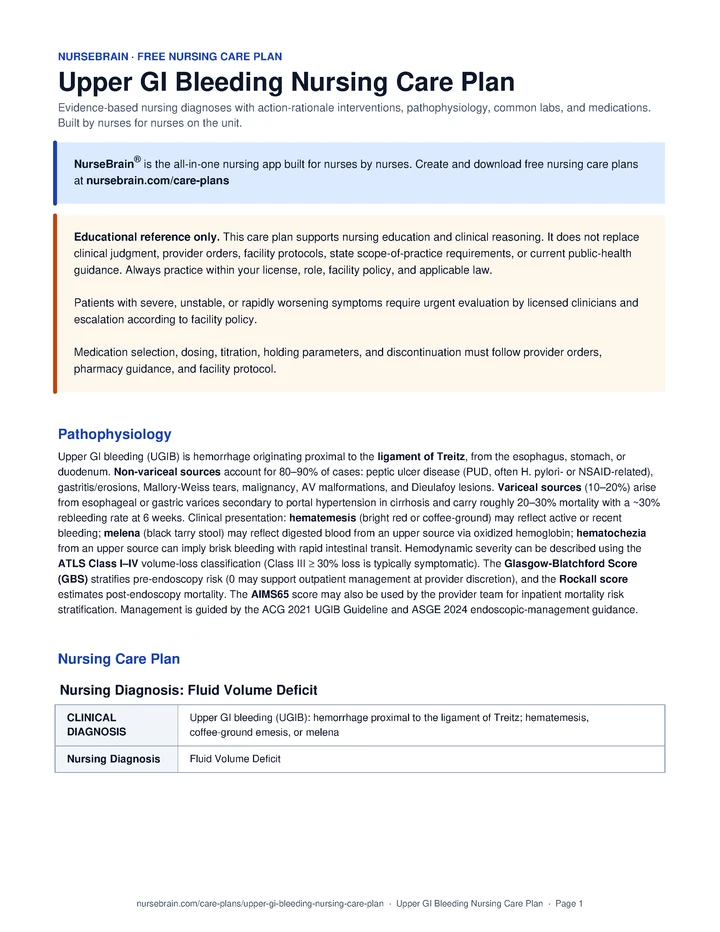
Upper Gastrointestinal Bleeding Nursing Care Plan
Upper GI bleed nursing care plan with prioritized diagnoses, fluid resuscitation, pain management, and a printable PDF. Built by nurses for nurses.
Nursing Care Plan
Nursing Diagnosis 1: Hypovolaemia
Fluid Volume Deficit related to Upper GI bleeding (UGIB): hemorrhage proximal to the ligament of Treitz; hematemesis, coffee-ground emesis, or melena as evidenced by Active hematemesis (bright red or coffee-ground); Melena or hematochezia documented; Tachycardia (HR > 110 bpm); Hypotension (SBP < 90 mmHg) or orthostatic changes; Decreased urine output (< 0.5 mL/kg/hr).
Interventions
- Monitor vital signs at intervals matched to clinical acuity and facility protocol (commonly q15 minutes during active bleed, advancing to q1h once stable); include orthostatics when safe and ordered.
- Establish and maintain two large-bore (16–18 g) peripheral IVs per facility protocol; coordinate central access with the provider team for failed peripheral attempts or persistent instability.
- Monitor and report serial Hgb, BUN, Cr, lactate, and coagulation studies per provider order (commonly q4–6h).
- Measure and document all emesis and stool output; describe character (bright red, coffee-ground, melena, hematochezia).
- Maintain strict hourly I&O; calculate net balance and trend with vital-sign changes per facility protocol.
- Maintain continuous cardiac telemetry and continuous pulse oximetry per facility protocol.
- Administer ordered IV crystalloid (NS or LR) per provider direction until blood products are available; reassess perfusion after each bolus.
- Verify type & cross is current and coordinate with blood bank to keep 2–4 units PRBC available bedside per provider order and facility protocol.
- Administer ordered blood products using two-RN/bedside verification per facility policy; transfuse PRBC over 2–4 hours, or rapidly via MTP when ordered for unstable patients.
- Administer ordered IV pantoprazole bolus and infusion (non-variceal) and/or octreotide bolus and infusion (suspected variceal) per provider order and facility protocol.
- Maintain NPO status per provider order; coordinate readiness for emergent endoscopy (consent support, NPO confirmation, baseline labs, blood available) per facility protocol.
- Support activation of the massive transfusion protocol (MTP) per facility protocol when criteria are met (commonly ≥ 4 U PRBC in 1 hour or ≥ 10 U in 24 hours) per provider order.
- Explain to the patient and family the rationale for IV access, NPO status, blood transfusions, and emergent endoscopy in plain language.
- Educate the patient post-stabilization on triggers to avoid (NSAIDs, alcohol, certain anticoagulants) and signs of rebleeding to report.
- Notify the provider for SBP < 90, HR > 120, UOP < 30 mL/hr x 2 hours, new hematemesis, or Hgb drop > 2 g/dL between draws.
- Coordinate with GI, anesthesia, ICU, and blood bank for emergent endoscopy and possible MTP activation per facility protocol.
- For refractory variceal bleeding despite ordered octreotide and endoscopic band ligation, coordinate with the provider team to prepare for balloon tamponade (Sengstaken-Blakemore or Minnesota tube) as a temporizing bridge and for emergent TIPS evaluation per facility protocol.
Outcome: MAP and perfusion indicators are monitored and reported within ordered parameters; HR trend is documented and reported within ordered parameters; Urine output is monitored and reported per facility protocol.
Nursing Diagnosis 2: Impaired Cardiovascular System
Cardiovascular Alteration related to Upper GI bleeding (UGIB): hemorrhage proximal to the ligament of Treitz; hematemesis, coffee-ground emesis, or melena as evidenced by Estimated volume loss ≥ 30% (ATLS Class III pattern); Sustained tachycardia and narrowed pulse pressure; Cool, mottled extremities with delayed capillary refill; Elevated lactate > 2 mmol/L; Troponin elevation that may reflect demand ischemia.
Interventions
- Maintain continuous cardiac telemetry per facility protocol; document any new arrhythmias or ST-segment changes.
- Assess peripheral perfusion (skin temperature, color, capillary refill, peripheral pulses) at intervals matched to clinical acuity (commonly every 1–2 hours).
- Trend serial lactate and central venous oxygen saturation when available and ordered.
- Monitor for signs of cardiogenic compromise: chest pain, dyspnea, new S3, JVD, pulmonary crackles.
- Recheck troponin and ECG per provider order with significant Hgb drop, sustained tachycardia, or new chest pain.
- Administer ordered vasopressor support (commonly norepinephrine first-line) per provider direction and facility protocol to support MAP within ordered parameters.
- Coordinate central line placement per facility protocol when sustained vasopressor support is anticipated or peripheral access is inadequate.
- Administer ordered blood products using restrictive thresholds per provider order (commonly Hgb < 7 g/dL; cirrhosis target 7–8 g/dL).
- During acute hypotensive episodes while ordered volume resuscitation is underway, position the patient supine per facility protocol when clinically appropriate.
- Cluster nursing care to allow rest periods between assessments and interventions when clinical state allows.
- Explain to the patient and family the rationale for ICU-level monitoring, vasopressors, and frequent labs in plain language.
- Educate the patient post-stabilization on cardiac risk factors and the importance of cardiology follow-up after UGIB-associated troponin rise, when ordered.
- Findings such as persistent SBP < 90, MAP < 65 despite ordered resuscitation, new mottling, or decreased LOC should prompt urgent reassessment, provider notification, and rapid-response activation per facility protocol.
- Coordinate cardiology consultation per provider order for new ischemic ECG changes, sustained troponin elevation, or new heart-failure signs.
Outcome: MAP and perfusion indicators are monitored and reported within ordered parameters; Capillary refill and peripheral perfusion are documented and reported; Lactate trend is documented and reported to the provider team.
Nursing Diagnosis 3: Impaired Nutritional Intake
Aspiration Risk related to Upper GI bleeding (UGIB): hemorrhage proximal to the ligament of Treitz; hematemesis, coffee-ground emesis, or melena as evidenced by Active hematemesis with potential for airway compromise; Altered level of consciousness from hypovolemia or sedation; Pre-procedure NPO may not always be feasible in emergent endoscopy; Decreased gag reflex during procedural sedation; Supine positioning during resuscitation.
Interventions
- Assess level of consciousness, gag reflex, and cough strength at intervals matched to clinical acuity (commonly every 1–2 hours during active bleed).
- Monitor SpO2 continuously and auscultate breath sounds per facility protocol and after any vomiting episode.
- Observe for signs of aspiration: new cough, focal crackles, increased work of breathing, fever, or desaturation.
- Assess for hepatic encephalopathy in cirrhotic patients (asterixis, confusion, somnolence).
- Position the patient with head of bed elevated 30–45° during active hematemesis when hemodynamically tolerated and per facility protocol.
- Maintain suction setup (Yankauer catheter, wall suction) ready at the bedside at all times per facility protocol.
- Maintain NPO status per provider order until endoscopy is completed and a diet is ordered.
- For altered LOC or pre-procedure sedation, support lateral positioning with HOB elevated when clinically feasible per facility protocol.
- Coordinate anesthesia presence and airway readiness for high-risk endoscopy (active hematemesis, altered LOC, suspected variceal) per facility protocol.
- Place NG/OG tube only per provider order; coordinate with the provider before insertion in suspected esophageal varices.
- When the patient is alert, instruct to turn the head to the side and call for suction if feeling nauseated or about to vomit.
- Educate the family on the rationale for HOB elevation, NPO status, and bedside suction.
- Notify the provider for new desaturation, witnessed aspiration event, or new focal crackles.
- Coordinate anesthesia consultation per provider order for airway protection in patients with altered LOC, ongoing massive hematemesis, or planned emergent endoscopy.
Outcome: Airway patency is monitored and supported per facility protocol; SpO2 is maintained within ordered parameters; Breath sounds are auscultated and changes reported.
Nursing Diagnosis 4: Impaired Urinary System Function
Anxiety related to Upper GI bleeding (UGIB): hemorrhage proximal to the ligament of Treitz; hematemesis, coffee-ground emesis, or melena as evidenced by Witnessing own hematemesis or large-volume melena; Verbalized fear of dying or worsening; Rapid escalation of care (multiple IVs, blood products, ICU transfer); Unfamiliar procedures (endoscopy, central line, transfusion); Sympathetic activation: tachycardia, restlessness, hypervigilance.
Interventions
- Assess anxiety level using a 0–10 scale at the start of every shift and PRN; identify patient-specific triggers.
- Observe for physical signs of anxiety: tachycardia disproportionate to clinical state, restlessness, hand-wringing.
- Differentiate anxiety-driven tachycardia from hypovolemic tachycardia by reassessing perfusion, Hgb trend, and response to ordered resuscitation.
- Provide a calm, reassuring presence; speak clearly and at a measured pace.
- Explain each procedure and finding in patient-friendly terms before performing it (IV insertion, transfusion, endoscopy prep).
- Facilitate a support person at the bedside when clinically feasible and per facility policy.
- Cluster nursing cares to allow protected rest periods when hemodynamically stable and per facility protocol.
- Limit non-essential stimuli at night (overhead lights, loud conversations, unnecessary alarms) per facility protocol.
- Teach diaphragmatic breathing and grounding techniques the patient can use independently.
- Educate the patient and family on what monitor alarms mean and what is and is not clinically concerning.
- Provide post-discharge education on what to expect at home, signs of rebleeding, and the follow-up plan.
- Coordinate with chaplaincy, social work, or psych services if anxiety persists or worsens despite non-pharmacologic measures.
- Notify the provider for severe or persistent anxiety unresponsive to non-pharmacologic measures.
Outcome: Patient verbalizes decreased anxiety on a 0–10 scale; Patient demonstrates at least one coping strategy; HR is consistent with clinical state and is monitored and reported.
Nursing Diagnosis 5: Lack Of Knowledge
Knowledge Deficit related to Upper GI bleeding (UGIB): hemorrhage proximal to the ligament of Treitz; hematemesis, coffee-ground emesis, or melena as evidenced by Prolonged NPO status pre- and post-endoscopy; Blood loss with associated iron-deficiency anemia; Increased metabolic demand from acute illness; Cirrhosis with baseline protein-calorie malnutrition; Nausea or anorexia post-endoscopy.
Interventions
- Assess for signs of rebleeding (new hematemesis, melena, drop in Hgb, tachycardia) before advancing diet per provider order.
- Monitor weight, intake, and tolerance of prescribed diet each shift.
- Monitor for iron-deficiency anemia (Hgb, ferritin, transferrin saturation) per provider order post-bleed.
- Administer ordered diet advancement per provider order (commonly clear liquids → full liquids → soft → regular as tolerated).
- Administer ordered iron replacement (oral or IV) per provider direction and facility protocol.
- Coordinate dietitian consultation per provider order for cirrhotic patients or those with significant baseline malnutrition.
- Support small, frequent meals and avoidance of GI irritants (alcohol, NSAIDs, spicy foods) during recovery per provider direction.
- Educate the patient on avoidance of NSAIDs, aspirin (unless cardio-protective and approved by the provider), alcohol, and tobacco.
- Teach the patient about H. pylori eradication therapy when prescribed and the importance of completing the full course.
- Educate on a diet adapted to comorbidities (e.g., low sodium for cirrhosis) per provider and dietitian guidance.
- Teach rebleeding warning signs (new hematemesis, black or tarry stools, dizziness, weakness, palpitations) and when to seek emergency care.
- Notify the provider for poor PO intake > 48 hours, signs of rebleed, or inability to advance diet.
- Coordinate outpatient GI follow-up per provider order for repeat endoscopy and H. pylori testing as indicated.
Outcome: Patient verbalizes understanding of the diet-advancement plan; Patient verbalizes understanding of medications, including any H. pylori regimen when prescribed; Patient verbalizes rebleeding warning signs and when to seek care.
Pathophysiology
Upper GI bleeding (UGIB) is hemorrhage originating proximal to the ligament of Treitz, from the esophagus, stomach, or duodenum. Non-variceal sources account for 80–90% of cases: peptic ulcer disease (PUD, often H. pylori- or NSAID-related), gastritis/erosions, Mallory-Weiss tears, malignancy, AV malformations, and Dieulafoy lesions. Variceal sources (10–20%) arise from esophageal or gastric varices secondary to portal hypertension in cirrhosis and carry roughly 20–30% mortality with a ~30% rebleeding rate at 6 weeks.
Clinical presentation: hematemesis (bright red or coffee-ground) may reflect active or recent bleeding; melena (black tarry stool) may reflect digested blood from an upper source via oxidized hemoglobin; hematochezia from an upper source can imply brisk bleeding with rapid intestinal transit. Hemodynamic severity can be described using the ATLS Class I–IV volume-loss classification (Class III ≥ 30% loss is typically symptomatic). The Glasgow-Blatchford Score (GBS) stratifies pre-endoscopy risk (0 may support outpatient management at provider discretion), and the Rockall score estimates post-endoscopy mortality. The AIMS65 score may also be used by the provider team for inpatient mortality risk stratification. Management is guided by the ACG 2021 UGIB Guideline and ASGE 2024 endoscopic-management guidance.
Quick Reference
- IV access: 2 large-bore 16–18g; coordinate central access per facility protocol if unstable
- MTP threshold: 4U PRBC/1h or 10U/24h (1:1:1 PRBC:FFP:plt) per facility protocol
- Hgb transfusion: Provider-team threshold; commonly < 7 g/dL; cirrhosis target 7–8
- Endoscopy: ≤ 24h non-variceal (after resus); ≤ 12h variceal/unstable per facility protocol
- Octreotide gtt: 50 mcg bolus + 50 mcg/h commonly started empirically in cirrhotic UGIB per provider order
- TXA: Not indicated in UGIB (HALT-IT 2020: no benefit, ↑ VTE)
Common Labs
| Lab | Normal range | Significance in Upper GI Bleeding |
|---|---|---|
| CBC / Hgb | 12–17 g/dL | May be normal initially before equilibration; nurses trend serial values per provider order (commonly q4–6h) and report concerning drops to the provider team. |
| Type & Cross | — | Coordinate with blood bank to keep 2–4 U PRBC available per provider order; reconfirm compatibility before each transfusion per facility protocol. |
| PT / INR | INR 0.8–1.2 | May be elevated in cirrhosis or warfarin use; reversal in active bleed with INR > 1.5 is a provider-team decision and is implemented by nursing per order and facility protocol. |
| aPTT | 25–35 sec | May identify heparin effect or intrinsic-pathway coagulopathy; nurses report values outside reference range to the provider team. |
| Platelets | 150–400 K/µL | Platelet transfusion thresholds (commonly < 50 K with active bleed) are determined by the provider team per facility protocol; nurses administer as ordered. |
| BUN / Cr | 7–20 / 0.6–1.2 mg/dL | A BUN:Cr ratio > 30 can support an upper GI source (blood digestion). Nurses report trend and concerning values to the provider team. |
| LFTs | AST/ALT < 40 U/L | May help screen for cirrhosis; AST:ALT > 2 can suggest alcoholic etiology. Interpretation is a provider-team responsibility; nurses report findings. |
| ABG / Lactate | pH 7.35–7.45 / < 2 mmol/L | May help identify shock physiology and tissue hypoperfusion. Nurses trend lactate during resuscitation and escalate failure to clear per facility protocol. |
| Troponin | < 0.04 ng/mL | Demand ischemia can occur in elderly patients with significant Hgb drop. Nurses report new elevations and ischemic ECG changes to the provider team. |
Common Medications
| Class | Examples | Mechanism of action | Key side effects | Nursing considerations |
|---|---|---|---|---|
| IV PPI (bolus + gtt) | Pantoprazole 80 mg IV bolus, then 8 mg/h x 72 h | Inhibits gastric H+/K+-ATPase → raises gastric pH → supports clot stability. | Hypomagnesemia, C. difficile risk with prolonged use, headache, diarrhea. | Administer as ordered per provider direction, pharmacy guidance, and facility protocol. Continuous infusion x 72 h post-endoscopy is commonly ordered in high-risk non-variceal lesions per ACG 2021; nurses monitor for response, recheck Mg2+ per order, and escalate adverse effects. |
| Octreotide gtt | 50 mcg IV bolus, then 50 mcg/h x 3–5 days | Somatostatin analog → splanchnic vasoconstriction → ↓ portal pressure. | Bradycardia, hyperglycemia, nausea, injection-site reaction. | Administer as ordered per provider direction and facility protocol. Per AASLD 2017, octreotide is commonly started empirically in cirrhotic UGIB (variceal until proven otherwise) and continued 3–5 days after endoscopic hemostasis per provider order; nurses monitor HR, glucose, and infusion site. |
| Antibiotic (cirrhosis) | Ceftriaxone 1 g IV q24h x 7 days | Empiric prophylaxis against bacterial translocation (SBP, bacteremia). | Diarrhea, biliary sludging, hypersensitivity. | Administer as ordered per provider direction and facility protocol. Per AASLD 2017 and ACG 2021, antibiotic prophylaxis in cirrhotic UGIB is associated with reduced mortality and rebleed risk; nurses monitor for allergy, response, and adverse effects. |
| IV crystalloid | 0.9% NS or Lactated Ringer’s, 500 mL–1 L bolus | Volume expansion to support intravascular volume, preload, and tissue perfusion. | Dilutional coagulopathy with excessive volumes; pulmonary edema in cardiac or cirrhotic patients; large-volume NaCl can drive hyperchloremic acidosis. | Administer as ordered. Bolus volumes and reassessment endpoints are provider-team decisions; in suspected variceal bleed, over-resuscitation can raise portal pressure and worsen hemorrhage, so nurses monitor MAP, lactate trend, and lung exam after each ordered bolus and escalate worsening pulmonary edema per facility protocol. |
| PRBC transfusion | 1 unit IV over 2–4 h (or rapid in MTP) | Restores oxygen-carrying capacity. | TRALI, TACO, febrile/allergic reaction, hyperkalemia in massive transfusion, hypocalcemia. | Administer as ordered per provider direction and facility protocol. Restrictive Hgb thresholds (commonly < 7 g/dL, or 7–8 in cirrhosis) are provider-team decisions; nurses verify two-RN/bedside checks per facility policy and monitor VS q15 min x 1 h after initiation. |
| FFP / Platelets | FFP 10–15 mL/kg; platelets 1 unit pheresis | Replaces clotting factors / supports platelet count. | TRALI, TACO, allergic reaction, transfusion-related infection. | Administer as ordered for active bleed with INR > 1.5 (FFP) or platelets < 50 K per provider order and facility protocol. In massive transfusion, balanced 1:1:1 PRBC:FFP:platelet ratio is the commonly ordered MTP target; nurses confirm ABO compatibility and monitor for transfusion reactions. |
| Vasopressor | Norepinephrine 0.05–0.5 mcg/kg/min IV gtt | α1-agonist → vasoconstriction → supports MAP. | Tachyarrhythmias, peripheral and digital ischemia, extravasation injury. | Administer as ordered per provider direction and facility protocol when hypotension persists despite ordered resuscitation. Per SSC 2021, vasopressor initiation should not be delayed for central-line placement; short-term peripheral administration is acceptable per facility policy while central access is being obtained. Nurses monitor MAP, rhythm, urine output, peripheral perfusion, and IV site. |
| Anticoag reversal | Vitamin K 10 mg IV (warfarin), 4F-PCC, andexanet alfa (Xa), idarucizumab (dabigatran) | Replenishes factors II/VII/IX/X or directly neutralizes DOAC anticoagulation. | Thrombosis risk (PCC, andexanet), hypersensitivity, infusion reaction. | Administer as ordered per provider direction, pharmacy guidance, and facility protocol. Agent selection depends on the anticoagulant, last dose, indication, and bleeding severity, and is a provider-team decision; nurses verify agent and timing, coordinate with pharmacy, and recheck INR 30–60 min post-reversal per order. |
| TXA (NOT indicated) | Tranexamic acid: not routinely indicated in UGIB | HALT-IT trial (Lancet 2020, n = 12,009) showed no mortality benefit in GI bleed. | Increased VTE risk; seizure at high dose. | Per ACG 2021, routine TXA is not recommended in UGIB. This entry is included so nurses recognize the difference between UGIB practice and trauma MTP practice; administer as ordered per provider direction and clarify with the provider if a TXA order appears in a UGIB context. |
References
- Makic, M. B. F., & Martinez-Kratz, M. R. (Eds.). (2023). Ackley and Ladwig’s Nursing Diagnosis Handbook: An Evidence-Based Guide to Planning Care (13th ed.). Elsevier.
- Laine, L., Barkun, A. N., Saltzman, J. R., Martel, M., & Leontiadis, G. I. (2021). ACG Clinical Guideline: Upper Gastrointestinal and Ulcer Bleeding. American Journal of Gastroenterology, 116(5), 899–917.
- Garcia-Tsao, G., Abraldes, J. G., Berzigotti, A., & Bosch, J. (2017). Portal Hypertensive Bleeding in Cirrhosis: Risk Stratification, Diagnosis, and Management: 2016 Practice Guidance by the American Association for the Study of Liver Diseases. Hepatology, 65(1), 310–335.
- Mullady, D. K., Wang, A. Y., & Waschke, K. A. (2024). AGA/ASGE Clinical Practice Update on Endoscopic Management of Acute Upper Gastrointestinal Bleeding. Gastrointestinal Endoscopy, 99(4), 619–637.
- HALT-IT Trial Collaborators. (2020). Effects of a high-dose 24-h infusion of tranexamic acid on death and thromboembolic events in patients with acute gastrointestinal bleeding (HALT-IT): an international randomised, double-blind, placebo-controlled trial. Lancet, 395(10241), 1927–1936.
- Villanueva, C., Colomo, A., Bosch, A., et al. (2013). Transfusion strategies for acute upper gastrointestinal bleeding. New England Journal of Medicine, 368(1), 11–21.
- Evans, L., Rhodes, A., Alhazzani, W., et al. (2021). Surviving Sepsis Campaign: International Guidelines for Management of Sepsis and Septic Shock 2021. Critical Care Medicine, 49(11), e1063–e1143.
Frequently Asked Questions
What is the nursing care plan for Upper GI Bleed?
A Upper GI Bleed nursing care plan organizes the assessment, nursing diagnoses, goals, interventions, and evaluation criteria for a patient with Upper Gastrointestinal Bleeding. Diagnoses are ordered by what is currently most destabilizing for the patient.
What are the priority nursing diagnoses for Upper GI Bleed?
Priority diagnoses for Upper GI Bleed appear in the Nursing Diagnoses section above, ordered by clinical acuity. The top diagnosis should reflect what is currently most destabilizing for this specific patient.
What is the priority nursing intervention for Upper GI Bleed?
Priority interventions for Upper GI Bleed are listed in the care plan above, organized by diagnosis. The most critical actions address airway, circulation, and the highest-acuity problem first.
What complications should the nurse monitor for in Upper GI Bleed?
Complications to monitor for in Upper GI Bleed are listed within each diagnosis section above. Trend vitals, mental status, and the condition-specific red flags described in the assessment section.
A report sheet built for this patient
This is exactly the kind of patient the report sheet templates in NurseBrain® Synapse are built for. Keep everything you track on one page, all shift.
Learn how NurseBrain Synapse uses the Clinical Care Classification System for nursing care plans.