Adrenal Insufficiency and Adrenal Crisis Nursing Care Plan
Adrenal insufficiency and adrenal crisis nursing care plan: cortisol replacement, fluid balance, nutrition, and a printable PDF.
Nursing Care Plan
Nursing Diagnosis 1: Hypovolaemia
Fluid Volume Deficit related to Adrenal insufficiency: primary (Addison disease, adrenal cortex damage) or secondary (pituitary or hypothalamic); adrenal crisis = acute life-threatening decompensation with hypotension, hyponatremia, hyperkalemia (primary only), hypoglycemia, and abdominal pain as evidenced by Hypotension: SBP < 90 mmHg or MAP < 65 mmHg or below ordered parameters; Tachycardia, HR > 110 bpm at rest; Volume depletion: dry mucous membranes, flat neck veins, capillary refill > 3 seconds; Decreased urine output (< 0.5 mL/kg/hr); Elevated BUN and creatinine consistent with prerenal pattern.
Interventions
- Obtain vital signs at intervals matched to clinical acuity (commonly every 15 minutes during active resuscitation and every 1 hour once stabilized) per facility protocol.
- Monitor strict intake and output; report UOP below ordered parameters (commonly < 30 mL/hr for 2 consecutive hours) to the provider team.
- Assess level of consciousness, orientation, and skin perfusion (color, temperature, capillary refill) at intervals matched to clinical acuity.
- Inspect skin for hyperpigmentation of palmar creases, buccal mucosa, scars, and nipples; document distribution.
- Trend serial lactate per provider order during resuscitation; report lactate > 2 mmol/L and any failure to clear.
- Administer ordered hydrocortisone (commonly 100 mg IV bolus on suspicion of adrenal crisis) per provider direction and facility protocol; treatment is commonly not delayed for ACTH-stim results.
- Administer ordered 0.9% normal saline (commonly a 1 L IV bolus followed by a titrated maintenance rate) per provider direction; monitor MAP, lung sounds, and UOP after each ordered bolus.
- Establish and maintain two large-bore peripheral IV lines (commonly 18 gauge or larger) or support central-line placement per facility protocol when ordered.
- Administer ordered dextrose (commonly D50 25 g IV push for symptomatic hypoglycemia, followed by D5-containing maintenance fluid) per facility protocol.
- When the patient is alert, explain in plain language what adrenal crisis is, what may have triggered it, and why steroid replacement is ongoing.
- Reinforce that abrupt steroid discontinuation can precipitate crisis, including in patients on chronic exogenous steroids for unrelated conditions.
- Educate the patient and family on the signs of crisis to report at home (severe weakness, vomiting, lightheadedness, confusion) and the path to emergency care.
- Notify the provider for refractory hypotension despite ordered hydrocortisone and saline, ongoing hyperkalemia, or new altered mentation.
- Coordinate identification and treatment of the precipitant: support ordered workup (pan-culture, CXR, UA) and administer ordered empiric antibiotics per facility protocol when infection is suspected.
- Coordinate transition from IV hydrocortisone to oral replacement once the patient is stable, tolerating PO, and afebrile, per provider order and facility protocol.
Outcome: MAP and BP are monitored and reported within ordered parameters with the smallest ordered crystalloid volume; Urine output is monitored and reported within ordered parameters (commonly ≥ 0.5 mL/kg/hr); Serum Na+ trend is monitored and communicated to the provider team.
Nursing Diagnosis 2: Impaired Spiritual Status
Electrolyte Imbalance related to Adrenal insufficiency: primary (Addison disease, adrenal cortex damage) or secondary (pituitary or hypothalamic); adrenal crisis = acute life-threatening decompensation with hypotension, hyponatremia, hyperkalemia (primary only), hypoglycemia, and abdominal pain as evidenced by Cortisol deficiency contributing to impaired free-water clearance and hyponatremia; Aldosterone deficiency (primary AI) contributing to sodium wasting and hyperkalemia; Volume depletion on admission; Active saline resuscitation with potential for rapid sodium correction; Concurrent renal impairment.
Interventions
- Trend serum Na+, K+, Cl−, BUN, Cr, and glucose at intervals matched to clinical acuity (commonly every 4–6 hours during active resuscitation) per provider order.
- Monitor cardiac rhythm continuously and report peaked T waves, widened QRS, or new bradyarrhythmia.
- Track the rate of sodium correction and report values approaching a rise > 8–10 mEq/L in 24 hours.
- Assess neurologic status (orientation, motor function, speech) at intervals matched to clinical acuity during sodium correction.
- Check fingerstick glucose per provider order (commonly every 1 hour until stable) and report values outside ordered parameters.
- Administer ordered 0.9% normal saline (not hypotonic fluids) for volume resuscitation per facility protocol; clarify any order for hypotonic fluid with the provider before administration.
- Administer ordered hydrocortisone on schedule per provider direction; report missed doses or interruption promptly.
- Administer ordered hyperkalemia therapy (commonly calcium gluconate for membrane stabilization, insulin with D50 for intracellular shift, and a potassium-binding agent or loop diuretic for elimination) per facility protocol when K+ is above ordered parameters or ECG changes are present.
- Avoid potassium-containing fluids (such as LR) in hyperkalemic primary AI patients unless specifically ordered; clarify with the provider when fluid choice is unclear.
- When the patient is alert, educate on signs of electrolyte disturbance to report at home: muscle weakness, palpitations, confusion, severe fatigue.
- Reinforce that primary AI patients commonly benefit from liberal salt intake per provider instruction, rather than restriction.
- Notify the provider for a sodium rise approaching > 10 mEq/L in 24 hours, persistent hyperkalemia despite ordered treatment, or new neurologic findings.
- Coordinate with pharmacy and the provider team on fludrocortisone initiation once the patient is tolerating PO (primary AI only) per facility protocol.
Outcome: Serum Na+ trend is monitored and reported within ordered parameters (commonly a rise ≤ 8–10 mEq/L in 24 hours per provider order); Serum K+ trend is monitored and reported within ordered parameters; ECG findings are monitored and any new conduction abnormality is reported promptly.
Nursing Diagnosis 3: Impaired Cardiac Output
Cardiac Output Alteration related to Adrenal insufficiency: primary (Addison disease, adrenal cortex damage) or secondary (pituitary or hypothalamic); adrenal crisis = acute life-threatening decompensation with hypotension, hyponatremia, hyperkalemia (primary only), hypoglycemia, and abdominal pain as evidenced by Hypotension consistent with combined hypovolemia and vasodilation; Tachycardia disproportionate to fever or clinical state; Hyperkalemia with peaked T waves or widened QRS on ECG (primary AI); Hyponatremia with serum Na+ < 130 mEq/L; Altered mental status consistent with hypoperfusion.
Interventions
- Maintain continuous cardiac monitoring; report peaked T waves, widened QRS, new bradyarrhythmia, or new tachyarrhythmia.
- Support continuous arterial line monitoring per facility protocol when ordered and document MAP at intervals matched to titration activity.
- Assess skin color, temperature, mottling, and capillary refill at intervals matched to clinical acuity.
- Monitor urine output hourly via Foley catheter when ordered; report UOP < 0.5 mL/kg/hr for 2 consecutive hours.
- Trend serial lactate per provider order during resuscitation; report values > 2 mmol/L and any failure to clear.
- Administer ordered hydrocortisone per provider direction and facility protocol; report any interruption or missed dose.
- Administer ordered crystalloid in the volumes and at the intervals directed by the provider; monitor MAP, lactate trend, lung sounds, and UOP after each ordered bolus and escalate worsening pulmonary findings per facility protocol.
- Administer ordered dextrose for hypoglycemia per facility protocol; recheck fingerstick per provider order until stable.
- Support central-line placement and ordered vasopressor therapy per facility protocol when refractory hypotension is identified; monitor MAP, rhythm, urine output, peripheral perfusion, and signs of extravasation.
- When the patient is alert, explain in plain language what the lines, drips, and monitors are doing.
- Educate the family on the goals of fluid and steroid support and what improvement commonly looks like (warm extremities, rising urine output, calmer mentation).
- Findings such as rising lactate, decreasing urine output, hypotension, new arrhythmia, or new mental-status change should prompt urgent reassessment and provider notification.
- Coordinate escalation to the ICU and endocrinology per facility protocol when refractory shock, persistent hyperkalemia, or altered mentation continues despite ordered therapy.
- Coordinate identification and treatment of the precipitant: support ordered pan-culture, CXR, and UA, and administer ordered empiric antibiotics per facility protocol when infection is suspected.
Outcome: MAP, HR, and perfusion indicators are monitored and reported within ordered parameters; Cardiac rhythm is monitored continuously and conduction changes are reported promptly; Urine output is monitored and reported within ordered parameters.
Nursing Diagnosis 4: Impaired Urinary System Function
Anxiety related to Adrenal insufficiency: primary (Addison disease, adrenal cortex damage) or secondary (pituitary or hypothalamic); adrenal crisis = acute life-threatening decompensation with hypotension, hyponatremia, hyperkalemia (primary only), hypoglycemia, and abdominal pain as evidenced by Patient verbalization of fear of dying, family separation, or the unknown; Restlessness or hypervigilance disproportionate to clinical state; Tachycardia disproportionate to clinical state and ordered therapy; New diagnosis of a lifelong condition requiring daily medication; Rapid clinical deterioration witnessed by patient and family.
Interventions
- Assess anxiety level using a 0–10 scale at the start of every shift and PRN.
- Identify the patient’s stated triggers (lightheadedness, monitor alarms, fear of recurrence, fear of dying, lifelong medication).
- Observe for physical signs of anxiety: tachycardia out of proportion to clinical state, restlessness, hand-wringing, hypervigilance.
- Assess sleep quality and contributors (alarms, lighting, frequent interventions, anxiety) daily.
- Provide a calm, reassuring presence; speak clearly and at a measured pace.
- Explain procedures and findings in plain, patient-friendly terms before performing them.
- Cluster cares to allow uninterrupted rest periods when clinical state allows.
- Limit non-essential nighttime stimuli (overhead lights, loud conversations, unnecessary alarms) per facility protocol.
- Facilitate family presence within facility policy; coordinate chaplaincy, social work, or interpreter services per patient preference.
- Teach diaphragmatic breathing and grounding techniques the patient can use independently.
- Educate the patient and family on adrenal insufficiency in plain language: what it is, what triggered the crisis, and what daily replacement involves.
- Teach the family what each ICU alarm means and what is and is not clinically concerning.
- Coordinate with chaplaincy, social work, or psych services if anxiety persists or worsens despite non-pharmacologic measures.
- Notify the provider for severe or persistent anxiety unresponsive to non-pharmacologic measures.
Outcome: Patient verbalizes decreased anxiety; Patient demonstrates at least one coping strategy (diaphragmatic breathing, grounding, music); Patient sleeps in 4-hour blocks when clinical state allows.
Nursing Diagnosis 5: Lack Of Knowledge Of Treatment Regime
Knowledge Deficit of Therapeutic Regimen related to Adrenal insufficiency: primary (Addison disease, adrenal cortex damage) or secondary (pituitary or hypothalamic); adrenal crisis = acute life-threatening decompensation with hypotension, hyponatremia, hyperkalemia (primary only), hypoglycemia, and abdominal pain as evidenced by New diagnosis of adrenal insufficiency; Patient verbalizes uncertainty about when to increase the steroid dose; No medical-alert identification at admission; No emergency injection kit at home; Recent missed doses or patient-initiated taper.
Interventions
- Assess baseline understanding of adrenal insufficiency, the role of cortisol, and the current replacement regimen.
- Identify the patient’s primary caregiver and assess their willingness to learn injection technique.
- Review the home medication list for any prescriber-initiated steroid changes or recent dose interruptions.
- Assess access to follow-up care, transportation, and ability to fill prescriptions promptly.
- Teach the sick-day rule per provider instruction using a written handout: commonly double the oral dose for minor illness or fever ≥ 38 °C, triple for major illness, and use IM injection when vomiting prevents PO intake.
- Demonstrate Solu-Cortef Act-O-Vial reconstitution and IM injection on a practice pad, then perform return demonstration with the patient and family.
- Provide a written wallet card listing the diagnosis, current replacement doses, emergency contact, and crisis instructions per provider input.
- Help the patient initiate a medical-alert (or equivalent) order before discharge per facility protocol.
- Reinforce that abrupt steroid cessation, including from chronic non-endocrine indications, can precipitate crisis.
- Teach pre-operative stress dosing per provider instruction (commonly 100 mg IV hydrocortisone pre-op + 200 mg/24 h × 48 h per facility protocol); reinforce the importance of informing every future surgical team about the diagnosis.
- Teach the patient to mimic the diurnal cortisol rhythm per provider order (commonly largest dose on waking, smaller mid-day, smallest in late afternoon).
- Reinforce that an emergency-department visit is commonly recommended after any IM emergency injection per provider instruction.
- Coordinate endocrinology follow-up within 1–2 weeks of discharge per facility protocol.
- Coordinate a social-work consult when the patient lacks coverage for chronic steroid or emergency-kit costs.
- Document teaching, return demonstration, and the patient’s verbalized plan in the discharge record.
Outcome: Patient verbalizes the sick-day rule per provider instruction (commonly doubling or tripling the oral dose for fever ≥ 38 °C, illness, or significant stress); Patient and a family member demonstrate reconstitution and IM injection of Solu-Cortef Act-O-Vial; Patient orders and plans to wear a medical-alert identification before discharge.
Pathophysiology
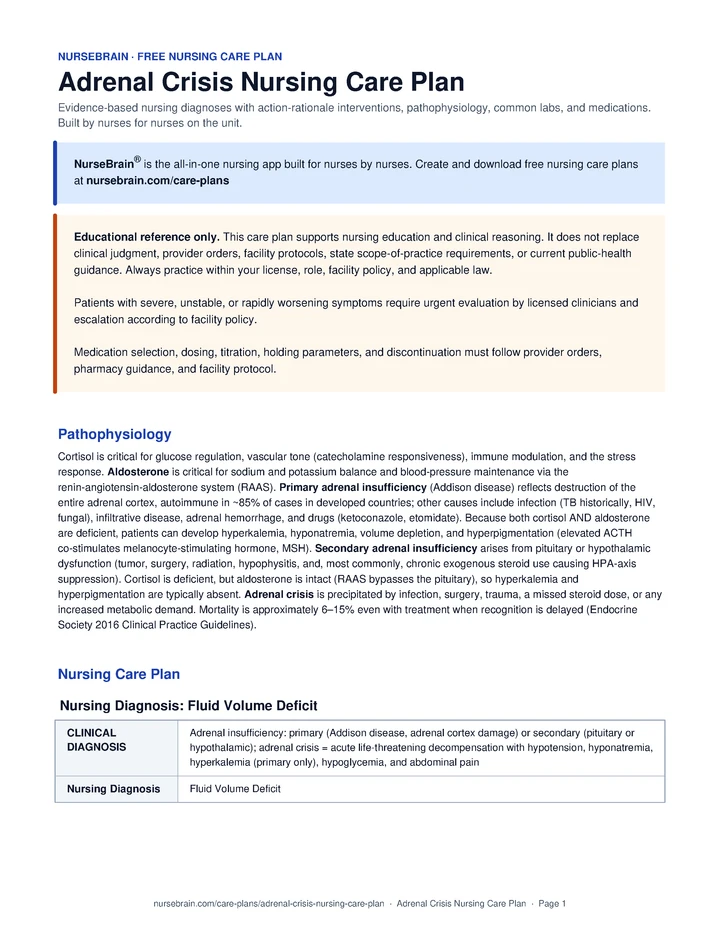
Cortisol is critical for glucose regulation, vascular tone (catecholamine responsiveness), immune modulation, and the stress response. Aldosterone is critical for sodium and potassium balance and blood-pressure maintenance via the renin-angiotensin-aldosterone system (RAAS). Primary adrenal insufficiency (Addison disease) reflects destruction of the entire adrenal cortex, autoimmune in ~85% of cases in developed countries; other causes include infection (TB historically, HIV, fungal), infiltrative disease, adrenal hemorrhage, and drugs (ketoconazole, etomidate). Because both cortisol AND aldosterone are deficient, patients can develop hyperkalemia, hyponatremia, volume depletion, and hyperpigmentation (elevated ACTH co-stimulates melanocyte-stimulating hormone, MSH).
Secondary adrenal insufficiency arises from pituitary or hypothalamic dysfunction (tumor, surgery, radiation, hypophysitis, and, most commonly, chronic exogenous steroid use causing HPA-axis suppression). Cortisol is deficient, but aldosterone is intact (RAAS bypasses the pituitary), so hyperkalemia and hyperpigmentation are typically absent. Adrenal crisis is precipitated by infection, surgery, trauma, a missed steroid dose, or any increased metabolic demand. Mortality is approximately 6–15% even with treatment when recognition is delayed (Endocrine Society 2016 Clinical Practice Guidelines).
Quick Reference
- Acute hydrocortisone: 100 mg IV bolus + 200 mg/24 h per facility protocol
- Diagnostic test: ACTH stim (cosyntropin 250 mcg IV)
- Sick-day rule: Double or triple dose for fever or illness per provider instruction
- Surgical stress dose: 100 mg IV pre-op + 200 mg/24 h × 48 h per facility protocol
- Shock triad: ↓ Na, ↑ K, ↓ BP + pigmentation
Common Labs
| Lab | Normal range | Significance in Adrenal Crisis |
|---|---|---|
| Cortisol (random) | Crisis: peak > 18 mcg/dL | A level < 18 mcg/dL in a critically ill patient at peak stress can support AI; baseline 8 a.m. cortisol is used when the patient is not in crisis. ACTH stim (cosyntropin 250 mcg IV, cortisol drawn at 30 and 60 minutes; peak < 18 mcg/dL) can support AI. Nurses report values to the provider team; treatment is not delayed for testing per facility protocol. |
| ACTH | 10–60 pg/mL | High in primary AI, low or normal in secondary AI. Helps differentiate the level of HPA-axis disruption for provider-team planning. |
| Aldosterone / Renin | Aldo 3–16 ng/dL | Low aldosterone with high renin can support primary AI; both typically normal in secondary AI. Supports the team’s decision on whether mineralocorticoid replacement is indicated. |
| Na+ | 135–145 mEq/L | Hyponatremia can occur in both primary and secondary AI (cortisol deficiency with a SIADH-like effect on free-water clearance). Nurses trend serial sodium and report values outside the ordered range. |
| K+ | 3.5–5.0 mEq/L | Hyperkalemia in primary AI only (aldosterone deficient); typically normal in secondary AI. Nurses monitor for hyperkalemic ECG changes and escalate per facility protocol. |
| Glucose | 70–110 mg/dL | Hypoglycemia is common in crisis; bedside fingerstick is performed on all suspected cases per facility protocol. Nurses report values below ordered parameters and administer ordered dextrose. |
| BUN / Cr | BUN 7–20 / Cr 0.6–1.2 mg/dL | Can be elevated with volume depletion. Trend supports the provider team’s assessment of resuscitation adequacy. |
| CBC | WBC 4–11 K/uL | Eosinophilia and lymphocytosis can suggest chronic cortisol deficiency; nurses report findings to the provider team. |
| 21-OH antibodies | Negative | A positive result can support autoimmune primary AI (Addison). Reviewed by the provider team alongside other workup. |
| TSH / Pituitary panel | TSH 0.4–4.5 mIU/L | Helps screen for Schmidt syndrome (autoimmune polyendocrine); pituitary panel supports the team’s evaluation for panhypopituitarism in secondary AI. |
Common Medications
| Class | Examples | Mechanism of action | Key side effects | Nursing considerations |
|---|---|---|---|---|
| Hydrocortisone IV (crisis) | Solu-Cortef 100 mg IV bolus then 200 mg/24 h continuous infusion (commonly preferred in unstable patients) or 50 mg IV q6h | Replaces cortisol; provides glucocorticoid plus partial mineralocorticoid activity at stress dose. | Hyperglycemia, hypertension, fluid retention; hypokalemia can be a later concern with prolonged high-dose therapy (acute crisis typically presents with hyperkalemia that resolves with steroids and saline). | Administer as ordered per provider direction, pharmacy guidance, and facility protocol. Per the 2016 Endocrine Society guideline, the first dose is given promptly when crisis is suspected and is not delayed for ACTH-stim results per facility protocol. Nurses monitor glucose, BP, and K+ and report findings outside ordered parameters. |
| Normal saline (0.9% NaCl) | 1 L IV bolus, then 200–500 mL/hr titrated per provider order | Volume resuscitation; supports correction of hyponatremia and hypotension that are volume-responsive once steroids are on board. | Volume overload can develop if over-resuscitated, especially in cardiac or renal disease. | Administer as ordered per facility protocol. Nurses trend BP, lung sounds, and UOP; rapid BP response is commonly seen when saline is paired with hydrocortisone, and findings are reported to the provider team. |
| Dextrose | D50 25 g IV push for symptomatic hypoglycemia, then D5NS maintenance per provider order | Supports correction of cortisol-deficiency hypoglycemia. | Rebound hypoglycemia can occur if maintenance is not started; hyperglycemia. | Administer as ordered per facility protocol. Nurses recheck fingerstick per provider order (commonly q1h until stable) and continue D5-containing fluid as ordered. |
| Fludrocortisone (Florinef) | 0.05–0.2 mg PO daily per provider order | Synthetic mineralocorticoid; replaces aldosterone in primary AI only. | Hypertension, hypokalemia, edema, weight gain. | Administer as ordered per provider direction and facility protocol. Typically not needed acutely (hydrocortisone > 50 mg/day has enough mineralocorticoid activity); commonly started once the patient is tolerating PO. |
| Hydrocortisone (chronic) | 15–25 mg PO daily, split 2–3 doses (largest on waking) per provider order | Glucocorticoid replacement aimed at mimicking the diurnal cortisol rhythm. | Cushingoid features if over-replaced; AI symptoms if under-replaced. | Administer as ordered per provider direction. Alternatives can include prednisone 3–5 mg daily per provider order; abrupt discontinuation is avoided and any change is made under provider direction. |
| Solu-Cortef Act-O-Vial (emergency) | 100 mg IM self-injection kit | Patient or family-administered emergency dose for vomiting, severe illness, or impending crisis. | Injection-site reaction. | Administer as ordered per provider direction. Many patients with primary AI carry one at home per provider recommendation; nurses teach reconstitution and IM technique with return demonstration. |
| Stress-dose protocol | Sick day: double or triple oral dose; major illness or surgery: 100 mg IV pre-op + 200 mg/24 h per facility protocol | Compensates for absent endogenous cortisol surge during physiologic stress. | Transient hyperglycemia, mood changes. | Administer as ordered per provider direction and facility protocol. Patient education supports recognition of triggers (fever ≥ 38 °C, vomiting, surgery, trauma) that commonly warrant a stress dose per provider instruction. |
| Precipitant therapy | Antibiotics for infection or cause-specific treatment per provider order | Adrenal crisis is rarely isolated; identifying and treating the trigger is part of supportive care. | Drug-specific. | Administer as ordered per facility protocol. Nurses support the workup (pan-culture, CXR, UA) and monitor for response to ordered therapy. |
References
- Makic, M. B. F., & Martinez-Kratz, M. R. (Eds.). (2023). Ackley and Ladwig’s Nursing Diagnosis Handbook: An Evidence-Based Guide to Planning Care (13th ed.). Elsevier.
- Bornstein, S. R., Allolio, B., Arlt, W., et al. (2016). Diagnosis and Treatment of Primary Adrenal Insufficiency: An Endocrine Society Clinical Practice Guideline. The Journal of Clinical Endocrinology & Metabolism, 101(2), 364–389.
- Husebye, E. S., Allolio, B., Arlt, W., et al. (2014). Consensus statement on the diagnosis, treatment and follow-up of patients with primary adrenal insufficiency. Journal of Internal Medicine, 275(2), 104–115.
Frequently Asked Questions
What is the nursing care plan for Adrenal Crisis?
A Adrenal Crisis nursing care plan organizes the assessment, nursing diagnoses, goals, interventions, and evaluation criteria for a patient with Adrenal Insufficiency and Adrenal Crisis. Diagnoses are ordered by what is currently most destabilizing for the patient.
What are the priority nursing diagnoses for Adrenal Crisis?
Priority diagnoses for Adrenal Crisis appear in the Nursing Diagnoses section above, ordered by clinical acuity. The top diagnosis should reflect what is currently most destabilizing for this specific patient.
What is the priority nursing intervention for Adrenal Crisis?
Priority interventions for Adrenal Crisis are listed in the care plan above, organized by diagnosis. The most critical actions address airway, circulation, and the highest-acuity problem first.
What complications should the nurse monitor for in Adrenal Crisis?
Complications to monitor for in Adrenal Crisis are listed within each diagnosis section above. Trend vitals, mental status, and the condition-specific red flags described in the assessment section.
Learn how NurseBrain Synapse uses the Clinical Care Classification System for nursing care plans.