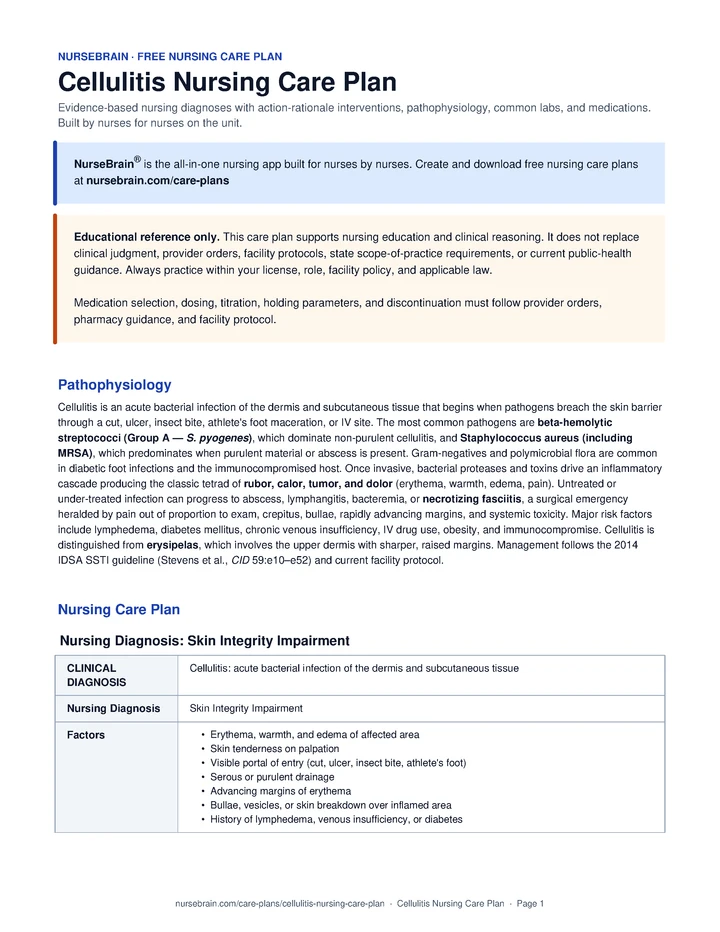
Cellulitis Nursing Care Plan
Cellulitis nursing care plan: antibiotic therapy, wound care, skin integrity, and a printable PDF. Built by nurses for nurses.
Nursing Care Plan
Nursing Diagnosis 1: Impaired Skin Integrity
Skin Integrity Impairment related to Cellulitis: acute bacterial infection of the dermis and subcutaneous tissue as evidenced by Erythema, warmth, and edema of affected area; Skin tenderness on palpation; Visible portal of entry (cut, ulcer, insect bite, athlete’s foot); Serous or purulent drainage; Advancing margins of erythema.
Interventions
- Outline the margins of erythema with a skin marker and document date and time; reassess at intervals matched to clinical acuity and facility protocol.
- Assess the affected area each shift for erythema, warmth, edema, induration, fluctuance, and tenderness; document size and location.
- Inspect for portal of entry such as cuts, ulcers, fissures, athlete’s foot, insect bites, or IV sites, and document findings.
- Assess drainage character (serous, sanguineous, purulent), amount, and odor; collect wound culture per provider order when purulent drainage is present.
- Monitor for bullae, vesicles, ecchymosis, skin necrosis, or crepitus and report findings promptly.
- Assess distal neurovascular status of the affected limb (pulses, capillary refill, sensation, color) at intervals matched to clinical acuity.
- Support elevation of the affected extremity above heart level when in bed or seated, per provider order and as tolerated.
- Apply warm, moist compresses to the affected area per provider order (commonly 15 to 20 minutes, 3 to 4 times daily).
- Perform wound care per facility protocol with gentle cleansing and sterile dressing changes; apply topical agents only as ordered.
- Administer prescribed antibiotics on the ordered schedule; for IV therapy, place venous access in an unaffected extremity when feasible per facility protocol.
- Apply gentle compression wraps for lymphedema only after the acute phase is settled and per provider order.
- Teach the patient and family to inspect skin daily, including toe webs, heels, and pressure points, and to address athlete’s foot or fissures promptly.
- Educate on hand hygiene before touching the affected area, before dressing changes, and during wound care.
- Educate on meticulous foot care for patients with diabetes or lymphedema: moisturize (not between toes), trim nails straight across, wear protective footwear.
- Notify the provider for advancement of erythema past the outlined border, new fluctuance, bullae, crepitus, or pain disproportionate to exam.
- Coordinate wound-care nurse and lymphedema therapy referrals per provider order and facility protocol.
Outcome: Erythema, warmth, and edema are monitored and reported to trend within ordered parameters; Advancing margins are monitored; advancement past the outlined border is reported promptly; No new bullae, drainage, or skin breakdown is observed and documented.
Nursing Diagnosis 2: Acute Pain
Acute Pain related to Cellulitis: acute bacterial infection of the dermis and subcutaneous tissue as evidenced by Patient-reported pain at the affected site (0–10 scale); Erythema, warmth, and edema producing tissue tension; Guarding of the affected extremity; Reluctance to bear weight or move the limb; Sleep disturbance from pain.
Interventions
- Assess pain location, quality, intensity (0–10), onset, duration, and aggravating or relieving factors per facility protocol and PRN.
- Specifically assess for pain out of proportion to exam findings.
- Reassess pain at the interval recommended by facility protocol after analgesic administration (commonly 30 to 60 minutes).
- Assess vital signs with pain ratings (tachycardia, hypertension, tachypnea).
- Assess for non-verbal signs of pain (grimacing, guarding, restlessness), especially in patients who may underreport.
- Administer prescribed analgesics on the ordered schedule, particularly during the first 24 to 48 hours when ordered.
- Support elevation of the affected limb above heart level with pillows per provider order and patient tolerance.
- Apply warm compresses or cool packs per patient preference and provider order.
- Administer non-opioid analgesics (acetaminophen, NSAIDs) per provider order; opioid use is a provider-team decision.
- Cluster nursing care and limit unnecessary movement of the affected limb.
- Teach the patient to request analgesia before pain becomes severe and before activity (dressing changes, ambulation).
- Teach non-pharmacologic strategies: deep breathing, guided imagery, distraction, music.
- Educate on the difference between expected post-treatment soreness and red-flag pain (sudden worsening, pain disproportionate to exam).
- Notify the provider for pain unrelieved by ordered analgesics, new severe pain, or pain disproportionate to exam.
- Coordinate with pharmacy and the provider team to support a multimodal pain regimen when first-line agents are inadequate.
Outcome: Patient reports pain within ordered parameters (commonly ≤ 3/10); Patient sleeps in blocks of at least 4 hours when clinical state allows; Patient demonstrates at least one non-pharmacologic strategy (elevation, distraction).
Nursing Diagnosis 3: Impaired Breathing
Hyperthermia related to Cellulitis: acute bacterial infection of the dermis and subcutaneous tissue as evidenced by Temperature > 38.0°C (100.4°F); Skin warm and flushed; Tachycardia consistent with fever; Reported chills or rigors; Diaphoresis.
Interventions
- Monitor temperature at intervals matched to clinical acuity (commonly every 4 hours, more frequently if febrile) and document the trend.
- Assess for systemic signs: tachycardia, hypotension, tachypnea, altered mental status (qSOFA / SIRS criteria).
- Monitor WBC, CRP, procalcitonin, and lactate per provider order.
- Assess hydration status: mucous membranes, skin turgor, urine output, blood pressure.
- Monitor for shaking chills or rigors and obtain blood cultures during rigor episodes per provider order.
- Administer prescribed antipyretics (acetaminophen, ibuprofen) per provider order, commonly for fever > 38.5°C.
- Administer prescribed antibiotics on the ordered schedule and avoid delays once cultures are drawn per facility protocol.
- Encourage oral fluids and administer IV fluids per provider order to support euvolemia.
- Apply cooling measures (light bedding, tepid sponging) per facility protocol; avoid cold packs that may induce shivering.
- Provide dry linens and gown changes after diaphoretic episodes.
- Teach the patient and family how to take and record temperature at home and when to call.
- Educate on adequate oral hydration during recovery per provider order (commonly target 2 L/day unless restricted).
- Educate on signs of sepsis to report immediately: confusion, dizziness on standing, decreased urine, persistent fever > 39°C.
- Notify the provider for temperature > 39.0°C unresponsive to antipyretics, new hypotension, or signs of sepsis.
- Coordinate sepsis-bundle activities (cultures, lactate, broad-spectrum antibiotics per provider order) when SIRS criteria are met, per facility sepsis protocol.
Outcome: Temperature is monitored and trends within ordered parameters after antibiotic initiation; Heart rate trends toward baseline once afebrile; Patient reports resolution of chills and rigors.
Nursing Diagnosis 4: Risk For Infection
Infection Risk related to Cellulitis: acute bacterial infection of the dermis and subcutaneous tissue as evidenced by Existing bacterial infection (cellulitis) at risk for spread; Diabetes mellitus with impaired glucose control; Lymphedema or chronic venous insufficiency; Immunocompromised status; Indwelling vascular access or surgical wound.
Interventions
- Assess the affected area each shift for advancement past outlined margins, new fluctuance, bullae, or skin necrosis.
- Monitor for necrotizing-fasciitis red flags: pain out of proportion, crepitus, bullae, dusky skin, rapid spread, systemic toxicity.
- Monitor vital signs per facility protocol and review trends for tachycardia, hypotension, tachypnea, altered mental status (SIRS/qSOFA).
- Monitor WBC, CRP, procalcitonin, lactate, and blood cultures (if drawn) per provider order.
- Assess all skin sites, including toe webs, perineum, and indwelling lines, daily for new portals of entry.
- Monitor blood glucose per facility glycemic protocol in patients with diabetes (commonly every 4 to 6 hours; target ranges are provider-team decisions).
- Implement strict hand hygiene before and after every patient contact per facility infection-prevention policy.
- Use standard precautions per facility infection-prevention policy; apply contact precautions for known or suspected MRSA or other MDRO per facility policy.
- Maintain meticulous IV site care; rotate peripheral IV sites per facility protocol and avoid the affected extremity when feasible.
- Administer antibiotics on the ordered schedule; report missed or delayed doses to the provider team and pharmacy.
- Prepare for and coordinate incision and drainage of abscess or fluctuance per provider order and facility protocol.
- Teach the patient strategies to support recurrence prevention: daily skin inspection, addressing tinea pedis, moisturizing, and prompt cleaning of any cut.
- Educate on the importance of completing the ordered antibiotic course even if symptoms resolve early.
- Educate on lymphedema management (compression stockings after the acute phase per provider order, elevation, skin care) and on weight management and glucose control where applicable per provider direction.
- Notify the provider promptly for any necrotizing red flag, advancing erythema despite 48 to 72 hours of antibiotics, new abscess, or signs of sepsis.
- Coordinate infectious-disease consult per provider order for recurrent cellulitis, unusual pathogens, or treatment failure.
- Discuss suppressive therapy options (for example, penicillin V 250 mg PO BID per IDSA 2014 §IX, PATCH I) with the provider team for patients with recurrent episodes.
Outcome: No progression to bacteremia, abscess, or necrotizing fasciitis is observed during admission; Blood cultures (if obtained) are monitored and results reported to the provider team; WBC and inflammatory markers are monitored and trend within ordered parameters.
Nursing Diagnosis 5: Lack Of Knowledge
Knowledge Deficit related to Cellulitis: acute bacterial infection of the dermis and subcutaneous tissue as evidenced by First episode of cellulitis with limited prior exposure; Patient or family asks questions about treatment and prevention; Inconsistent skin-care practices reported on history; Limited understanding of antibiotic adherence; Modifiable risk factors present (lymphedema, diabetes, tinea pedis).
Interventions
- Assess baseline knowledge of cellulitis, prior episodes, and current self-care practices.
- Identify learning preferences (verbal, written, video, demonstration) and health-literacy level.
- Identify language barriers and use interpreter services per facility policy; family members are not commonly used for clinical teaching.
- Assess the patient’s readiness to learn; pain, anxiety, and fatigue can impair retention.
- Provide written, plain-language handouts on cellulitis, antibiotic schedule, and home care per facility patient-education resources.
- Demonstrate wound care, dressing changes, and warm-compress application; use teach-back to confirm understanding.
- Provide a printed antibiotic schedule with start date, dose, frequency, and stop date per provider order.
- Teach the cellulitis disease process in plain language: bacteria entered through a break in the skin and are causing the redness and swelling.
- Teach the importance of completing the ordered antibiotic course even if symptoms resolve in 2 to 3 days.
- Teach daily skin inspection, prompt cleaning of cuts or scrapes with soap and water, and addressing athlete’s foot.
- Teach proper foot care for patients with diabetes: daily inspection, moisturize (not between toes), trim nails straight, avoid going barefoot.
- Teach lymphedema management per provider direction: elevation, compression stockings after the acute phase resolves, skin care, weight management.
- Teach red-flag return precautions: advancing redness past the marked border, severe pain disproportionate to exam, fever > 39°C, dark or dusky skin, crepitus, confusion.
- Coordinate follow-up appointment per provider order, commonly within 48 to 72 hours of discharge with primary care or wound clinic.
- Coordinate referrals to diabetes educator, lymphedema therapy, or wound-care specialist per provider order.
Outcome: Patient verbalizes understanding of cellulitis, its causes, and the treatment plan before discharge; Patient demonstrates wound care and dressing change consistent with discharge teaching; Patient verbalizes the ordered antibiotic course, dose, schedule, and the importance of completion.
Pathophysiology
Cellulitis is an acute bacterial infection of the dermis and subcutaneous tissue that begins when pathogens breach the skin barrier through a cut, ulcer, insect bite, athlete’s foot maceration, or IV site. The most common pathogens are beta-hemolytic streptococci (Group A — S. pyogenes), which dominate non-purulent cellulitis, and Staphylococcus aureus (including MRSA), which predominates when purulent material or abscess is present. Gram-negatives and polymicrobial flora are common in diabetic foot infections and the immunocompromised host. Once invasive, bacterial proteases and toxins drive an inflammatory cascade producing the classic tetrad of rubor, calor, tumor, and dolor (erythema, warmth, edema, pain).
Untreated or under-treated infection can progress to abscess, lymphangitis, bacteremia, or necrotizing fasciitis, a surgical emergency heralded by pain out of proportion to exam, crepitus, bullae, rapidly advancing margins, and systemic toxicity. Major risk factors include lymphedema, diabetes mellitus, chronic venous insufficiency, IV drug use, obesity, and immunocompromise. Cellulitis is distinguished from erysipelas, which involves the upper dermis with sharper, raised margins. Management follows the 2014 IDSA SSTI guideline (Stevens et al., CID 59:e10–e52) and current facility protocol.
Quick Reference
- Outline borders: Mark with marker + date/time to track spread
- Elevation: Affected limb above heart when ordered and tolerated
- Warm compresses: May support perfusion and comfort per provider order
- Red-flag escalation: Pain out of proportion to exam can signal necrotizing fasciitis
- Antibiotic duration: 5 days can be sufficient if improving by day 5 (Hepburn 2004 / IDSA 2014); extension is a provider-team decision
- Erysipelas vs cellulitis: Same antibiotic classes typically used; upper-dermis erysipelas has sharper raised border
Common Labs
| Lab | Normal range | Significance in Cellulitis |
|---|---|---|
| WBC (CBC) | 4.5–11.0 K/µL | Leukocytosis with left shift can support a bacterial picture. Nurses monitor the trend and report concerning values to the provider team. |
| CRP | < 10 mg/L | Acute-phase reactant that often trends with antibiotic response. Nurses report rising or non-resolving values to the provider team. |
| ESR | 0–22 mm/hr (M) / 0–29 (F) | Slower responder than CRP; can be useful when CRP plateaus. Interpretation is a provider-team decision. |
| Blood cultures | No growth | Obtained per provider order, commonly when the patient is febrile, hypotensive, or immunocompromised. Nurses draw and report results promptly. |
| Wound culture | No growth | Sent per provider order, commonly when purulent drainage or abscess is present. Nurses collect using sterile technique and report results. |
| Procalcitonin | < 0.25 ng/mL | May help support assessment of bacterial vs viral processes; can rise in sepsis. Per IDSA, procalcitonin alone should not be used to start or stop antibiotics. |
| Creatinine | 0.6–1.2 mg/dL | Often reviewed by the provider team for vancomycin or aminoglycoside dosing decisions. Nurses report values outside reference range. |
| Glucose | 70–99 mg/dL (fasting) | Diabetes is a risk factor and hyperglycemia can impair wound healing. Nurses monitor and report per facility glycemic protocol. |
| Lactate | < 2.0 mmol/L | Elevation can suggest sepsis or necrotizing soft-tissue infection. Nurses trend lactate during resuscitation and report findings to the provider team. |
Common Medications
| Class | Examples | Mechanism of action | Key side effects | Nursing considerations |
|---|---|---|---|---|
| Cephalexin (PO) | Keflex | 1st-gen cephalosporin; covers MSSA + Group A strep. Per IDSA 2014, cephalexin is a commonly used option for non-purulent outpatient cellulitis. | GI upset, rash, rare anaphylaxis (cross-reactivity with PCN allergy < 2%). | Administer as ordered per provider direction, pharmacy guidance, and facility protocol. Confirm PCN allergy history before administration; encourage taking with food; reinforce completing the ordered course. Notify the provider for new rash, breathing change, or signs of allergic reaction. |
| Dicloxacillin (PO) | Dynapen | Anti-staphylococcal penicillin; an alternative non-purulent oral option per IDSA 2014. | GI upset, rash, hypersensitivity. | Administer as ordered per provider direction and facility protocol. Take on empty stomach when ordered; QID dosing can challenge adherence and is worth reinforcing with the patient. |
| Clindamycin (PO/IV) | Cleocin | Lincosamide; inhibits 50S ribosome; covers strep + MSSA and can suppress toxin production. May be selected by the provider team in PCN allergy or when toxin suppression is desired. | C. difficile colitis, diarrhea, rash. | Administer as ordered per provider direction and facility protocol. Monitor for new or worsening diarrhea; hold and notify the provider if C. difficile is suspected, per facility protocol. |
| TMP-SMX (PO) | Bactrim, Septra | Folate-synthesis inhibitor; covers MRSA. Per IDSA 2014, TMP-SMX is a commonly used option for purulent outpatient cellulitis with MRSA coverage selected per provider direction. | Rash (including SJS), hyperkalemia, ↑ Cr, marrow suppression. | Administer as ordered per provider direction, pharmacy guidance, and facility protocol. Encourage adequate oral fluid intake; report new rash, mucosal lesions, or concerning K+/Cr changes. MRSA-coverage decisions and use in late pregnancy or sulfa allergy are provider-team decisions. |
| Doxycycline (PO) | Vibramycin | Tetracycline; can be selected for MRSA outpatient coverage. Per IDSA 2014, doxycycline has limited reliable strep coverage, so pairing with cephalexin in non-purulent disease may be ordered per provider direction. | Photosensitivity, GI upset, esophagitis, dental staining in children < 8 y. | Administer as ordered per provider direction and facility protocol. Reinforce taking upright with water and sun precautions; use in children < 8 or in pregnancy is a provider-team decision. |
| Vancomycin (IV) | Vancocin | Glycopeptide; inhibits cell-wall synthesis. Per IDSA 2014, vancomycin is commonly used for severe or MRSA-coverage inpatient cellulitis. | Nephrotoxicity, ototoxicity, infusion reaction (vancomycin infusion reaction), thrombophlebitis. | Administer as ordered per provider direction, pharmacy guidance, and facility protocol. Trough or AUC monitoring and renal-function monitoring are coordinated with pharmacy per facility protocol. Infuse over ≥ 60 min per protocol; report infusion reactions promptly. Central access is commonly preferred per facility policy. |
| Piperacillin-tazobactam (IV) | Zosyn | Extended-spectrum PCN + β-lactamase inhibitor; can cover gram-negatives and anaerobes. May be selected by the provider team for diabetic foot or polymicrobial infection per IDSA 2014. | Diarrhea, rash, ↑ LFTs, hypokalemia, ↑ Cr. | Administer as ordered per provider direction, pharmacy guidance, and facility protocol. Renal-dose adjustment is a pharmacy and provider decision; monitor K+ and renal function and report concerning trends. |
| Linezolid / Daptomycin (IV/PO) | Zyvox / Cubicin | Alternative MRSA coverage selected by the provider team when vancomycin is contraindicated or response is inadequate. | Linezolid: thrombocytopenia, serotonin syndrome. Daptomycin: ↑ CPK, myopathy. | Administer as ordered per provider direction, pharmacy guidance, and facility protocol. Weekly CBC for linezolid and weekly CPK for daptomycin are commonly coordinated by pharmacy and the provider team; daptomycin is not commonly used for pneumonia (surfactant inactivation). |
References
- Makic, M. B. F., & Martinez-Kratz, M. R. (Eds.). (2023). Ackley and Ladwig’s Nursing Diagnosis Handbook: An Evidence-Based Guide to Planning Care (13th ed.). Elsevier.
- Stevens, D. L., Bisno, A. L., Chambers, H. F., Dellinger, E. P., Goldstein, E. J. C., Gorbach, S. L., Hirschmann, J. V., Kaplan, S. L., Montoya, J. G., & Wade, J. C. (2014). Practice Guidelines for the Diagnosis and Management of Skin and Soft Tissue Infections: 2014 Update by the Infectious Diseases Society of America. Clinical Infectious Diseases, 59(2), e10–e52.
- Infectious Diseases Society of America. (2014). IDSA Update for the Management of Purulent Skin and Soft Tissue Infections. Arlington, VA: IDSA.
Frequently Asked Questions
What is the nursing care plan for Cellulitis?
A Cellulitis nursing care plan organizes the assessment, nursing diagnoses, goals, interventions, and evaluation criteria for a patient with Cellulitis. Diagnoses are ordered by what is currently most destabilizing for the patient.
What are the priority nursing diagnoses for Cellulitis?
Priority diagnoses for Cellulitis appear in the Nursing Diagnoses section above, ordered by clinical acuity. The top diagnosis should reflect what is currently most destabilizing for this specific patient.
What is the priority nursing intervention for Cellulitis?
Priority interventions for Cellulitis are listed in the care plan above, organized by diagnosis. The most critical actions address airway, circulation, and the highest-acuity problem first.
What complications should the nurse monitor for in Cellulitis?
Complications to monitor for in Cellulitis are listed within each diagnosis section above. Trend vitals, mental status, and the condition-specific red flags described in the assessment section.
A report sheet built for this patient
This is exactly the kind of patient the report sheet templates in NurseBrain® Synapse are built for. Keep everything you track on one page, all shift.
Learn how NurseBrain Synapse uses the Clinical Care Classification System for nursing care plans.