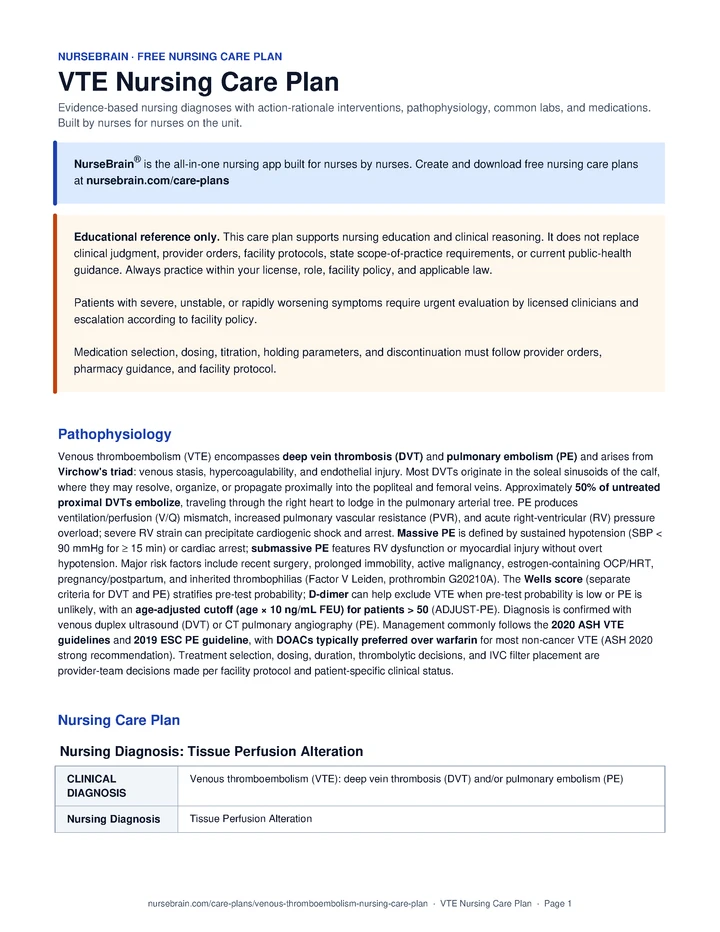
Venous Thromboembolism (DVT and PE) Nursing Care Plan
Venous thromboembolism (DVT and PE) nursing care plan: prioritized diagnoses, anticoagulation, breathing-pattern monitoring, and a printable PDF.
Nursing Care Plan
Nursing Diagnosis 1: Ineffective Tissue Perfusion
Tissue Perfusion Alteration related to Venous thromboembolism (VTE): deep vein thrombosis (DVT) and/or pulmonary embolism (PE) as evidenced by Unilateral calf or thigh swelling (> 3 cm circumference difference); Calf pain or tenderness on palpation along the deep venous tract; Warmth and erythema of the affected extremity; Palpable cord along the course of a deep vein; Pitting edema localized to the affected limb.
Interventions
- Measure calf and thigh circumference bilaterally at the same landmark each shift; document and report differences > 3 cm.
- Assess the affected extremity for pain, warmth, erythema, palpable cord, and pitting edema at intervals matched to clinical acuity and facility protocol.
- Check distal pulses, capillary refill, sensation, and motor function in the affected limb at intervals matched to clinical acuity.
- Document the Homan sign result if obtained, but do not use it to guide care or to rule in or out DVT.
- Monitor any patient with confirmed DVT for sudden-onset dyspnea, pleuritic chest pain, tachycardia, or hypoxia.
- Review serial coagulation studies (aPTT, anti-Xa, INR, platelets) per provider order and report values outside the ordered range.
- Administer the ordered anticoagulant (UFH gtt, LMWH, or DOAC) on schedule per provider order, pharmacy guidance, and facility protocol; verify dose against weight and renal function before each dose.
- Elevate the affected extremity above heart level when in bed per provider order; avoid placing pillows behind the knee.
- Apply graduated compression stockings (GCS) to the unaffected leg per provider order; coordinate with the provider team before applying to an acutely thrombosed limb.
- Support early ambulation once therapeutic anticoagulation is achieved per provider order and facility protocol.
- Maintain at least one patent IV in the unaffected upper extremity per facility protocol.
- Educate the patient on taking the ordered anticoagulant exactly as prescribed for the full ordered duration.
- Teach the patient to call 911 for signs of clot propagation or PE: increased calf swelling, sudden dyspnea, chest pain, hemoptysis, or syncope.
- Educate on long-term VTE risk reduction: walk every 1–2 h on prolonged travel, hydrate, and discuss estrogen-containing contraceptives with the provider after recurrent VTE.
- Notify the provider immediately for findings consistent with phlegmasia cerulea dolens (massive swelling, cyanotic limb, diminished pulses).
- Coordinate hematology consultation per provider order for unprovoked or recurrent VTE thrombophilia workup.
Outcome: Calf pain and tenderness are monitored and reported within ordered parameters during admission; Extremity circumference is measured and trended; changes are reported to the provider team; Skin warmth, color, and capillary refill of the affected limb are monitored and reported.
Nursing Diagnosis 2: Impaired Gas Exchange
Gas Exchange Impairment related to Venous thromboembolism (VTE): deep vein thrombosis (DVT) and/or pulmonary embolism (PE) as evidenced by Sudden-onset dyspnea or tachypnea (RR > 20); Pleuritic chest pain worse on inspiration; SpO2 < 92% on room air; Tachycardia (HR > 100) disproportionate to clinical state; ABG: widened A-a gradient with hypoxemia and respiratory alkalosis.
Interventions
- Monitor SpO2 continuously and respiratory rate, depth, and effort at intervals matched to clinical acuity and facility protocol.
- Auscultate lung fields at intervals matched to clinical acuity; document pleural friction rub, wheezing, or diminished sounds.
- Monitor cardiac rhythm continuously for new RV-strain patterns: S1Q3T3, new RBBB, T-wave inversion V1–V4, or sinus tachycardia.
- Trend troponin and BNP/NT-proBNP per provider order and report values outside the ordered range.
- Monitor for findings consistent with RV failure: rising CVP/JVD, hypotension, syncope, mottled extremities, decreased UOP.
- Reassess pain using a 0–10 scale; differentiate pleuritic pain from new ischemic chest pain.
- Administer supplemental oxygen as ordered and titrate within provider parameters to maintain SpO2 within the ordered range.
- Position the patient in high-Fowler’s or semi-Fowler’s with HOB at 30–45° as tolerated and per provider order.
- Administer ordered anticoagulation promptly after PE confirmation per provider order, pharmacy guidance, and facility protocol.
- Anticipate and prepare for ordered thrombolytic therapy (alteplase) per facility protocol for hemodynamically unstable PE: confirm two large-bore IVs, crash cart at bedside, and reversal agents available.
- Maintain bed rest per provider order until hemodynamically stable and therapeutic anticoagulation is achieved; progress activity per facility protocol.
- Administer ordered analgesia for pleuritic pain; coach splinting with a pillow during cough.
- Teach pursed-lip and diaphragmatic breathing the patient can use independently during dyspnea.
- Educate the patient and family on findings that warrant 911: sudden dyspnea, chest pain, syncope, hemoptysis.
- Reinforce completion of the full ordered anticoagulation course (commonly a minimum of 3 months, often longer per provider direction).
- Notify the provider and activate rapid response per facility protocol for SBP < 90 mmHg sustained > 15 min, severe hypoxia despite supplemental oxygen, or cardiac arrest.
- Coordinate ICU transfer per provider order for patients with RV dysfunction on echo or biomarker elevation (submassive PE).
Outcome: Patient maintains SpO2 within ordered parameters with the lowest ordered O2 support; Respiratory rate stays within ordered parameters with relaxed work of breathing; Pleuritic chest pain is monitored and reported, with comfort interventions supported as ordered.
Nursing Diagnosis 3: Acute Pain
Acute Pain related to Venous thromboembolism (VTE): deep vein thrombosis (DVT) and/or pulmonary embolism (PE) as evidenced by Patient-reported calf pain rated 6–8/10 (DVT); Pleuritic chest pain worse on inspiration (PE); Pain on palpation along the deep venous tract; Guarding or splinting behavior; Tachycardia and elevated BP consistent with pain response.
Interventions
- Assess pain location, quality, intensity (0–10), radiation, and aggravating or relieving factors at intervals matched to clinical acuity and PRN.
- Differentiate musculoskeletal calf pain from DVT pain: DVT pain is commonly deep, constant, worse with dorsiflexion or palpation, and associated with swelling.
- Differentiate pleuritic PE pain from cardiac chest pain: PE pain is commonly sharp, worse on inspiration, and often lateral; cardiac pain is commonly pressure-like, central, and may radiate.
- Monitor vital signs before and after analgesic administration.
- Observe for nonverbal pain indicators (grimacing, splinting, guarding), particularly in patients who minimize pain.
- Administer ordered analgesia on schedule per provider order, pharmacy guidance, and facility protocol; discuss with the provider before NSAID administration in patients on anticoagulation.
- Administer acetaminophen as ordered for mild-to-moderate pain per provider direction and facility protocol.
- Apply warm compress to the affected calf per provider order; coordinate with the provider team before applying heat over an acutely thrombosed limb.
- Position the patient for comfort with the affected limb elevated (DVT) or in semi-Fowler’s (PE) per provider order.
- Coach splinting with a pillow over the chest during coughing or deep breathing in PE.
- Teach the patient to report pain promptly rather than waiting until severe.
- Educate on non-pharmacologic strategies: relaxation, distraction, guided imagery, repositioning.
- Reinforce that increasing pain, new pain locations, or pain with sudden dyspnea should be reported immediately.
- Notify the provider for inadequate pain control despite scheduled analgesia, new pain characteristics, or findings consistent with bleeding.
- Coordinate with pain service per provider order for refractory pain or chronic pain on baseline opioids.
Outcome: Patient reports pain within ordered comfort goal after ordered analgesia; Patient demonstrates relaxed posture and breathing pattern; HR and BP are monitored and reported within ordered parameters after analgesia.
Nursing Diagnosis 4: Risk For Haemorrhaging
Bleeding Risk related to Venous thromboembolism (VTE): deep vein thrombosis (DVT) and/or pulmonary embolism (PE) as evidenced by Current therapeutic anticoagulation (UFH, LMWH, DOAC, or warfarin); Supratherapeutic aPTT, anti-Xa, or INR values; Concurrent antiplatelet therapy (aspirin, clopidogrel); Age > 75 years; History of GI bleed, peptic ulcer disease, or recent surgery.
Interventions
- Assess all body systems for bleeding each shift: gums, nose, urine, stool, sputum, IV and injection sites, and skin (petechiae, ecchymoses).
- Monitor vital signs at intervals matched to clinical acuity for tachycardia, hypotension, or new mental-status changes.
- Trend hemoglobin, hematocrit, platelets, aPTT, anti-Xa, INR, and creatinine per provider order.
- Monitor platelet count per provider order during heparin therapy (commonly every 2–3 days); report a > 50% drop or an absolute value < 100 × 103/µL.
- When HIT is suspected, support 4Ts pre-test probability scoring (Thrombocytopenia, Timing of platelet fall, Thrombosis, oTher causes; 0–8 points) before the provider team orders PF4-heparin ELISA.
- Test stool for occult blood and urine for hematuria per provider order.
- Assess for headache, vision changes, focal weakness, or sudden severe back or flank pain.
- Implement bleeding precautions per facility protocol: electric razor, soft toothbrush, no rectal temperatures or suppositories, minimize venipunctures.
- Hold pressure to all venipuncture sites for at least 5 minutes (10 minutes for arterial) per facility protocol.
- Coordinate availability of reversal agents per facility protocol: vitamin K and PCC for warfarin; protamine for UFH/LMWH; andexanet alfa for apixaban/rivaroxaban; idarucizumab for dabigatran. Administer as ordered for life-threatening bleeding.
- Coordinate fall prevention per facility protocol: bed alarm, call light within reach, non-slip footwear, assist with ambulation.
- Coordinate with the provider team to limit IM injections; when essential, use the smallest needle and apply pressure post-injection per facility protocol.
- Verify the ordered anticoagulant dose against the most recent weight, renal function, and coagulation studies before each dose per facility protocol.
- Educate the patient on bleeding findings that warrant 911: severe headache, vision changes, weakness, melena, hematemesis, hematuria, prolonged nosebleeds, or large bruises.
- Teach the patient about food and drug interactions specific to their anticoagulant (warfarin and vitamin K, DOAC and P-gp inhibitors) per provider direction.
- Reinforce wearing a medical alert bracelet or carrying an anticoagulation card.
- Teach the patient to inform all healthcare providers (including dentists) before any procedure.
- Notify the provider for findings consistent with major bleeding, a drop in H/H > 2 g/dL, supratherapeutic labs, or HIT-suspicious platelet trends.
- Coordinate pharmacy review of all medications for interactions with the ordered anticoagulant per facility protocol.
Outcome: Body systems are monitored for bleeding each shift and findings are documented and reported; Coagulation findings are documented and values outside the ordered range are reported promptly; Hemoglobin and hematocrit trend is monitored and reported per facility protocol.
Nursing Diagnosis 5: Anxiety
Anxiety related to Venous thromboembolism (VTE): deep vein thrombosis (DVT) and/or pulmonary embolism (PE) as evidenced by Patient verbalization of fear of dying or recurrent PE; Sudden, unexpected onset of dyspnea and chest pain; Restlessness or hypervigilance toward monitors; Tachycardia disproportionate to clinical state; Sleep disturbance and difficulty resting.
Interventions
- Assess anxiety level using a 0–10 scale at the start of each shift and PRN.
- Identify the patient’s stated fears (fear of death, recurrence, lifelong medication, bleeding).
- Observe for physical findings disproportionate to clinical state: persistent tachycardia, restlessness, hand-wringing, hypervigilance.
- Provide a calm, reassuring presence; speak clearly and at a measured pace.
- Explain procedures, labs, and findings in plain, patient-friendly terms before performing them.
- Limit non-essential stimuli at night and cluster cares to allow uninterrupted rest periods of ≥ 30 minutes per facility protocol.
- Teach diaphragmatic breathing and grounding techniques the patient can use independently.
- Educate the patient and family about the diagnosis, prognosis with treatment, and the rationale for the ordered length of anticoagulation.
- Provide written discharge instructions covering medication, warning signs, follow-up, and dietary considerations.
- Coordinate with chaplaincy, social work, or psychology when anxiety persists or PTSD findings emerge.
- Notify the provider for severe or persistent anxiety unresponsive to non-pharmacologic measures.
Outcome: Patient verbalizes decreased anxiety; Patient demonstrates use of at least one coping strategy; HR is consistent with clinical state and ordered parameters.
Nursing Diagnosis 6: Lack Of Knowledge
Knowledge Deficit related to Venous thromboembolism (VTE): deep vein thrombosis (DVT) and/or pulmonary embolism (PE) as evidenced by New diagnosis of VTE (DVT, PE, or both); Patient questions or misconceptions about anticoagulation, prognosis, or recurrence risk; Limited understanding of warning signs that warrant 911; Limited understanding of medication adherence, food and drug interactions, or follow-up labs; Health literacy or language barriers.
Interventions
- Assess baseline understanding of VTE, anticoagulation, warning signs, and the ordered follow-up plan at admission and PRN.
- Identify language preferences and health-literacy needs; coordinate interpreter services per facility protocol when needed.
- Identify caregivers or family members involved in care and confirm consent for inclusion in teaching per facility protocol.
- Provide structured teaching about the diagnosis, the ordered medication, expected duration of therapy, and follow-up labs per facility protocol.
- Demonstrate any self-administered medication technique (e.g., LMWH SC injection) and observe a return demonstration before discharge per facility protocol.
- Provide written or visual discharge materials in the patient’s preferred language per facility protocol.
- Teach warning signs that warrant 911: sudden dyspnea, chest pain, syncope, hemoptysis, severe headache, vision changes, weakness, melena, hematemesis.
- Teach food and drug interactions specific to the ordered anticoagulant: warfarin and vitamin K; DOAC and P-gp inhibitors; alcohol limits per provider direction.
- Reinforce the ordered duration of therapy (commonly a minimum of 3 months, often longer per provider direction) and the rationale for not stopping early.
- Teach mobility on prolonged travel (walk every 1–2 h), hydration, and contraception discussions with the provider after recurrent VTE.
- Use teach-back to confirm comprehension of medication name, dose, schedule, warning signs, and follow-up plan before discharge.
- Coordinate referrals (anticoagulation clinic, primary care follow-up, hematology if unprovoked or recurrent VTE) per provider order and facility protocol.
- Notify the provider when teaching reveals significant misconceptions, unaddressed barriers, or risk-factor concerns that may affect adherence.
Outcome: Patient verbalizes the diagnosis, the ordered treatment plan, and the ordered duration of anticoagulation; Patient identifies warning signs that warrant 911 and follow-up triggers; Patient demonstrates correct technique for any self-administered medication (e.g., LMWH SC injection) per facility protocol.
Pathophysiology
Venous thromboembolism (VTE) encompasses deep vein thrombosis (DVT) and pulmonary embolism (PE) and arises from Virchow’s triad: venous stasis, hypercoagulability, and endothelial injury. Most DVTs originate in the soleal sinusoids of the calf, where they may resolve, organize, or propagate proximally into the popliteal and femoral veins. Approximately 50% of untreated proximal DVTs embolize, traveling through the right heart to lodge in the pulmonary arterial tree. PE produces ventilation/perfusion (V/Q) mismatch, increased pulmonary vascular resistance (PVR), and acute right-ventricular (RV) pressure overload; severe RV strain can precipitate cardiogenic shock and arrest.
Massive PE is defined by sustained hypotension (SBP < 90 mmHg for ≥ 15 min) or cardiac arrest; submassive PE features RV dysfunction or myocardial injury without overt hypotension. Major risk factors include recent surgery, prolonged immobility, active malignancy, estrogen-containing OCP/HRT, pregnancy/postpartum, and inherited thrombophilias (Factor V Leiden, prothrombin G20210A). The Wells score (separate criteria for DVT and PE) stratifies pre-test probability; D-dimer can help exclude VTE when pre-test probability is low or PE is unlikely, with an age-adjusted cutoff (age × 10 ng/mL FEU) for patients > 50 (ADJUST-PE).
Diagnosis is confirmed with venous duplex ultrasound (DVT) or CT pulmonary angiography (PE). Management commonly follows the 2020 ASH VTE guidelines and 2019 ESC PE guideline, with DOACs typically preferred over warfarin for most non-cancer VTE (ASH 2020 strong recommendation). Treatment selection, dosing, duration, thrombolytic decisions, and IVC filter placement are provider-team decisions made per facility protocol and patient-specific clinical status.
Quick Reference
- Wells score (PE): Dichotomized: ≤ 4 PE unlikely · > 4 PE likely (per ESC 2019)
- D-dimer cutoff: < 500 ng/mL FEU (age ≤ 50); age × 10 if > 50 (ADJUST-PE)
- aPTT on UFH: 1.5–2.5× control (~60–100 sec)
- INR on warfarin: 2.0–3.0 for VTE treatment
- DVT prophylaxis: Commonly SC heparin 5000 U q8–12h or LMWH per facility protocol
Common Labs
| Lab | Normal range | Significance in VTE |
|---|---|---|
| D-dimer | < 500 ng/mL FEU (or age × 10 if > 50) | Sensitive, not specific; can help exclude VTE in low or unlikely pre-test probability. Age-adjusted cutoff per ADJUST-PE (Righini 2014) for patients > 50. Interpretation is a provider-team decision per facility protocol. |
| PT / INR | PT 11–13 sec / INR 0.8–1.2 | Therapeutic INR 2.0–3.0 on warfarin. Baseline values are commonly drawn before therapy per provider order; nurses trend serial values and report findings outside the ordered range. |
| aPTT | 25–35 sec baseline | Target 1.5–2.5× control (~60–100 sec) on UFH gtt; titration follows the facility nomogram and provider order. Nurses draw labs on schedule, report values, and adjust the infusion per the nomogram or escalate to the provider per facility protocol. |
| Anti-Xa | LMWH tx 0.5–1.0 · UFH tx 0.3–0.7 IU/mL | Commonly preferred over aPTT for LMWH/UFH in obesity, renal impairment, pregnancy, or HIT-suspect (per ASH 2018). Assay selection is a provider-team decision per facility protocol. |
| Platelets (CBC) | 150–400 × 103/µL | Monitor for HIT: a > 50% drop on days 5–14 of heparin therapy can suggest HIT and should prompt provider notification. The 4Ts pre-test probability score (Thrombocytopenia, Timing of platelet fall, Thrombosis, oTher causes) supports the workup. |
| Creatinine | 0.6–1.2 mg/dL | Drives DOAC and LMWH renal dosing per provider order. CrCl < 30 may alter apixaban or rivaroxaban dose per facility protocol. |
| Troponin | < 0.04 ng/mL | Can be elevated in submassive PE from RV strain and may inform thrombolysis discussions with the provider team. |
| BNP / NT-proBNP | BNP < 100 pg/mL | Elevation can reflect RV dysfunction in PE; a prognostic marker monitored by nurses and reported to the provider team. |
| ABG (A-a gradient) | PaO2 80–100 mmHg | A widened A-a gradient with hypoxemia is common in PE; respiratory alkalosis from tachypnea is also common. Nurses trend serial values and report findings outside ordered parameters. |
| LFTs | AST/ALT < 40 U/L | Anticoagulant selection in hepatic impairment is a provider-team decision: rivaroxaban use in Child-Pugh B/C with coagulopathy and apixaban use in Child-Pugh C are commonly avoided per current labeling; warfarin commonly requires closer INR monitoring per facility protocol. |
Common Medications
| Class | Examples | Mechanism of action | Key side effects | Nursing considerations |
|---|---|---|---|---|
| Unfractionated heparin (UFH) | IV gtt: commonly 80 U/kg bolus (max 10,000 U) + 18 U/kg/hr (max 2,300 U/hr) per facility protocol | Potentiates antithrombin III → inactivates thrombin (IIa) and Xa | Bleeding, HIT (1–3%), osteoporosis (long-term), hyperkalemia | Administer as ordered per provider direction, pharmacy guidance, and facility protocol. Nurses draw aPTT or anti-Xa per the ordered schedule (commonly q6h until therapeutic, then daily), trend platelets q2–3d for HIT, and report values outside the ordered range. Protamine is the commonly used reversal agent and is administered as ordered for bleeding emergencies. |
| LMWH (enoxaparin) | Commonly 1 mg/kg SC BID or 1.5 mg/kg SC daily per provider order | Selective anti-Xa activity via antithrombin III; longer half-life than UFH | Bleeding, HIT (lower than UFH), injection-site bruising | Administer as ordered. Renal dosing may be reduced (e.g., 1 mg/kg daily if CrCl < 30) per provider order and facility protocol. Anti-Xa monitoring is used in selected populations per provider direction. Nurses rotate SC sites and document the site used. |
| DOAC – apixaban | Commonly 10 mg PO BID × 7 days, then 5 mg BID per provider order | Direct factor Xa inhibitor; bridging is commonly not needed | Bleeding (lower ICH risk vs warfarin in trial data), GI upset | Administer as ordered. Holding for procedures (commonly ≥ 24 h pre-low-risk, 48 h high-risk) is directed by the provider team per facility protocol. Andexanet alfa is the commonly available reversal agent and is administered as ordered. Per ASH 2020, DOACs are typically preferred over warfarin as first-line for most non-cancer VTE. |
| DOAC – rivaroxaban | Commonly 15 mg PO BID × 21 days, then 20 mg daily per provider order | Direct factor Xa inhibitor; once-daily after the loading phase | Bleeding, hepatotoxicity; commonly taken with food (15/20 mg doses) | Administer as ordered. Coordinate administration with the largest meal for absorption per facility protocol. Use in CrCl < 30 is a provider-team decision. Dabigatran and edoxaban regimens commonly require a 5–10 d parenteral lead-in per provider order. |
| Warfarin | Commonly 5 mg PO daily; titrated to INR 2.0–3.0 per provider order | Vitamin K antagonist; depletes factors II, VII, IX, X and proteins C, S | Bleeding, skin necrosis (early), teratogenic, many drug and food interactions | Administer as ordered. Parenteral overlap is commonly continued ≥ 5 days AND until INR > 2 for 24 h per facility protocol. Vitamin K (commonly 10 mg slow IV) and PCC are the commonly available reversal options for major bleeding and are administered as ordered. |
| Thrombolytics (alteplase) | Commonly 100 mg IV over 2 h for hemodynamically unstable PE per facility protocol | Converts plasminogen → plasmin → fibrinolysis | Major bleeding (ICH ~2–3%), reperfusion arrhythmias | Administer as ordered per provider direction and facility protocol. The decision to use systemic thrombolysis (vs catheter-directed thrombolysis or surgical embolectomy) is a provider-team decision based on hemodynamics, bleeding risk, and institutional criteria. Absolute and relative contraindications (recent stroke, active bleed, recent surgery) are weighed by the prescriber. |
| IVC filter | Retrievable device per provider order | Mechanically traps emboli traveling from lower extremities to pulmonary circulation | Filter thrombosis, migration, IVC perforation, late DVT recurrence | Placement is a provider-team decision per facility protocol, commonly considered when anticoagulation is contraindicated or has failed. Retrieval timing is also a provider-team decision (commonly as soon as anticoagulation resumes). Nurses prepare the patient, monitor the access site, and document findings. |
| Mechanical prophylaxis | SCDs, graduated compression stockings (GCS) per provider order | External compression promotes venous return; reduces stasis | Skin breakdown, arterial compromise if PAD | Implement per provider order and facility protocol. Commonly applied continuously when in bed; nurses assess skin and pulses each shift. Use over an acutely thrombosed limb is a provider-team decision per facility protocol. |
References
- Makic, M. B. F., & Martinez-Kratz, M. R. (Eds.). (2023). Ackley and Ladwig’s Nursing Diagnosis Handbook: An Evidence-Based Guide to Planning Care (13th ed.). Elsevier.
- Ortel, T. L., Neumann, I., Ageno, W., et al. (2020). American Society of Hematology 2020 guidelines for management of venous thromboembolism: treatment of deep vein thrombosis and pulmonary embolism. Blood Advances, 4(19), 4693–4738.
- Konstantinides, S. V., Meyer, G., Becattini, C., et al. (2020). 2019 ESC Guidelines for the diagnosis and management of acute pulmonary embolism developed in collaboration with the European Respiratory Society (ERS). European Heart Journal, 41(4), 543–603.
- Righini, M., Van Es, J., Den Exter, P. L., et al. (2014). Age-adjusted D-dimer cutoff levels to rule out pulmonary embolism: the ADJUST-PE study. JAMA, 311(11), 1117–1124.
- Cuker, A., Arepally, G. M., Chong, B. H., et al. (2018). American Society of Hematology 2018 guidelines for management of venous thromboembolism: heparin-induced thrombocytopenia. Blood Advances, 2(22), 3360–3392.
Frequently Asked Questions
What is the nursing care plan for VTE?
A VTE nursing care plan organizes the assessment, nursing diagnoses, goals, interventions, and evaluation criteria for a patient with Venous Thromboembolism (DVT and PE). Diagnoses are ordered by what is currently most destabilizing for the patient.
What are the priority nursing diagnoses for VTE?
Priority diagnoses for VTE appear in the Nursing Diagnoses section above, ordered by clinical acuity. The top diagnosis should reflect what is currently most destabilizing for this specific patient.
What is the priority nursing intervention for VTE?
Priority interventions for VTE are listed in the care plan above, organized by diagnosis. The most critical actions address airway, circulation, and the highest-acuity problem first.
What complications should the nurse monitor for in VTE?
Complications to monitor for in VTE are listed within each diagnosis section above. Trend vitals, mental status, and the condition-specific red flags described in the assessment section.
A report sheet built for this patient
This is exactly the kind of patient the report sheet templates in NurseBrain® Synapse are built for. Keep everything you track on one page, all shift.
Learn how NurseBrain Synapse uses the Clinical Care Classification System for nursing care plans.