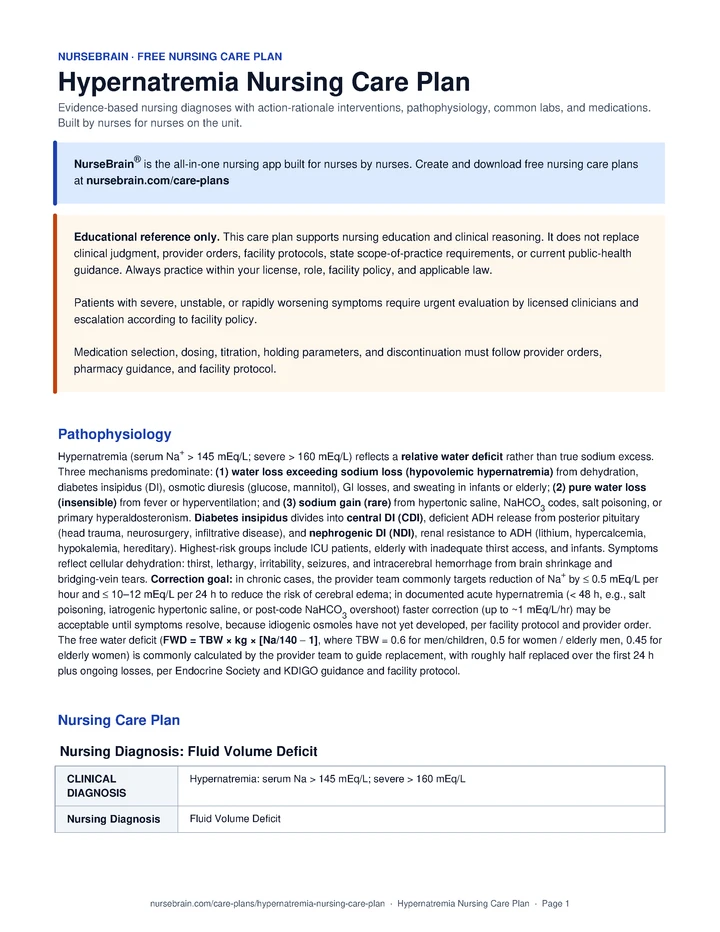
Hypernatremia Nursing Care Plan
Hypernatremia nursing care plan: fluid resuscitation, electrolyte monitoring, and a printable PDF. Built by nurses for nurses.
Nursing Care Plan
Nursing Diagnosis 1: Hypovolaemia
Fluid Volume Deficit related to Hypernatremia: serum Na > 145 mEq/L; severe > 160 mEq/L as evidenced by Serum Na+ > 145 mEq/L (severe > 160); Urine output < 0.5 mL/kg/hr; Dry mucous membranes, decreased skin turgor; Hypotension (SBP < 90) or orthostatic drop; Tachycardia and weak peripheral pulses.
Interventions
- Monitor serum Na+ at the interval ordered (commonly q4–6h during active correction) and document the trend.
- Document the free water deficit calculation when ordered (FWD = TBW × kg × [Na/140 − 1]; TBW = 0.6 men/children, 0.5 women / elderly men, 0.45 elderly women) per facility protocol.
- Monitor strict intake and output hourly; report UOP < 0.5 mL/kg/hr for 2 consecutive hours.
- Assess vital signs at intervals matched to clinical acuity and facility protocol; note tachycardia, hypotension, and orthostatic changes.
- Inspect mucous membranes, skin turgor, capillary refill, and axillary moisture each shift.
- Monitor BUN, Cr, glucose, urine osmolality, and urine specific gravity per provider order.
- Obtain daily weights at the same time, on the same scale, in the same garments when clinical state allows.
- Administer ordered NS bolus first for hypovolemic shock (SBP < 90, MAP < 65) before transitioning to hypotonic fluid, per provider order and facility protocol.
- Administer ordered hypotonic fluid (0.45% NaCl or D5W) at the rate ordered to support correction within the ordered trajectory (commonly ≤ 10–12 mEq/L/24h in chronic cases).
- Offer free water by mouth when the patient is alert and able to swallow safely; oral or enteral water is commonly preferred over IV when feasible.
- Provide frequent oral care and lip balm; offer ice chips per provider order if PO is restricted.
- Teach the patient and family the importance of consistent fluid intake, especially in elderly or cognitively impaired individuals who may not perceive thirst.
- Educate on daily home weights and reporting losses > 2 lb/day to the provider.
- Teach caregivers in long-term care or home settings to offer fluids on a schedule rather than relying on patient request.
- Notify the provider for Na+ drop > 12 mEq/L in 24 h, UOP < 0.5 mL/kg/hr for 2 consecutive hours, or SBP < 90 mmHg.
- Coordinate nephrology and/or endocrinology consultation per provider order for refractory hypernatremia or suspected DI.
Outcome: Serum Na+ trend is monitored and reported within ordered parameters (commonly ≤ 10–12 mEq/L/24h in chronic cases); Urine output is monitored and reported within ordered parameters; Mucous membranes and skin turgor are assessed and changes reported.
Nursing Diagnosis 2: Impaired Communication
Injury Risk related to Hypernatremia: serum Na > 145 mEq/L; severe > 160 mEq/L as evidenced by Altered mental status from cellular dehydration; Serum Na+ > 160 mEq/L (severe range); History of seizures or new seizure activity; Generalized weakness and unsteady gait; Risk of intracerebral hemorrhage from brain shrinkage.
Interventions
- Perform neurologic checks (LOC, orientation, pupils, motor strength) at intervals matched to clinical acuity (commonly every 2 hours during active correction) per facility protocol.
- Use a validated fall-risk tool (Morse, Hendrich II) on admission and per facility protocol.
- Monitor for prodromal seizure signs: focal twitching, aura, sudden behavioral change.
- Assess for headache, vomiting, lethargy, or new confusion during correction.
- Keep bed in lowest position, side rails up per facility protocol, call light within reach, and bed alarm activated.
- Implement seizure precautions per facility protocol: padded side rails, oral suction at bedside, oxygen at bedside, no oral temperature.
- Assist with transfers and ambulation while neurologic and hemodynamic status is unstable.
- Cluster nursing care and reduce stimuli (lights, noise) when cerebral irritability is suspected.
- Reorient the patient frequently and provide a quiet, well-lit environment with familiar items.
- Instruct the patient and family on call-light use and to request assistance rather than ambulate alone.
- Educate the family on seizure first aid: protect the head, do not restrain, time the event, turn to the side post-ictally.
- Teach the patient and family to report any new headache, vision change, vomiting, or sudden weakness immediately.
- Notify the provider promptly for new seizure activity, focal neurologic change, or rapid LOC deterioration.
- Coordinate neurology consultation per provider order for new-onset seizures or unexplained neurologic decline.
- Confirm rescue benzodiazepine (lorazepam, midazolam) is available per facility protocol; administer as ordered if seizure occurs.
Outcome: Patient remains free from falls during admission; Seizure activity is monitored and controlled with ordered interventions when it occurs; Neurologic exam is monitored; new focal deficits are reported promptly.
Nursing Diagnosis 3: Altered Perception
Confusion related to Hypernatremia: serum Na > 145 mEq/L; severe > 160 mEq/L as evidenced by Cellular dehydration of central nervous system; Serum Na+ > 150 mEq/L; Disorientation to time, place, or person; Lethargy alternating with irritability; New inability to follow commands.
Interventions
- Assess orientation, attention, and recall at intervals matched to clinical acuity (commonly every 2–4 hours); document baseline from family.
- Use a validated delirium screen (CAM, CAM-ICU) per facility protocol each shift.
- Identify and document reversible contributors: pain, infection, medications, sleep loss, sensory deprivation.
- Trend serum Na+, glucose, and renal function per provider order.
- Reorient frequently: clock, calendar, name, location, reason for admission.
- Maintain hearing aids, glasses, and dentures in place when the patient is awake.
- Provide a quiet, well-lit room during the day and a dim, low-stimulus environment at night.
- Minimize unnecessary restraints, lines, and tethers per facility protocol.
- Encourage family presence at the bedside per facility policy.
- Promote mobility as ordered and as tolerated; sit up for meals, ambulate with assistance.
- Educate the family that acute confusion is commonly reversible with correction of the underlying cause.
- Coach the family on simple reorientation techniques and on how to avoid arguing with delusions.
- Teach the patient (when able) and family the importance of fluid intake and follow-up to support recurrence prevention.
- Notify the provider for any new focal neurologic change, sudden worsening of confusion, or refusal of fluids or food.
- Coordinate with pharmacy and the provider team to review the medication list for deliriogenic agents (anticholinergics, benzodiazepines, opioids).
Outcome: Patient returns to baseline level of orientation as clinical state allows; Patient follows simple commands appropriately; Behavior is monitored; agitation is addressed with ordered interventions.
Nursing Diagnosis 4: Non Adherence
Knowledge Deficit related to Hypernatremia: serum Na > 145 mEq/L; severe > 160 mEq/L as evidenced by New diagnosis of diabetes insipidus or chronic hypernatremia; Patient or caregiver verbalizes lack of understanding; Inability to describe symptoms requiring provider notification; Lack of understanding of fluid-intake requirements; Limited prior exposure to DDAVP or related medications.
Interventions
- Assess current knowledge of hypernatremia, DI, and the prescribed treatment plan.
- Identify learning preferences (verbal, written, video, demonstration) and language needs.
- Assess for barriers: cognitive impairment, low literacy, financial constraints, caregiver availability.
- Use teach-back to confirm comprehension after each major teaching point.
- Provide written education materials at an appropriate reading level (commonly 5th–6th grade target).
- Demonstrate the ordered DDAVP administration technique (intranasal or SQ) when prescribed; have the patient or caregiver return-demonstrate.
- Coach the patient on tracking daily weights, urine output (or void frequency), and fluid intake.
- Coordinate with the dietitian when a low-sodium diet is ordered.
- Explain the difference between central and nephrogenic DI in plain language when relevant.
- Teach symptoms requiring same-day provider contact: increasing thirst, low urine output, weight loss > 2 lb/day, confusion, headache.
- Educate caregivers of dependent elderly or cognitively impaired patients on scheduled hydration.
- Review medication purpose, dose, frequency, common side effects, and what to do if a dose is missed.
- Provide a written discharge summary including target Na+ range, fluid plan, and follow-up appointments per facility protocol.
- Coordinate referral to home health per provider order for medication setup, weight monitoring, and reinforcement in high-risk patients.
- Coordinate endocrinology follow-up per provider order within 1–2 weeks for newly diagnosed DI.
- Coordinate psychiatry review per provider order for lithium therapy in lithium-induced nephrogenic DI; balance bipolar control against renal injury.
Outcome: Patient or caregiver verbalizes condition, triggers, and treatment plan; Patient or caregiver describes the ordered DDAVP administration technique when applicable; Patient or caregiver demonstrates daily weight and intake tracking.
Nursing Diagnosis 5: Electrolyte Imbalance
Electrolyte Imbalance related to Hypernatremia: serum Na > 145 mEq/L; severe > 160 mEq/L as evidenced by Active correction of chronic hypernatremia with hypotonic fluids; Risk of cerebral edema if Na+ drops > 12 mEq/L in 24 h; Concomitant DDAVP therapy; Coexisting heart failure or chronic kidney disease; Variable insensible and renal losses (fever, DI).
Interventions
- Recheck serum Na+ at the interval ordered (commonly every 4–6 hours during active correction).
- Trend hourly correction rate from serial Na+ values; document and report changes.
- Monitor neurologic status (LOC, headache, pupils) at intervals matched to clinical acuity (commonly every 2 hours during correction).
- Track strict I&O hourly; document insensible losses (fever, hyperventilation, ostomy).
- Auscultate breath sounds at intervals matched to clinical acuity; monitor SpO2 continuously in high-risk patients per facility protocol.
- Monitor daily weight trends alongside I&O.
- Administer hypotonic fluid at the rate ordered; coordinate with the provider team for orders to slow or hold if correction exceeds the ordered trajectory (commonly > 10–12 mEq/L/24h).
- Use an infusion pump for all hypotonic fluids per facility protocol.
- When overcorrection is suspected, anticipate orders for D5W to slow correction or hypertonic saline to gently re-raise Na+, per provider order and facility protocol.
- Coordinate DDAVP timing with fluid orders; communicate with the provider team about holding or reducing DDAVP if Na+ is dropping faster than the ordered trajectory.
- Explain the rationale for slow correction to the patient and family in plain language: too-fast correction can contribute to brain cell swelling.
- Teach the patient and family to immediately report new headache, nausea, vomiting, blurred vision, or confusion.
- Educate on the importance of consistent reporting of urine output and intake at home post-discharge.
- Notify the provider for Na+ drop > 12 mEq/L in 24 h or > 0.5 mEq/L per hour sustained.
- Coordinate ICU transfer per provider order for neurologic deterioration during correction.
Outcome: Serum Na+ trend is monitored and reported within ordered parameters (commonly ≤ 10–12 mEq/L per 24 h in chronic cases); Neurologic status is monitored; new headache, vomiting, or LOC change is reported promptly; Net fluid balance is documented within ordered parameters.
Pathophysiology
Hypernatremia (serum Na+ > 145 mEq/L; severe > 160 mEq/L) reflects a relative water deficit rather than true sodium excess. Three mechanisms predominate: (1) water loss exceeding sodium loss (hypovolemic hypernatremia) from dehydration, diabetes insipidus (DI), osmotic diuresis (glucose, mannitol), GI losses, and sweating in infants or elderly; (2) pure water loss (insensible) from fever or hyperventilation; and (3) sodium gain (rare) from hypertonic saline, NaHCO3 codes, salt poisoning, or primary hyperaldosteronism. Diabetes insipidus divides into central DI (CDI), deficient ADH release from posterior pituitary (head trauma, neurosurgery, infiltrative disease), and nephrogenic DI (NDI), renal resistance to ADH (lithium, hypercalcemia, hypokalemia, hereditary).
Highest-risk groups include ICU patients, elderly with inadequate thirst access, and infants. Symptoms reflect cellular dehydration: thirst, lethargy, irritability, seizures, and intracerebral hemorrhage from brain shrinkage and bridging-vein tears. Correction goal: in chronic cases, the provider team commonly targets reduction of Na+ by ≤ 0.5 mEq/L per hour and ≤ 10–12 mEq/L per 24 h to reduce the risk of cerebral edema; in documented acute hypernatremia (< 48 h, e.g., salt poisoning, iatrogenic hypertonic saline, or post-code NaHCO3 overshoot) faster correction (up to ~1 mEq/L/hr) may be acceptable until symptoms resolve, because idiogenic osmoles have not yet developed, per facility protocol and provider order.
The free water deficit (FWD = TBW × kg × [Na/140 − 1], where TBW = 0.6 for men/children, 0.5 for women / elderly men, 0.45 for elderly women) is commonly calculated by the provider team to guide replacement, with roughly half replaced over the first 24 h plus ongoing losses, per Endocrine Society and KDIGO guidance and facility protocol.
Quick Reference
- Severe threshold: Na+ > 160 mEq/L
- Correction rate: ≤ 0.5 mEq/L/hr; ≤ 10–12 mEq/L/24h chronic, per facility protocol
- Acute exception: < 48 h onset: up to ~1 mEq/L/hr per provider order
- FWD formula: TBW × kg × (Na/140 − 1); TBW 0.6 M/peds, 0.5 F / elderly M, 0.45 elderly F
- DI workup: Water deprivation test, specialist-directed
- Replacement: ~½ deficit over first 24h, per provider order
Common Labs
| Lab | Normal range | Significance in Hypernatremia |
|---|---|---|
| Serum Na+ | 135–145 mEq/L | Trended initially and at intervals matched to active correction (commonly q4–6h) per provider order; nurses report the trend to support pacing decisions by the provider team. |
| Serum osmolality | 275–295 mOsm/kg | Elevated in parallel with Na+; supports the hypertonic-state picture. Nurses report values outside reference range to the provider team. |
| Urine osmolality | 300–900 mOsm/kg | Commonly < 300 in DI; high (> 700) in dehydration. Helps the provider team distinguish renal from extrarenal water loss. |
| Urine Na+ | 20–40 mEq/L | Often low in extrarenal water loss; variable in DI. Reported to support provider-team workup. |
| Urine specific gravity | 1.005–1.030 | Commonly < 1.005 in DI; > 1.020 in dehydration. Nurses document and report values that may signal DI. |
| Glucose | 70–110 mg/dL | Hyperglycemia can drive osmotic diuresis and contribute to water loss. Nurses report values outside ordered parameters. |
| BUN / Cr | 7–20 / 0.6–1.2 mg/dL | BUN:Cr > 20:1 can suggest prerenal volume depletion. Nurses trend serial values and report concerning patterns. |
| Lithium level | 0.6–1.2 mEq/L | Therapeutic range; chronic lithium use can contribute to nephrogenic DI. Reported to support provider-team review. |
| Water deprivation test | Specialist-directed | Distinguishes DI from primary polydipsia. Coordinated by endocrinology; nurses prepare the patient and monitor per facility protocol. |
| DDAVP challenge | Specialist-directed | Urine osmolality rising with DDAVP can support central DI; minimal response can support nephrogenic DI. Coordinated by the provider team; nurses monitor and document per facility protocol. |
Common Medications
| Class | Examples | Mechanism of action | Key side effects | Nursing considerations |
|---|---|---|---|---|
| Free water replacement (oral/enteral preferred over IV when feasible) | Tap water PO or enteral water bolus when safe; D5W IV per provider order when NPO or PO/enteral is not feasible | Replaces the pure water deficit and corrects hypertonicity from the inside out. | Cerebral edema if infused faster than the ordered correction limit; relative hyponatremia with overshoot. | Administer as ordered per provider direction and facility protocol. The free water deficit (FWD = TBW × kg × [Na/140 − 1]) is commonly calculated by the provider team to guide the volume and pace of replacement. Oral or enteral water is generally preferred over D5W when the patient can swallow safely or has an enteral access; nurses monitor serial Na+, neurologic status, and I&O and escalate concerns per facility protocol. |
| 0.45% NaCl (½NS) | Half-normal saline | Provides both volume and free water; commonly considered for hypovolemic hypernatremia by the provider team. | Cerebral edema if too rapid; ongoing hypovolemia if too slow. | Administer as ordered per provider direction and facility protocol. Nurses monitor serial Na+ at the interval ordered, neurologic status, MAP, and urine output, and escalate deviations from the ordered correction trajectory. |
| 0.9% NaCl (NS) bolus | Normal saline | Commonly used by the provider team to restore intravascular volume in hypovolemic shock before free-water replacement is prioritized. | Volume overload; can transiently slow Na+ correction. | Administer as ordered per provider direction and facility protocol. Nurses monitor MAP, urine output, lung exam, and perfusion indicators after each ordered bolus, and coordinate with the provider team on the transition to hypotonic fluid. |
| DDAVP (desmopressin) | Intranasal, SQ, or IV | Synthetic ADH analog; supports renal water reabsorption in central DI when ordered. | Relative hyponatremia from overcorrection, headache, nausea. | Administer as ordered per provider direction and facility protocol for central DI. Nurses monitor daily weights, strict I&O, and serial Na+, and reinforce ordered fluid-intake adjustments with the patient and family. |
| Hydrochlorothiazide | Thiazide diuretic | Paradoxical antidiuretic effect in nephrogenic DI (volume contraction can increase proximal reabsorption). | Hypokalemia, hypotension, hypercalcemia. | Administer as ordered per provider direction and facility protocol for nephrogenic DI. Nurses monitor K+, BP, and Ca2+; coordinate with the dietitian on the ordered low-sodium diet; reinforce thirst-driven hydration as ordered. |
| Indomethacin | NSAID (nephrogenic DI adjunct) | Inhibits prostaglandin-mediated antagonism of ADH at the collecting duct. | GI bleed, renal impairment, fluid retention. | Administer as ordered per provider direction and facility protocol when selected by the provider team as an adjunct for nephrogenic DI. Nurses monitor Cr, GI symptoms, and BP, and report concerning patterns. |
| Amiloride | K+-sparing diuretic | Blocks lithium entry into collecting-duct cells; commonly considered by the provider team as a first-line option for lithium-induced nephrogenic DI. | Hyperkalemia, hypotension. | Administer as ordered per provider direction and facility protocol. Nurses monitor K+ and BP per ordered interval; coordinate with psychiatry and nephrology on lithium-vs-NDI decisions through the provider team. |
| Low-sodium diet | ≤ 2 g Na+/day per provider order | Reduces solute load and the associated obligate water excretion in chronic DI. | Relative hyponatremia if combined aggressively with DDAVP. | Implemented per provider order and facility protocol. Nurses coordinate dietitian referral and reinforce label-reading and hidden-sodium teaching. |
References
- Makic, M. B. F., & Martinez-Kratz, M. R. (Eds.). (2023). Ackley and Ladwig’s Nursing Diagnosis Handbook: An Evidence-Based Guide to Planning Care (13th ed.). Elsevier.
- Adrogué, H. J., & Madias, N. E. (2000). Hypernatremia. New England Journal of Medicine, 342(20), 1493–1499.
- Verbalis, J. G., Goldsmith, S. R., Greenberg, A., et al. (2013). Diagnosis, evaluation, and treatment of hyponatremia: expert panel recommendations. The American Journal of Medicine, 126(10 Suppl 1), S1–S42.
Frequently Asked Questions
What is the nursing care plan for Hypernatremia?
A Hypernatremia nursing care plan organizes the assessment, nursing diagnoses, goals, interventions, and evaluation criteria for a patient with Hypernatremia. Diagnoses are ordered by what is currently most destabilizing for the patient.
What are the priority nursing diagnoses for Hypernatremia?
Priority diagnoses for Hypernatremia appear in the Nursing Diagnoses section above, ordered by clinical acuity. The top diagnosis should reflect what is currently most destabilizing for this specific patient.
What is the priority nursing intervention for Hypernatremia?
Priority interventions for Hypernatremia are listed in the care plan above, organized by diagnosis. The most critical actions address airway, circulation, and the highest-acuity problem first.
What complications should the nurse monitor for in Hypernatremia?
Complications to monitor for in Hypernatremia are listed within each diagnosis section above. Trend vitals, mental status, and the condition-specific red flags described in the assessment section.
Learn how NurseBrain Synapse uses the Clinical Care Classification System for nursing care plans.