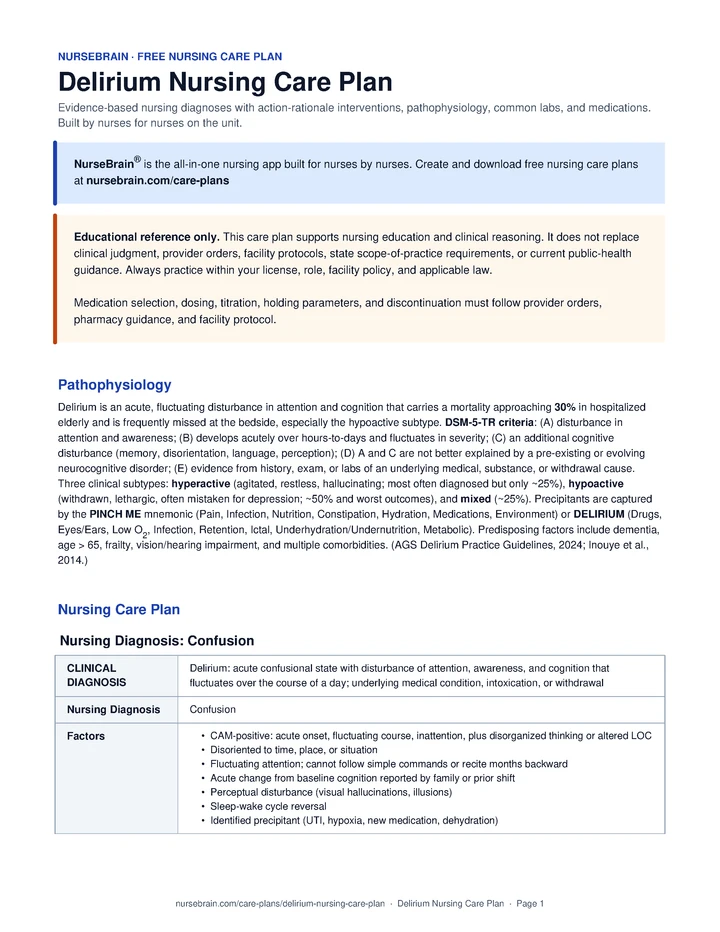
Delirium Nursing Care Plan
Delirium (acute confusional state) nursing care plan: CAM assessment, environment modulation, and a printable PDF.
Nursing Care Plan
Nursing Diagnosis 1: Altered Perception
Confusion related to Delirium: acute confusional state with disturbance of attention, awareness, and cognition that fluctuates over the course of a day; underlying medical condition, intoxication, or withdrawal as evidenced by CAM-positive: acute onset, fluctuating course, inattention, plus disorganized thinking or altered LOC; Disoriented to time, place, or situation; Fluctuating attention; cannot follow simple commands or recite months backward; Acute change from baseline cognition reported by family or prior shift; Perceptual disturbance (visual hallucinations, illusions).
Interventions
- Screen with the Confusion Assessment Method (CAM) every shift and PRN with any acute change, per facility protocol.
- Document a specific behavioral description rather than vague labels (e.g., "pulling at IV, attempting to climb out of bed" instead of "agitated").
- Establish and document the patient’s cognitive baseline from family, prior notes, or chart review.
- Work through the PINCH ME precipitant checklist each shift: Pain, Infection, Nutrition, Constipation, Hydration, Medications, Environment.
- Identify and document the subtype each shift: hyperactive, hypoactive, or mixed.
- Review the medication list against Beers Criteria for deliriogenic agents (anticholinergics, benzodiazepines, opioids, H2 blockers) and surface concerns to the provider team.
- In the ICU, screen with the CAM-ICU (Ely 2001) every shift and pair management with the ABCDEF bundle per facility protocol: Awakening trials, spontaneous Breathing trials, Coordination of analgesia and sedation, Delirium monitoring, Early mobility, and Family engagement.
- In the ventilated ICU patient, coordinate with the provider team to support the lightest effective sedation per facility protocol; per SCCM PADIS 2018, dexmedetomidine or propofol is commonly preferred over benzodiazepines, and paired daily spontaneous awakening trials and spontaneous breathing trials are part of the ABCDEF bundle.
- Reorient at every interaction: state your name, the patient’s name, the location, the date, and why they are here.
- Ensure glasses and hearing aids are on during waking hours.
- Place a visible clock and calendar in the patient’s line of sight; mark the day each morning.
- Encourage early mobility per facility protocol: out of bed to chair for meals, supervised ambulation as tolerated.
- Coordinate with the provider team to support deprescribing of deliriogenic medications identified on Beers review.
- Educate the family that delirium is acute and commonly reversible, that recovery can take days to weeks, and that the behavior is not the patient’s choice.
- Coach the family on simple reorientation phrasing ("You’re in the hospital, today is Tuesday, I’m your daughter") and the value of familiar objects from home.
- Educate the patient during lucid intervals about what is happening and what is being done to address it.
- Notify the provider for any acute change in mental status, new CAM-positive screen, or failure of CAM trend to improve within 72 hours of precipitant treatment.
- Coordinate consultation with geriatrics or psychiatry per facility protocol for persistent, severe, or atypical presentations.
Outcome: CAM trend is monitored and reported as the underlying precipitant is treated; Patient is oriented to person, place, time, and situation when clinical state allows; Patient is able to attend to a 1–2 step command when clinical state allows.
Nursing Diagnosis 2: Impaired Verbal Communication
Fall Risk related to Delirium: acute confusional state with disturbance of attention, awareness, and cognition that fluctuates over the course of a day; underlying medical condition, intoxication, or withdrawal as evidenced by Fluctuating attention and judgment; Attempting to climb out of bed or remove lines, tubes, drains; Wandering or attempting to leave the unit; Visual hallucinations or illusions; Unsteady gait, lower-extremity weakness from immobility.
Interventions
- Complete a fall-risk assessment (e.g., Morse, Hester Davis) on admission and every shift per facility protocol.
- Round on the patient at least hourly and address the 4 Ps: position, pain, potty, possessions per facility protocol.
- Observe for early signs of escalating agitation: restlessness, picking at sheets, calling out, attempting to disconnect lines.
- Keep the bed in the lowest position with side rails used per facility policy, and call light within reach. Per CMS §482.13(e), a restraint is defined by its effect on the patient: any side-rail configuration (commonly four full rails) that restricts the patient’s freedom to exit the bed meets the regulatory definition of a restraint and requires the corresponding documentation, monitoring, and order.
- Place non-skid footwear on the patient any time they are out of bed.
- Coordinate a 1:1 sitter per facility protocol when available for patients at high risk of self-harm, line removal, or elopement.
- Use bed and chair alarms as adjuncts to direct observation per facility protocol.
- Limit restraint use whenever possible per facility protocol; consider restraints a last resort with documented justification, monitoring, and provider order.
- Cluster cares and keep the room well-lit during the day; minimize at-night interruptions.
- Coordinate placement in a room near the nursing station per facility protocol when fall or elopement risk is high.
- Educate the family on the safety plan and on the importance of not assisting the patient out of bed without staff.
- Coach the family to call for staff if the patient attempts to climb out of bed, remove a line, or leave the room.
- Teach the patient during lucid intervals to use the call light before getting up.
- Notify the provider for any new fall, near-fall, line dislodgement, or elopement attempt.
- If chemical or physical restraint is ordered for imminent safety, follow facility protocol with documented justification, monitoring intervals, and provider reassessment.
Outcome: Fall-risk assessment is completed and updated per facility protocol; Lines, catheters, and other devices remain in place when clinical state allows; Patient remains in protected line-of-sight when clinical state and resources support it, per facility protocol.
Nursing Diagnosis 3: Impaired Peripheral Neurovascular Function
Sleep Pattern Disturbance related to Delirium: acute confusional state with disturbance of attention, awareness, and cognition that fluctuates over the course of a day; underlying medical condition, intoxication, or withdrawal as evidenced by Sleep-wake cycle reversal: awake at night, sleeps during the day; Frequent nighttime nursing interruptions for vitals, blood draws, medications; Hospital environmental noise: monitor alarms, hallway conversation, overhead lights; Pain, dyspnea, or urinary urgency triggering nocturnal awakening; Daytime napping reducing nocturnal sleep pressure.
Interventions
- Document the patient’s home sleep routine: bedtime, wake time, nighttime habits, sleep aids.
- Track sleep duration and quality each shift in a sleep log.
- Identify and document specific sleep disruptors (pain, noise, lights, procedures, urinary urgency).
- Cluster nighttime nursing care; coordinate with the provider team to defer non-essential procedures during protected sleep hours (commonly 22:00 to 06:00) per facility protocol.
- Dim overhead lights at night; use bedside task lighting only when needed.
- Minimize alarm volume and hallway noise near the room during nighttime hours per facility protocol.
- Open shades and turn on bright light during the day; encourage out-of-bed activity when clinical state allows.
- Offer warm non-caffeinated drink, back rub, or quiet music as bedtime ritual when appropriate.
- Administer prescribed melatonin or trazodone as ordered per provider direction and facility protocol when non-pharm measures are insufficient.
- Surface concerns about benzodiazepines and diphenhydramine to the provider team when seen on the medication list for sleep.
- Teach the family the rationale for protected sleep hours and ask them to limit nighttime visits.
- Educate the patient and family on the link between sleep deprivation and worsening confusion.
- Coach the patient during lucid intervals on bedtime relaxation techniques: slow breathing, progressive muscle relaxation.
- Notify the provider if sleep remains fragmented despite environmental measures and any ordered adjunct medications.
Outcome: Sleep duration and consolidation are monitored and reported per facility protocol; Patient is awake and engaged during the day when clinical state allows; Patient verbalizes feeling rested when clinical state allows.
Nursing Diagnosis 4: Impaired Urinary System Function
Anxiety related to Delirium: acute confusional state with disturbance of attention, awareness, and cognition that fluctuates over the course of a day; underlying medical condition, intoxication, or withdrawal as evidenced by Family witnessing acute, dramatic cognitive change in a previously independent patient; Fear that delirium represents permanent decline or new dementia; Distress at hallucinations, agitation, or failure-to-recognize-family; Long hours at the bedside leading to physical and emotional fatigue; Anticipated post-discharge supervision demands.
Interventions
- Assess the family’s understanding of delirium and their current emotional state each shift they are present.
- Identify the primary caregiver(s) and their current support system.
- Assess for signs of fatigue, anticipatory grief, or burnout in the family member at the bedside.
- Provide a calm, non-judgmental presence; allow the family to express fear and frustration.
- Update the family at each shift on the patient’s status, what the team is doing, and the expected timeline.
- Invite the family to participate in reorientation and care activities they are comfortable with.
- Encourage the family to bring familiar objects from home: photos, a favorite blanket, eyeglasses, hearing aids.
- Encourage the family to take breaks, eat regular meals, and sleep at home when possible.
- Educate the family on the typical delirium trajectory: acute onset, fluctuation, commonly resolves with treatment of the cause, can take days to weeks.
- Teach the family practical reorientation phrasing and simple de-escalation techniques.
- Educate the family that delirium behavior (anger, accusations, failure to recognize) is the illness, not the patient.
- Provide written materials about delirium, recovery, and signs to watch for after discharge.
- Coordinate referral to chaplaincy, social work, or palliative care per facility protocol for ongoing family support.
- Coordinate post-discharge planning with case management for home support, respite care, or caregiver resources per facility protocol.
Outcome: Family verbalizes understanding that delirium is acute and commonly reversible; Family identifies and uses at least one coping strategy; Family identifies and uses at least one source of support (chaplaincy, social work, family member).
Nursing Diagnosis 5: Risk For Aspiration
Aspiration Risk related to Delirium: acute confusional state with disturbance of attention, awareness, and cognition that fluctuates over the course of a day; underlying medical condition, intoxication, or withdrawal as evidenced by Lethargy and reduced level of consciousness during episodes; Impaired swallow during fluctuations in attention; Drowsiness from sedating medications (antipsychotic, opioid); Vomiting or reflux from underlying illness; Position changes during agitation that can compromise airway.
Interventions
- Assess level of consciousness, swallow, and gag reflex before each PO intake.
- Auscultate breath sounds before and after meals; document any new crackles or wet voice and report to the provider team.
- Monitor SpO2 per facility protocol when sedating medications are administered.
- Observe for clinical aspiration signs during meals: coughing, choking, wet voice, throat clearing, prolonged meal time.
- Maintain head of bed elevation per facility protocol (commonly 30–45° when supine, and 90° during meals and for 30 minutes after when not contraindicated).
- Perform a bedside dysphagia screen (e.g., 3-oz water swallow test) within the RN scope of practice per facility protocol for any patient with altered LOC before initiating PO intake; hold PO and escalate to the provider team if the screen fails.
- Coordinate with the provider team for a formal speech-language pathology (SLP) swallow evaluation when the bedside screen fails, when symptoms persist, or when diet-texture recommendations are needed.
- Provide oral care every 4 hours and after meals per facility protocol.
- If NPO is ordered, provide alternative nutrition (enteral) as ordered per provider direction; do not push PO in a high-risk patient.
- Teach the patient during lucid intervals and family to take small bites, chin-tuck, and rest between bites.
- Educate the family on signs of aspiration to report promptly: cough or choke during meals, new fever, increased congestion, drop in SpO2.
- Teach the family why the patient is on a specific diet texture or thickened liquids and the harm of overriding the plan.
- Notify the provider for any clinical aspiration event: choking, new desaturation, new pulmonary crackles, fever.
- Coordinate chest imaging and antibiotic administration as ordered per provider direction and facility protocol when aspiration pneumonia is suspected.
Outcome: Aspiration precautions are documented and consistently in place per facility protocol; SpO2 is monitored and reported within ordered parameters; Lungs are auscultated and findings reported each shift.
Nursing Diagnosis 6: Risk For Injury
Injury Risk related to Delirium: acute confusional state with disturbance of attention, awareness, and cognition that fluctuates over the course of a day; underlying medical condition, intoxication, or withdrawal as evidenced by Fluctuating attention and judgment; Attempting to remove lines, tubes, or drains; Visual hallucinations or illusions; Polypharmacy with sedating or orthostatic-causing agents; Use of physical or chemical restraint per provider order.
Interventions
- Assess line, tube, and drain integrity each shift and PRN with agitation.
- Assess skin integrity each shift, including under any restraint device, per facility protocol.
- Observe for early signs of escalating agitation: restlessness, picking at sheets, calling out, attempting to disconnect lines.
- Use the least restrictive measures first per facility protocol: reorientation, family presence, sitter, environmental modification, before considering restraints.
- When restraints are ordered, follow facility protocol with documented justification, monitoring intervals (commonly q15 minutes for behavioral, q2 hours for non-behavioral), and provider reassessment per CMS §482.13(e).
- Pad or secure lines and tubes to reduce accidental dislodgement; consider mitten-style soft limb holders per facility protocol when clinically indicated.
- Reposition every 2 hours when in bed and provide skin care per facility protocol; check restrained extremities for color, motion, sensation, and pulses per protocol.
- Coordinate with the provider team when chemical restraint (commonly a low-dose antipsychotic per provider order) is being considered; nurses administer as ordered, monitor for adverse effects, and reassess the need each shift.
- Educate the family about why restraints are being used (when ordered), what monitoring is in place, and the plan to discontinue them at the earliest opportunity.
- Teach the patient during lucid intervals not to pull at lines or tubes and why each device is in place.
- Notify the provider for any line, tube, or drain dislodgement; new skin breakdown; or injury related to agitation or restraint.
- Coordinate with the provider team for the earliest possible discontinuation of restraints per facility protocol.
Outcome: Lines, tubes, and drains are monitored and remain in place when clinical state allows; Skin integrity is monitored and reported per facility protocol; Restraint use, when ordered, is documented and reassessed per facility protocol and CMS requirements.
Pathophysiology
Delirium is an acute, fluctuating disturbance in attention and cognition that carries a mortality approaching 30% in hospitalized elderly and is frequently missed at the bedside, especially the hypoactive subtype. DSM-5-TR criteria: (A) disturbance in attention and awareness; (B) develops acutely over hours-to-days and fluctuates in severity; (C) an additional cognitive disturbance (memory, disorientation, language, perception); (D) A and C are not better explained by a pre-existing or evolving neurocognitive disorder; (E) evidence from history, exam, or labs of an underlying medical, substance, or withdrawal cause.
Three clinical subtypes: hyperactive (agitated, restless, hallucinating; most often diagnosed but only ~25%), hypoactive (withdrawn, lethargic, often mistaken for depression; ~50% and worst outcomes), and mixed (~25%). Precipitants are captured by the PINCH ME mnemonic (Pain, Infection, Nutrition, Constipation, Hydration, Medications, Environment) or DELIRIUM (Drugs, Eyes/Ears, Low O2, Infection, Retention, Ictal, Underhydration/Undernutrition, Metabolic). Predisposing factors include dementia, age > 65, frailty, vision/hearing impairment, and multiple comorbidities. (AGS Delirium Practice Guidelines, 2024; Inouye et al., 2014.)
Quick Reference
- CAM screening: q-shift gold standard
- Subtype mix: Hyperactive 25%, hypoactive 50%, mixed 25%
- DSM-5-TR vs CAM: CAM = clinical, DSM = diagnostic
- Non-pharm first: Reorient, sleep hygiene, mobility
- Antipsychotic: Considered for severe agitation per provider order
Common Labs
| Lab | Normal range | Significance in Delirium |
|---|---|---|
| CBC | WBC 4.5–11 K/µL | ↑ WBC may support infection workup; anemia may contribute to hypoxia-driven cognitive change. Nurses report findings to the provider team. |
| BMP | Na 135–145, glucose 70–110 | Hyponatremia, hyper/hypoglycemia, and rising BUN/Cr (uremia) can contribute to delirium. Trend and report to the provider team. |
| TSH | 0.4–4.0 µIU/mL | Hypothyroidism can mimic hypoactive delirium; commonly drawn on new altered mental status per provider order. |
| Ammonia | < 35 µmol/L | Elevated values can be seen in hepatic encephalopathy (an ESLD precipitant). Provider team interprets in context. |
| B12 / folate | B12 > 200 pg/mL | Deficiency can contribute to reversible cognitive change in elderly patients; replacement decisions are provider-team decisions. |
| UA + culture | Negative | UTI is among the most common precipitants in elderly patients; nurses obtain per provider order and report results. |
| Drug levels | Digoxin 0.8–2.0 ng/mL | Toxicity (digoxin, lithium, anticonvulsants) can present as delirium. Report values outside reference range to the provider team. |
| Tox / BAL | Per agent | Helps the provider team assess intoxication or withdrawal as a primary contributor. |
| Brain CT/MRI | No acute change | Imaging is provider-ordered and supports the team’s assessment for CVA, hemorrhage, or mass when focal deficits or acute change are present. |
| EEG | No epileptiform activity | Detects subtle (non-convulsive) seizure and diffuse encephalopathy when provider-ordered; nurses prepare the patient and coordinate with neurology per facility protocol. |
Common Medications
| Class | Examples | Mechanism of action | Key side effects | Nursing considerations |
|---|---|---|---|---|
| Treat underlying cause | Antibiotics, IV fluids, O2, electrolyte repletion per provider order | Targets the precipitant (PINCH ME). Identifying and treating the cause is the most important part of delirium care. | Specific to agent (e.g., C. difficile for clindamycin; nephrotoxicity for aminoglycosides). | Administer as ordered per provider direction, pharmacy guidance, and facility protocol. Reassess CAM after each precipitant is addressed and document subtype response. |
| Non-pharm first-line | Reorientation, sleep hygiene, mobility, glasses/hearing aids | Reduces sensory deprivation and circadian disruption; supports the cognitive scaffolding that delirium disrupts. | None; first-line nursing measures for every patient regardless of subtype. | Document specific interventions used and patient response each shift per facility protocol. |
| Haloperidol | Per provider order (commonly 0.25–0.5 mg PO/IM/IV PRN severe agitation) | D2 antagonist; can be selected by the provider team when severe agitation threatens patient or staff safety. | QTc prolongation, EPS, NMS, and increased mortality in elderly patients with dementia (FDA black-box for atypicals; comparable concern documented for haloperidol). | Administer as ordered per provider direction and facility protocol. Nurses monitor ECG for QTc > 500 ms, support the lowest effective dose, and reassess the need for ongoing antipsychotic with the provider team. |
| Atypical antipsychotics | Quetiapine or olanzapine per provider order | Less EPS than haloperidol; may be selected when Parkinson’s disease or Lewy body dementia is present. | Black-box: increased mortality in elderly patients with dementia; orthostasis, sedation, metabolic effects. | Administer as ordered. Same QTc and mortality considerations apply; non-pharmacologic measures remain first-line per facility protocol. |
| Melatonin | Per provider order (commonly 3–5 mg PO at bedtime) | Supports circadian rhythm and sleep onset; commonly used as a low-risk adjunct to sleep hygiene. | Mild headache, vivid dreams; minimal interactions. | Administer as ordered. Evidence is limited but harm profile is low; pair with environmental sleep hygiene per facility protocol. |
| Trazodone | Per provider order (commonly 25–50 mg PO at bedtime) | Alternative non-benzodiazepine sleep aid; mild sedation via 5-HT2A blockade. | Orthostasis, priapism (rare), QTc effect at higher doses. | Administer as ordered. Hold per provider parameters (commonly SBP < 90); nurses monitor for next-day sedation in elderly patients. |
| AVOID where possible | Benzodiazepines, anticholinergics, excess opioids | Benzodiazepines can worsen delirium except in alcohol or benzodiazepine withdrawal; anticholinergics are on Beers; opioids require careful titration by the provider team. | Paradoxical agitation, increased falls, increased aspiration, prolonged delirium. | Nurses cross-check the medication list against Beers Criteria and surface concerns to the provider team; deprescribing decisions are made by the prescriber per facility protocol. |
| Dexmedetomidine | Per provider order (ICU continuous infusion) | α2-agonist; provides sedation without GABA pathway suppression. | Bradycardia, hypotension. | Administer as ordered per provider direction and facility protocol. Per SCCM PADIS 2018, dexmedetomidine or propofol is commonly preferred over benzodiazepines for sedation in ventilated ICU patients; titration is provider-directed. |
References
- Makic, M. B. F., & Martinez-Kratz, M. R. (Eds.). (2023). Ackley and Ladwig’s Nursing Diagnosis Handbook: An Evidence-Based Guide to Planning Care (13th ed.). Elsevier.
- American Geriatrics Society. (2024). 2024 Updated AGS Beers Criteria® for Potentially Inappropriate Medication Use in Older Adults. Journal of the American Geriatrics Society.
- Inouye, S. K., Westendorp, R. G. J., & Saczynski, J. S. (2014). Delirium in elderly people. The Lancet, 383(9920), 911–922.
- American Geriatrics Society. (2024). AGS Updated Postoperative Delirium Clinical Practice Guideline.
- Devlin, J. W., Skrobik, Y., Gélinas, C., et al. (2018). Clinical Practice Guidelines for the Prevention and Management of Pain, Agitation/Sedation, Delirium, Immobility, and Sleep Disruption in Adult Patients in the ICU (PADIS). Critical Care Medicine, 46(9), e825–e873.
- Ely, E. W., Inouye, S. K., Bernard, G. R., et al. (2001). Delirium in mechanically ventilated patients: validity and reliability of the Confusion Assessment Method for the Intensive Care Unit (CAM-ICU). JAMA, 286(21), 2703–2710.
Frequently Asked Questions
What is the nursing care plan for Delirium?
A Delirium nursing care plan organizes the assessment, nursing diagnoses, goals, interventions, and evaluation criteria for a patient with Delirium. Diagnoses are ordered by what is currently most destabilizing for the patient.
What are the priority nursing diagnoses for Delirium?
Priority diagnoses for Delirium appear in the Nursing Diagnoses section above, ordered by clinical acuity. The top diagnosis should reflect what is currently most destabilizing for this specific patient.
What is the priority nursing intervention for Delirium?
Priority interventions for Delirium are listed in the care plan above, organized by diagnosis. The most critical actions address airway, circulation, and the highest-acuity problem first.
What complications should the nurse monitor for in Delirium?
Complications to monitor for in Delirium are listed within each diagnosis section above. Trend vitals, mental status, and the condition-specific red flags described in the assessment section.
A report sheet built for this patient
This is exactly the kind of patient the report sheet templates in NurseBrain® Synapse are built for. Keep everything you track on one page, all shift.
Learn how NurseBrain Synapse uses the Clinical Care Classification System for nursing care plans.