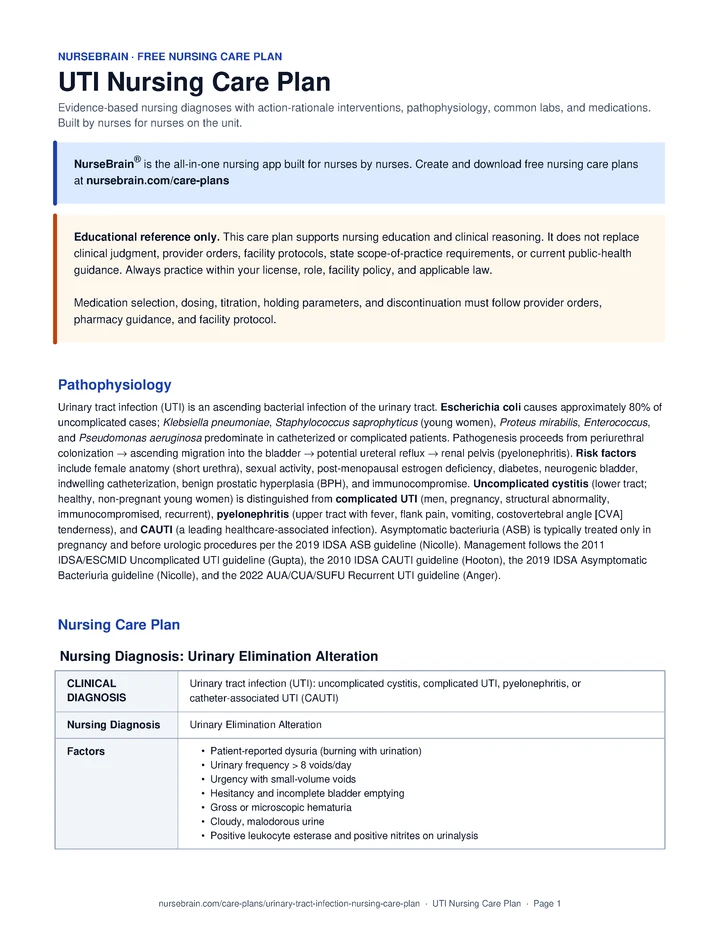
Urinary Tract Infection (UTI) Nursing Care Plan
UTI nursing care plan: antimicrobial therapy, comfort measures, prevention teaching, and a printable PDF. Built by nurses for nurses.
Nursing Care Plan
Nursing Diagnosis 1: Impaired Urinary System Function
Urinary Elimination Alteration related to Urinary tract infection (UTI): uncomplicated cystitis, complicated UTI, pyelonephritis, or catheter-associated UTI (CAUTI) as evidenced by Patient-reported dysuria (burning with urination); Urinary frequency > 8 voids/day; Urgency with small-volume voids; Hesitancy and incomplete bladder emptying; Gross or microscopic hematuria.
Interventions
- Assess voiding pattern, frequency, urgency, hesitancy, and post-void residual sensation each shift and PRN.
- Inspect urine for color, clarity, odor, sediment, and presence of blood at each void; document findings per facility protocol.
- Obtain a clean-catch midstream urine specimen for urinalysis and culture before the first antibiotic dose when feasible and ordered.
- Measure and document intake and output (I&O) per facility protocol; report UOP < 0.5 mL/kg/hr for 2 consecutive hours or other parameters set by the provider.
- Palpate the suprapubic region for bladder distention and tenderness each shift.
- Assess costovertebral angle (CVA) tenderness bilaterally at least once per shift.
- Administer the ordered antibiotic on schedule; verify that a pre-treatment culture was obtained when ordered.
- Encourage oral fluid intake of approximately 1.5–3 L/day unless contraindicated by heart failure, renal failure, or an ordered fluid restriction; verify the patient-specific target with the provider order.
- Provide perineal care after each void and bowel movement; reinforce front-to-back wiping for patients with female anatomy.
- Offer warm sitz baths or a heating pad to the suprapubic area for comfort per facility protocol.
- Administer ordered phenazopyridine (Pyridium) for short-term dysuria relief (commonly ≤ 2 days) per provider order.
- Educate the patient to complete the entire ordered antibiotic course even if symptoms resolve early.
- Teach patients with female anatomy about post-coital voiding and counsel on spermicide-coated barrier contraception per provider direction.
- Counsel on adequate hydration with water as the preferred fluid and on limiting caffeine, alcohol, and carbonated beverages during active infection.
- Inform patients that phenazopyridine can stain urine, tears, and contact lenses orange-red.
- Review the limited and variable evidence base for cranberry products and D-mannose for recurrence prevention; emphasize that these do not replace ordered therapy.
- Notify the provider for hematuria with clots, inability to void, fever > 38.3 °C, new CVA tenderness, or vomiting.
- Coordinate urology referral per provider direction for recurrent UTI (commonly ≥ 2 in 6 months or ≥ 3 in 12 months), first UTI in men, or complicated or recurrent infection per facility protocol.
Outcome: Dysuria trends toward resolution within 48–72 hours of ordered antibiotic therapy; Urinary frequency trends toward baseline (commonly ≤ 7 voids/day) within ordered parameters; Urine appearance is monitored and changes are documented and reported.
Nursing Diagnosis 2: Acute Pain
Acute Pain related to Urinary tract infection (UTI): uncomplicated cystitis, complicated UTI, pyelonephritis, or catheter-associated UTI (CAUTI) as evidenced by Patient-reported suprapubic pain (commonly rated around 6/10 in cystitis); Flank pain and CVA tenderness in pyelonephritis; Burning with urination (dysuria); Guarding behavior on abdominal palpation; Restlessness and grimacing.
Interventions
- Assess pain quality, location, intensity (0–10), and radiation at the start of every shift and PRN.
- Reassess pain 30–60 minutes after each ordered pharmacologic intervention.
- Palpate the suprapubic region and percuss the costovertebral angles bilaterally.
- Monitor vital signs, particularly heart rate and blood pressure, during pain episodes.
- Assess for non-verbal indicators (grimacing, guarding, withdrawal) in patients who minimize pain reporting.
- Administer ordered analgesics (acetaminophen or NSAIDs) on schedule per provider direction and facility protocol, not only PRN, when scheduled dosing is ordered.
- Administer ordered phenazopyridine for short-term dysuria relief (commonly ≤ 2 days) per provider direction.
- Apply a warm compress or heating pad to the suprapubic area for approximately 15–20 minutes as desired and per facility protocol.
- Encourage warm sitz baths once or twice daily per facility protocol when not contraindicated.
- Position the patient comfortably; offer pillow support to flank or abdomen for pyelonephritis-related flank pain.
- Teach distraction, slow breathing, and guided imagery as adjuncts to ordered pharmacologic management.
- Educate the patient that dysuria commonly improves within 24–48 hours of effective ordered antibiotic therapy and to report persistent or worsening pain.
- Counsel on avoiding bladder irritants (caffeine, alcohol, citrus, spicy foods) during active infection.
- Notify the provider for pain unrelieved by ordered scheduled analgesics, escalation to flank pain, or new vomiting.
- Coordinate with the provider team on transition to oral therapy per facility protocol once pain is controlled and the patient has been afebrile within ordered parameters.
Outcome: Patient reports pain at or below the goal set with the provider team (commonly ≤ 3/10) within ordered parameters; Patient demonstrates relaxed posture without guarding; Patient sleeps in 4-hour blocks when clinical state allows.
Nursing Diagnosis 3: Impaired Breathing
Hyperthermia related to Urinary tract infection (UTI): uncomplicated cystitis, complicated UTI, pyelonephritis, or catheter-associated UTI (CAUTI) as evidenced by Temperature > 38.3 °C (101 °F); Chills and rigors; Tachycardia > 100 bpm; Warm, flushed skin; Diaphoresis.
Interventions
- Monitor temperature every 4 hours and PRN; document route and any ordered antipyretic given per facility protocol.
- Trend heart rate, blood pressure, respiratory rate, and SpO2 every 4 hours or at intervals matched to clinical acuity per facility protocol.
- Calculate qSOFA (RR ≥ 22, altered mentation, SBP ≤ 100) at least once per shift in febrile patients per facility sepsis-screening protocol.
- Assess level of consciousness and orientation each shift, particularly in older adults.
- Monitor WBC, lactate, and blood cultures when ordered; report lactate > 2 mmol/L per facility sepsis-bundle protocol.
- Assess fluid status: skin turgor, mucous membranes, urine output, and daily weight per facility protocol.
- Administer ordered antibiotics on schedule; do not delay administration for transport or testing per facility protocol.
- Administer ordered antipyretics (acetaminophen, ibuprofen) per provider direction and facility fever-management protocol.
- Provide cooling measures: lightweight bedding, room temperature 70–72 °F, tepid sponge bath for high fever per facility protocol.
- Encourage oral fluids or maintain ordered IV fluids per provider direction to support replacement of febrile losses.
- Change linens promptly after diaphoresis; provide a dry gown and comfort care.
- Educate the patient and family on monitoring temperature at home and reporting fever > 38.3 °C, chills, or new confusion after discharge.
- Counsel on alternating acetaminophen and ibuprofen only when prescribed and within ordered renal and hepatic safety limits.
- Notify the provider for temperature > 39.5 °C, qSOFA ≥ 2, lactate > 2 mmol/L, or new hypotension.
- Coordinate sepsis-bundle elements per facility protocol when ordered: blood cultures before ordered antibiotics, lactate, and ordered crystalloid resuscitation for hypotension or lactate ≥ 4 mmol/L.
Outcome: Temperature trends toward < 38.0 °C within ordered parameters following ordered antibiotic initiation; Heart rate trends toward baseline (commonly < 100 bpm at rest) within ordered parameters; Skin is monitored and findings are documented (warm, dry, normal color).
Nursing Diagnosis 4: Risk For Infection
Infection Risk related to Urinary tract infection (UTI): uncomplicated cystitis, complicated UTI, pyelonephritis, or catheter-associated UTI (CAUTI) as evidenced by Indwelling urinary catheter in place; Female anatomy (short urethra) with prior UTI history; Post-menopausal estrogen deficiency; Diabetes mellitus with glycosuria; Sexual activity with spermicide use.
Interventions
- Review the indication for any indwelling urinary catheter each shift and document the assessment per facility protocol.
- Assess the catheter for kinks, dependent loops, secure leg attachment, and continuous gravity drainage with the bag below bladder level.
- Inspect the urinary meatus and catheter insertion site each shift for redness, discharge, or encrustation.
- Identify modifiable risk factors: sexual activity, spermicide use, glycemic control, post-menopausal status, fluid intake.
- In women, screen for post-menopausal vaginal atrophy (dryness, dyspareunia, recurrent UTI) and report findings to the provider team.
- Support the CAUTI-prevention bundle per facility protocol: insert only with an appropriate indication, sterile insertion technique, secure to leg, maintain a closed system, and coordinate removal at the earliest opportunity.
- Perform perineal hygiene with soap and water at least daily and after each bowel movement for catheterized patients per facility protocol.
- Empty the drainage bag when approximately two-thirds full and at the end of shift using a clean, patient-specific container per facility protocol.
- Avoid routine catheter changes and routine bladder irrigation for CAUTI prevention; replace only when clinically indicated and ordered per facility protocol.
- For patients with neurogenic bladder, coordinate clean intermittent catheterization (CIC) over an indwelling catheter when feasible per provider direction and facility protocol.
- Teach patients with female anatomy about front-to-back wiping, post-coital voiding, and non-spermicide contraception options per provider direction.
- Counsel on adequate hydration (commonly approximately 1.5–3 L/day unless contraindicated) and complete bladder emptying with timed voiding per provider direction.
- Discuss the limited and variable evidence base for cranberry products and D-mannose; reinforce that these do not replace medical evaluation of recurrent UTI.
- Educate post-menopausal patients on the option of topical vaginal estrogen for recurrent UTI as a prescriber-directed therapy.
- For diabetic patients, reinforce ordered glycemic targets and explain that glycosuria can promote bacterial growth.
- Provide written discharge instructions in plain language with red-flag symptoms and follow-up timing per facility protocol.
- Coordinate with the provider team to remove indwelling catheters at the earliest clinically appropriate time using nurse-driven removal protocols where available per facility protocol.
- Coordinate urology or infectious-disease referral for recurrent UTI patients per provider direction (suppression strategies, post-coital prophylaxis, or self-start therapy may be considered by the prescriber).
Outcome: Patient remains free of new symptomatic UTI episodes during admission and through follow-up to the extent nursing can influence; If catheterized, no CAUTI develops during admission per CDC/NHSN definition; Patient verbalizes at least four evidence-based prevention strategies.
Nursing Diagnosis 5: Lack Of Knowledge
Knowledge Deficit related to Urinary tract infection (UTI): uncomplicated cystitis, complicated UTI, pyelonephritis, or catheter-associated UTI (CAUTI) as evidenced by Patient reports limited understanding of UTI causes, course, and recurrence prevention; Patient new to a self-management routine (hydration goals, timed voiding, post-coital voiding); Patient on a new antibiotic regimen with course completion expectations; Patient with indwelling catheter or intermittent catheterization at home; Health-literacy or language considerations identified on admission.
Interventions
- Assess baseline understanding of UTI causes, symptoms, and prevention; identify language and health-literacy needs.
- Identify the patient’s preferred learning style (written, visual, demonstration, video) and any cultural or family considerations.
- Use teach-back to confirm comprehension of each major teaching point.
- Assess for barriers to follow-through (cost of medication, transportation, caregiver support).
- Provide written discharge instructions in plain language with red-flag symptoms, medication schedule, and follow-up timing per facility protocol.
- Coordinate interpreter services for patients with limited English proficiency per facility policy.
- Cluster teaching to align with caregiver presence whenever possible.
- Teach the rationale for completing the entire ordered antibiotic course and the risk of resistance with premature discontinuation.
- Teach personal red-flag symptoms tailored to the patient’s clinical picture: fever > 38.3 °C, new flank pain, vomiting, hematuria with clots, inability to void, or new confusion.
- Teach risk-tailored prevention strategies: hydration, timed voiding, perineal hygiene, post-coital voiding when applicable, and non-spermicide contraception when applicable.
- For patients with indwelling or intermittent catheters at home, teach insertion technique (CIC), hand hygiene, equipment care, and red flags (cloudy urine, fever, flank pain) per facility protocol.
- Teach the patient and family the role of follow-up urinalysis and culture when ordered, and why it may or may not be repeated.
- Provide age- and sex-appropriate prevention messaging (post-menopausal vaginal estrogen as a prescriber option, post-coital voiding in younger sexually active women, BPH evaluation in men with recurrent UTI).
- Coordinate referral to social work, pharmacy assistance, or community resources when financial or access barriers are identified per facility protocol.
- Notify the provider when teaching reveals a significant gap (e.g., misunderstanding about catheter care, antibiotic course, or red flags) that may affect post-discharge safety.
Outcome: Patient verbalizes understanding of the rationale for completing the ordered antibiotic course; Patient verbalizes at least three personal red-flag symptoms that should prompt callback or return to the provider; Patient demonstrates or teaches back at least one prevention strategy relevant to personal risk profile.
Pathophysiology
Urinary tract infection (UTI) is an ascending bacterial infection of the urinary tract. Escherichia coli causes approximately 80% of uncomplicated cases; Klebsiella pneumoniae, Staphylococcus saprophyticus (young women), Proteus mirabilis, Enterococcus, and Pseudomonas aeruginosa predominate in catheterized or complicated patients. Pathogenesis proceeds from periurethral colonization → ascending migration into the bladder → potential ureteral reflux → renal pelvis (pyelonephritis). Risk factors include female anatomy (short urethra), sexual activity, post-menopausal estrogen deficiency, diabetes, neurogenic bladder, indwelling catheterization, benign prostatic hyperplasia (BPH), and immunocompromise.
Uncomplicated cystitis (lower tract; healthy, non-pregnant young women) is distinguished from complicated UTI (men, pregnancy, structural abnormality, immunocompromised, recurrent), pyelonephritis (upper tract with fever, flank pain, vomiting, costovertebral angle [CVA] tenderness), and CAUTI (a leading healthcare-associated infection). Asymptomatic bacteriuria (ASB) is typically treated only in pregnancy and before urologic procedures per the 2019 IDSA ASB guideline (Nicolle). Management follows the 2011 IDSA/ESCMID Uncomplicated UTI guideline (Gupta), the 2010 IDSA CAUTI guideline (Hooton), the 2019 IDSA Asymptomatic Bacteriuria guideline (Nicolle), and the 2022 AUA/CUA/SUFU Recurrent UTI guideline (Anger).
Quick Reference
- Cystitis abx: Nitrofurantoin 5 d / TMP-SMX 3 d / Fosfomycin 3 g single dose per provider order
- Pyelonephritis abx: 7–14 days per agent, severity, and provider order
- Foley care: Secured to leg with continuous gravity drainage; care per facility protocol
- CAUTI bundle: Insert only when indicated; remove at earliest opportunity per facility protocol
- Fluid target: 1.5–3 L/day unless contraindicated per provider direction
Common Labs
| Lab | Normal range | Significance in UTI |
|---|---|---|
| Urinalysis (UA) | Negative leukocyte esterase / negative nitrite | Positive leukocyte esterase, positive nitrite, and pyuria support UTI; WBC casts can support upper-tract involvement (pyelonephritis). Nurses obtain when ordered and report findings to the provider team. |
| Urine culture and sensitivity | No growth | Gold-standard test that identifies organism and susceptibilities and supports de-escalation from empiric to narrow-spectrum therapy. When feasible, obtain before the first antibiotic dose per provider order and facility protocol. |
| CBC with differential | WBC 4.5–11.0 × 10⁹/L | Leukocytosis with a left shift can support pyelonephritis or urosepsis. Nurses trend serial values and report concerning patterns to the provider team. |
| Blood culture | No growth | May be ordered in pyelonephritis, suspected sepsis, or immunocompromise per provider direction. When ordered as part of a sepsis-bundle workflow, draw before antibiotic administration when feasible per facility protocol. |
| BMP (Cr, BUN) | Cr 0.6–1.2 mg/dL | Dehydration and AKI from pyelonephritis or contrast can alter renal function and inform renal-dose antibiotic adjustments by the provider team. |
| CRP | < 10 mg/L | Trends systemic inflammation; can be elevated in pyelonephritis. Nurses report trend to the provider team. |
| PSA (men) | < 4 ng/mL | May be ordered to screen for BPH or prostatitis as an obstructive or infectious source per provider direction. |
| Pelvic ultrasound | No hydronephrosis | May be ordered when complicated UTI or obstruction is suspected per provider direction and facility protocol. |
| CT abdomen/pelvis | No abscess or stone | May be ordered for complicated pyelonephritis, perinephric abscess, or obstruction per provider direction and facility protocol. |
| Urine β-hCG | Negative (non-pregnant) | May be ordered before antibiotic selection in patients of reproductive age, as pregnancy alters antibiotic options (TMP-SMX and fluoroquinolones are generally avoided) per provider direction and facility protocol. |
Common Medications
| Class | Examples | Mechanism of action | Key side effects | Nursing considerations |
|---|---|---|---|---|
| Nitrofurantoin | Macrobid, Macrodantin | Damages bacterial DNA via reactive intermediates; concentrates in urine. | GI upset, pulmonary toxicity (long-term), peripheral neuropathy, hemolysis in G6PD deficiency. | Commonly selected as a first-line option for uncomplicated cystitis per the IDSA 2011 uncomplicated UTI guideline (Gupta). Administer as ordered per provider direction, pharmacy guidance, and facility protocol. Generally avoided when CrCl < 30 mL/min per prescribing guidance; nurses verify renal-function trend and screen for hemolysis risk in G6PD. Coordinate timing with food per order to support tolerability. |
| TMP-SMX (Bactrim) | Trimethoprim-Sulfamethoxazole | Sequential blockade of folate synthesis (DHPS + DHFR). | Rash, Stevens-Johnson syndrome, hyperkalemia, rising creatinine, hemolysis in G6PD deficiency. | May be selected for uncomplicated cystitis when local resistance is low per the IDSA 2011 uncomplicated UTI guideline (Gupta). Administer as ordered per provider direction, pharmacy guidance, and facility protocol. Generally avoided in first- and third-trimester pregnancy per prescribing guidance; nurses confirm documented sulfa allergy status before administration and report any new rash, potassium elevation, or creatinine rise to the provider team. |
| Fosfomycin | Monurol | Inhibits MurA, blocking peptidoglycan synthesis. | Diarrhea, headache, vaginitis. | May be selected as a single 3 g PO dose for uncomplicated cystitis per the IDSA 2011 uncomplicated UTI guideline (Gupta), with an adherence advantage for patients unlikely to complete a multi-day course. Administer as ordered per provider direction and facility protocol. Nurses support patient preparation (mix in 3–4 oz water per labeling) and reinforce dosing instructions. |
| Fluoroquinolones | Ciprofloxacin, Levofloxacin | Inhibit bacterial DNA gyrase and topoisomerase IV. | Black box warnings: tendon rupture, peripheral neuropathy, CNS effects, and myasthenia gravis exacerbation. Other serious effects: aortic aneurysm and dissection, hypoglycemia, mental-health effects, QT prolongation. | May be selected as a first-line outpatient option for pyelonephritis per the IDSA 2011 uncomplicated UTI guideline (Gupta); commonly reserved due to FDA safety warnings on adverse effects. Administer as ordered per provider direction, pharmacy guidance, and facility protocol. Nurses coordinate separation from divalent cations (calcium, magnesium, iron) by approximately 2 hours per labeling and monitor for tendon pain, new neuropathy, mood changes, and QT-related rhythm changes; escalate concerns to the provider team. |
| Cephalosporins | Ceftriaxone (IV), Cefpodoxime (PO) | Inhibit cell-wall synthesis via PBP binding (β-lactam). | Rash, GI upset, C. difficile-associated diarrhea, biliary sludging (ceftriaxone). | Commonly selected for inpatient pyelonephritis (ceftriaxone IV) and oral step-down (cefpodoxime) per culture and sensitivity and provider direction. Administer as ordered per provider direction, pharmacy guidance, and facility protocol. Nurses monitor for hypersensitivity, GI tolerance, and stool changes; coordinate IV-to-PO step-down with the provider team when clinical criteria support transition. |
| Aminoglycosides | Gentamicin, Tobramycin | 30S ribosomal inhibition with bactericidal effect; synergistic with β-lactams. | Nephrotoxicity, ototoxicity, neuromuscular blockade. | May be selected for synergy in pyelonephritis or urosepsis per provider direction and facility antimicrobial stewardship guidance. Administer as ordered; once-daily dosing is commonly preferred. Nurses coordinate trough levels and daily creatinine monitoring per pharmacy guidance and facility protocol; report any new hearing change, vestibular symptoms, or rising creatinine to the provider team. |
| Phenazopyridine | Pyridium, AZO | Azo dye that acts as a topical urinary mucosal analgesic; not antibacterial. | Orange-red urine and tears (can stain contact lenses), headache, methemoglobinemia. | May be offered for short-term dysuria relief (commonly ≤ 2 days) per provider direction and facility protocol. Administer as ordered; does not replace antibiotic therapy. Nurses provide anticipatory teaching about urine and tear staining and monitor for headache or signs of methemoglobinemia. |
| Carbapenems | Ertapenem, Meropenem | Broad-spectrum β-lactam that binds PBPs and is stable to most β-lactamases. | Seizures (notably with imipenem), C. difficile-associated diarrhea, rash. | Commonly reserved for ESBL-producing organisms or multi-drug-resistant pathogens per culture and sensitivity, antimicrobial stewardship guidance, and provider direction. Administer as ordered per provider direction, pharmacy guidance, and facility protocol. Nurses monitor neurologic status (notably seizure risk in renal impairment) and report new GI or neurologic findings to the provider team. |
References
- Makic, M. B. F., & Martinez-Kratz, M. R. (Eds.). (2023). Ackley and Ladwig’s Nursing Diagnosis Handbook: An Evidence-Based Guide to Planning Care (13th ed.). Elsevier.
- Gupta, K., Hooton, T. M., Naber, K. G., et al. (2011). International clinical practice guidelines for the treatment of acute uncomplicated cystitis and pyelonephritis in women: A 2010 update by the IDSA and the ESCMID. Clinical Infectious Diseases, 52(5), e103–e120.
- Hooton, T. M., Bradley, S. F., Cardenas, D. D., et al. (2010). Diagnosis, prevention, and treatment of catheter-associated urinary tract infection in adults: 2009 international clinical practice guidelines from the Infectious Diseases Society of America. Clinical Infectious Diseases, 50(5), 625–663.
- Anger, J., Lee, U., Ackerman, A. L., et al. (2022). Recurrent uncomplicated urinary tract infections in women: AUA/CUA/SUFU guideline (amended 2022). The Journal of Urology, 208(3), 536–541.
- Nicolle, L. E., Gupta, K., Bradley, S. F., et al. (2019). Clinical practice guideline for the management of asymptomatic bacteriuria: 2019 update by the Infectious Diseases Society of America. Clinical Infectious Diseases, 68(10), e83–e110.
Frequently Asked Questions
What is the nursing care plan for UTI?
A UTI nursing care plan organizes the assessment, nursing diagnoses, goals, interventions, and evaluation criteria for a patient with Urinary Tract Infection (UTI). Diagnoses are ordered by what is currently most destabilizing for the patient.
What are the priority nursing diagnoses for UTI?
Priority diagnoses for UTI appear in the Nursing Diagnoses section above, ordered by clinical acuity. The top diagnosis should reflect what is currently most destabilizing for this specific patient.
What is the priority nursing intervention for UTI?
Priority interventions for UTI are listed in the care plan above, organized by diagnosis. The most critical actions address airway, circulation, and the highest-acuity problem first.
What complications should the nurse monitor for in UTI?
Complications to monitor for in UTI are listed within each diagnosis section above. Trend vitals, mental status, and the condition-specific red flags described in the assessment section.
A report sheet built for this patient
This is exactly the kind of patient the report sheet templates in NurseBrain® Synapse are built for. Keep everything you track on one page, all shift.
Learn how NurseBrain Synapse uses the Clinical Care Classification System for nursing care plans.