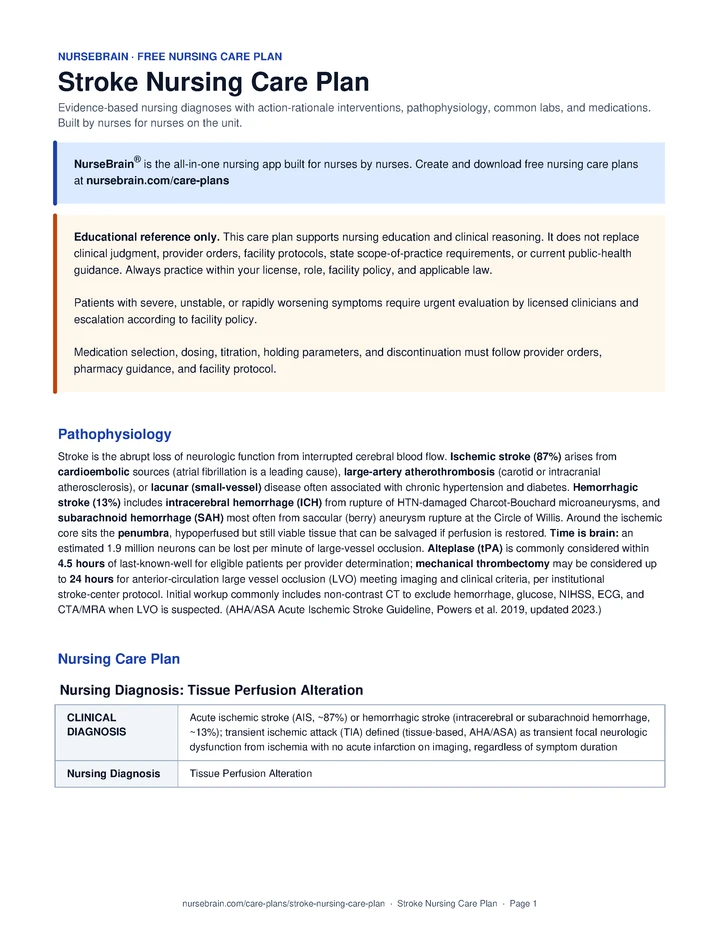
Stroke (CVA) / TIA Nursing Care Plan
Stroke (CVA/TIA) nursing care plan with prioritized diagnoses, interventions, NIHSS assessment, and a printable PDF. Built by nurses for nurses.
Nursing Care Plan
Nursing Diagnosis 1: Ineffective Tissue Perfusion
Tissue Perfusion Alteration related to Acute ischemic stroke (AIS, ~87%) or hemorrhagic stroke (intracerebral or subarachnoid hemorrhage, ~13%); transient ischemic attack (TIA) defined (tissue-based, AHA/ASA) as transient focal neurologic dysfunction from ischemia with no acute infarction on imaging, regardless of symptom duration as evidenced by Acute onset focal neurologic deficits (NIHSS ≥ 4); Altered level of consciousness (drowsy, confused, aphasic); Unilateral motor weakness or hemiplegia; Facial droop, dysarthria, gaze deviation; BP outside ordered parameters for stroke type.
Interventions
- Perform NIHSS on admission and at the intervals ordered by the provider, commonly q15 min during tPA infusion and ×2 h after, q30 min ×6 h, q1h ×16 h, then q4h per facility stroke protocol.
- Obtain a fingerstick glucose on any suspected stroke as soon as feasible per facility stroke pathway (commonly target 70–140 mg/dL); treat hypoglycemia per facility hypoglycemia protocol before attributing deficits to ischemia.
- Assess pupils (size, equality, reactivity), gaze, and cranial nerves at intervals matched to clinical acuity and facility protocol (commonly every 1–2 hours).
- Monitor BP at the intervals and parameters ordered by the provider for the stroke type (commonly q15 min during and 2 h post-tPA, then q30 min ×6 h, then q1h ×16 h; commonly < 180/105 post-tPA; permissive up to < 220/120 for non-tPA ischemic; commonly < 140/90 for hemorrhagic per provider parameters).
- Monitor for findings that may signal hemorrhagic transformation in the first 24 h post-tPA: sudden neuro decline, severe headache, new nausea/vomiting, or new uncontrolled hypertension; notify the provider promptly.
- Monitor cardiac rhythm continuously and document any new atrial fibrillation, ventricular ectopy, or other new arrhythmia.
- Monitor for findings consistent with increased ICP: worsening LOC, Cushing's triad (bradycardia, widened pulse pressure, irregular respirations), papilledema, projectile vomiting.
- Position head of bed per provider order and facility stroke protocol (commonly 0–15° in acute ischemic stroke unless aspiration risk or elevated ICP; commonly 30° in hemorrhagic stroke or post-tPA).
- Administer tPA or facilitate thrombectomy as ordered per provider direction, pharmacy guidance, and facility stroke protocol. Verify the provider-team eligibility checklist is complete and BP is within ordered parameters before the alteplase bolus.
- Administer ordered IV labetalol or nicardipine and titrate within provider parameters to keep BP within the ordered range; avoid dropping BP more than the rate the provider team specifies (commonly capped at ~15% in the first 24 h of an ischemic stroke).
- Support normothermia per facility protocol (commonly 36–37 °C); administer ordered antipyretics and apply cooling measures per provider direction.
- Avoid invasive lines, NG tube placement, urinary catheters, and antiplatelet or anticoagulant medications for 24 hours after tPA per facility post-tPA protocol unless ordered otherwise by the provider.
- Teach the patient and family FAST: Face drooping, Arm weakness, Speech difficulty, Time to call 911.
- Educate the patient and family on the importance of last-known-well time and on calling 911 for any sudden neurologic change rather than waiting.
- Reinforce stroke risk-factor management with the patient and family: BP, A1c, LDL, smoking cessation, and AFib anticoagulation adherence per the provider plan.
- Notify the provider promptly for an NIHSS worsening of ≥ 4 points, new pupil changes, findings consistent with Cushing's triad, or BP outside ordered parameters despite titration.
- Coordinate neurointerventional radiology or neurosurgery consultation per facility protocol for LVO patients meeting thrombectomy criteria within 24 h, or for hemorrhagic stroke with mass effect.
Outcome: NIHSS is monitored at ordered intervals and changes are reported promptly; Level of consciousness and pupillary findings are monitored and changes communicated to the provider team; BP is monitored within ordered parameters for the stroke type.
Nursing Diagnosis 2: Anxiety
Verbal Impairment related to Acute ischemic stroke (AIS, ~87%) or hemorrhagic stroke (intracerebral or subarachnoid hemorrhage, ~13%); transient ischemic attack (TIA) defined (tissue-based, AHA/ASA) as transient focal neurologic dysfunction from ischemia with no acute infarction on imaging, regardless of symptom duration as evidenced by Aphasia (expressive [Broca], receptive [Wernicke], or global); Dysarthria with slurred or unintelligible speech; Difficulty following multi-step commands; Frustration, withdrawal, or emotional lability; NIHSS language and dysarthria sub-scores > 0.
Interventions
- Assess communication ability on admission: spontaneous speech, naming, repetition, comprehension, reading, and writing per facility neuro-assessment.
- Distinguish aphasia from dysarthria: aphasia is a language problem (word retrieval, comprehension); dysarthria is a motor speech problem (slurred but correctly chosen words).
- Screen for cognitive comprehension before assuming the patient cannot answer: ask yes/no questions and watch for accurate head-nod or thumbs-up responses.
- Reassess language daily during the acute hospitalization and document changes against the NIHSS language sub-score.
- Speak slowly, in short simple sentences, facing the patient at eye level; allow extended time for response.
- Offer a communication board with pictures of common needs (pain, bathroom, water, family); use yes/no cards or written choices.
- Coordinate a speech-language pathology consult per facility protocol (commonly within 24 hours) for formal evaluation and individualized therapy planning.
- Limit background noise (TV, conversations, alarms) during communication attempts.
- Acknowledge frustration without minimizing it; validate the patient's effort.
- Teach the family one technique at a time: face the patient, use one simple sentence, wait, and use gestures or writing as backup.
- Educate the family that aphasia is not a sign of decreased intelligence or hearing loss.
- Teach the patient and family about the expected recovery trajectory and the value of continued outpatient SLP after discharge.
- Coordinate continued speech-language pathology follow-up post-discharge with case management.
- Refer the patient and family to stroke support group and aphasia community resources at discharge per facility protocol.
Outcome: Patient communicates basic needs using verbal or alternative methods as ability allows; Patient uses at least one augmentative communication tool when offered; Family verbalizes understanding of the patient's communication pattern.
Nursing Diagnosis 3: Impaired Nutritional Status
Aspiration Risk related to Acute ischemic stroke (AIS, ~87%) or hemorrhagic stroke (intracerebral or subarachnoid hemorrhage, ~13%); transient ischemic attack (TIA) defined (tissue-based, AHA/ASA) as transient focal neurologic dysfunction from ischemia with no acute infarction on imaging, regardless of symptom duration as evidenced by Dysphagia identified on bedside swallow screen; Decreased level of consciousness or somnolence; Facial droop with poor lip seal; Weak or absent cough/gag reflex; Dysarthria, drooling, or pocketing of food.
Interventions
- Keep the patient NPO (including medications, water, and ice chips) until a bedside dysphagia screen is completed and passed by a trained nurse or SLP per facility protocol.
- Perform a validated bedside swallow screen (e.g., 3-oz water swallow test) per facility protocol when the patient is alert, sitting upright, and able to follow commands.
- Auscultate breath sounds at intervals matched to clinical acuity and facility protocol (commonly every 4 hours and after any feeding); monitor temperature, SpO2, and respiratory rate.
- Observe for clinical signs of aspiration during meals: coughing, choking, wet or gurgly voice after swallow, throat clearing, watery eyes, drooling, or food pocketing in the affected cheek.
- Reassess swallow ability daily; many stroke patients improve over the first 1–2 weeks and can be advanced to safer diets per SLP and provider direction.
- Coordinate a speech-language pathology consult for a formal swallow evaluation if the bedside screen is failed or equivocal.
- Position the patient upright at ≥ 90° during all meals and for 30–45 minutes after per facility protocol.
- Provide modified diet textures (thickened liquids, pureed, mechanical soft) as ordered by SLP and the provider team.
- Provide thorough oral care every 4 hours per facility VAP-/SAP-prevention protocol, including brushing teeth and tongue, to reduce oropharyngeal bacterial load.
- Keep suction equipment immediately available at the bedside during meals.
- If NG or OG feeding is initiated, verify tube placement before each feed, keep HOB ≥ 30°, and check residuals per facility protocol.
- Teach the patient compensatory strategies recommended by SLP (e.g., chin tuck, head turn to the affected side, double swallow) as ability allows.
- Educate the patient and family on safe-swallow principles: upright posture, small bites, no straws unless cleared by SLP, no talking with food in the mouth, and alternating solids and liquids when recommended.
- Teach the family signs of aspiration pneumonia: fever, productive cough, increased shortness of breath, or change in mental status; instruct to call the provider promptly.
- Notify the provider for a failed swallow screen, new desaturation after PO, new fever > 38.0 °C, or any witnessed aspiration event.
- Coordinate an enteral nutrition plan with the provider team and dietitian (NG tube, PEG) for patients with persistent dysphagia, per facility nutrition protocol.
Outcome: Patient remains NPO until the bedside swallow screen is passed per facility protocol; Findings consistent with aspiration are monitored and reported; SpO2 ≥ ordered parameters, no new fever, breath sounds monitored; Patient practices safe-swallow techniques after SLP evaluation as ability allows.
Nursing Diagnosis 4: Self Care Deficit
Self Care Deficit related to Acute ischemic stroke (AIS, ~87%) or hemorrhagic stroke (intracerebral or subarachnoid hemorrhage, ~13%); transient ischemic attack (TIA) defined (tissue-based, AHA/ASA) as transient focal neurologic dysfunction from ischemia with no acute infarction on imaging, regardless of symptom duration as evidenced by Unilateral motor weakness (hemiparesis or hemiplegia); Sensory loss on the affected side; Visual field deficits (homonymous hemianopia) or neglect; Apraxia (difficulty performing learned motor tasks); Cognitive deficits affecting ADL sequencing.
Interventions
- Assess motor strength bilaterally using the 0–5 scale; document drift, grip strength, and ability to lift against gravity per facility neuro-assessment.
- Assess for unilateral neglect (often left-sided in right-hemisphere stroke): does the patient eat only from one side of the plate, dress only one side, or ignore stimuli on one side?
- Assess for visual field deficits (homonymous hemianopia) by confrontation testing on each side per facility protocol.
- Evaluate ADL performance daily: bathing, dressing, grooming, toileting, transfers, and ambulation.
- Assess skin every 2 hours on the affected (immobile) side, especially heels, sacrum, scapulae, and dependent areas per facility skin-care protocol.
- Position the patient with the affected side supported using pillows; turn every 2 hours per facility protocol; avoid pulling on the affected arm during transfers.
- Place the call light, water, phone, and personal items within reach on the unaffected side initially.
- As neglect or hemianopia improves, gradually shift items toward the affected side to encourage compensatory scanning per OT direction.
- Coordinate an OT consult for adaptive equipment per facility protocol (one-handed dressing aids, button hooks, raised toilet seat, tub bench, sock aid).
- Coordinate daily PT and OT sessions per the team plan; encourage participation even on tired days.
- Allow the patient adequate time to attempt tasks before stepping in; offer setup help before doing the task for them.
- Teach the patient compensatory techniques (dressing the affected side first, using the strong side to assist the weak side).
- Educate the family on safe-transfer techniques, gait-belt use, and home setup (remove throw rugs, install grab bars, add night lights) per OT and PT recommendations.
- Reinforce realistic expectations: most functional recovery happens in the first 3 months, but improvement can continue for 6–12 months with sustained therapy.
- Coordinate case management referral for home health, outpatient PT and OT, or inpatient rehab placement.
- Notify the provider for new or worsening motor deficit, new shoulder subluxation, or stage 2+ pressure injury.
Outcome: Patient performs identified ADLs with the minimum necessary assistance; Patient uses adaptive equipment correctly within 48–72 hours of introduction as ability allows; Patient and family verbalize home modifications needed for discharge.
Nursing Diagnosis 5: Risk For Fall
Fall Risk related to Acute ischemic stroke (AIS, ~87%) or hemorrhagic stroke (intracerebral or subarachnoid hemorrhage, ~13%); transient ischemic attack (TIA) defined (tissue-based, AHA/ASA) as transient focal neurologic dysfunction from ischemia with no acute infarction on imaging, regardless of symptom duration as evidenced by Unilateral motor weakness or hemiparesis; Impaired balance and coordination; Visual field deficits or unilateral neglect; Cognitive impairment, impulsivity, or impaired judgment; Orthostatic hypotension (often related to new antihypertensives).
Interventions
- Perform a validated fall-risk assessment (Morse or Hendrich II) on admission, every shift, and after any status change per facility protocol.
- Assess orthostatic vital signs (supine, sitting, standing) before first ambulation and after any change in antihypertensives per facility protocol.
- Evaluate balance, gait, and assistive-device fit at every transfer initially, in coordination with PT.
- Assess for unilateral neglect and hemianopia at every interaction; reorient the patient to the room layout each time.
- Review the medication list for sedating drugs, antihypertensives, diuretics, and any sleep aids; identify peak-effect times.
- Apply high-fall-risk identifiers per institution policy (wristband, signage, bed alarm, yellow socks).
- Keep bed in the lowest position, brakes locked, two upper side rails up (four side rails generally constitute restraint per CMS/Joint Commission per facility policy); keep call light and personal items within reach on the unaffected side.
- Use a bed or chair alarm for impulsive or cognitively impaired patients per facility protocol.
- Offer scheduled toileting (commonly every 2–3 hours) per facility protocol rather than waiting for the call light, especially with neglect or aphasia.
- Provide non-skid footwear (yellow stroke-protocol socks or supportive shoes) for every transfer and ambulation.
- Coordinate PT for safe-transfer training and assistive-device fitting before independent mobility.
- Support adequate lighting, especially overnight; offer a night light.
- Teach the patient to call for help before standing, even for what feels like a small move.
- Educate the family on home modifications: remove throw rugs, install grab bars in the bathroom, add stair handrails, clear walking paths, improve lighting, and use a shower chair.
- Teach the patient and family safe-transfer technique using the unaffected side to lead.
- Notify the provider after any fall for evaluation; coordinate stat CT per facility protocol for head strike, anticoagulation, or new neuro deficit.
- Coordinate a home-safety evaluation by OT before discharge for any patient returning home with a mobility deficit.
Outcome: No falls during hospitalization; Patient and family use the call light before standing; Bed in the lowest position with call light and personal items within reach on the unaffected side.
Pathophysiology
Stroke is the abrupt loss of neurologic function from interrupted cerebral blood flow. Ischemic stroke (87%) arises from cardioembolic sources (atrial fibrillation is a leading cause), large-artery atherothrombosis (carotid or intracranial atherosclerosis), or lacunar (small-vessel) disease often associated with chronic hypertension and diabetes. Hemorrhagic stroke (13%) includes intracerebral hemorrhage (ICH) from rupture of HTN-damaged Charcot-Bouchard microaneurysms, and subarachnoid hemorrhage (SAH) most often from saccular (berry) aneurysm rupture at the Circle of Willis. Around the ischemic core sits the penumbra, hypoperfused but still viable tissue that can be salvaged if perfusion is restored. Time is brain: an estimated 1.9 million neurons can be lost per minute of large-vessel occlusion. Alteplase (tPA) is commonly considered within 4.5 hours of last-known-well for eligible patients per provider determination; mechanical thrombectomy may be considered up to 24 hours for anterior-circulation large vessel occlusion (LVO) meeting imaging and clinical criteria, per institutional stroke-center protocol. Initial workup commonly includes non-contrast CT to exclude hemorrhage, glucose, NIHSS, ECG, and CTA/MRA when LVO is suspected. (AHA/ASA Acute Ischemic Stroke Guideline, Powers et al. 2019, updated 2023.)
Quick Reference
- NIHSS frequency (per protocol): q15 min during tPA & ×2 h after, q30 min ×6 h, q1 h ×16 h, then q4h
- BP pre-tPA (per protocol): < 185/110 mmHg
- BP post-tPA (per protocol): < 180/105 mmHg ×24 h
- BP non-tPA ischemic: permissive up to < 220/120 mmHg per provider parameters
- BP hemorrhagic: < 140/90 mmHg per provider parameters
- Door-to-needle: < 60 min (AHA/ASA quality target)
Common Labs
| Lab | Normal range | Significance in Stroke |
|---|---|---|
| Glucose (POC) | 70–140 mg/dL | Commonly checked first on suspected stroke per facility protocol; hypoglycemia (< 60) and hyperglycemia (> 400) can mimic stroke. Nurses correct per provider order and facility hypo-/hyperglycemia protocol. |
| CBC | WBC 4–11, Hgb 12–17, Plts 150–400 K | Per AHA/ASA, platelets ≥ 100 K is one of several considerations the provider team weighs for tPA eligibility; helps surface thrombocytopenia or polycythemia. |
| INR / PT | < 1.7 (off anticoagulation) | Per AHA/ASA, INR > 1.7 is one factor that may exclude tPA unless reversal is documented; checked on suspected stroke per facility protocol. Eligibility is a provider-team decision. |
| aPTT | 25–35 sec | Elevated aPTT (recent heparin exposure) is one factor the provider team weighs against tPA; drawn per facility stroke protocol. |
| Creatinine / eGFR | Cr 0.6–1.2 mg/dL | Often required before CT angiography per facility radiology protocol; does not delay non-contrast CT or tPA per AHA/ASA acute-stroke pathway. |
| Troponin | < 0.04 ng/mL | Helps screen for concurrent MI and cardioembolic sources (Takotsubo, recent infarct) per provider-team workup. |
| Lipid panel | LDL < 100 mg/dL (< 70 if high risk per provider determination) | Supports the provider team’s decision on high-intensity statin therapy for secondary prevention per AHA/ASA secondary-prevention guideline. |
| Hemoglobin A1c | < 7.0% (per provider goal in diabetics) | Helps identify undiagnosed or uncontrolled DM; chronic hyperglycemia is associated with worse stroke outcome. |
| Type & screen | ABO/Rh typed; antibody screen negative | Obtained per provider order. Hemorrhagic transformation in the first 24 h post-tPA may warrant transfusion per provider direction. |
| LFTs (AST/ALT) | < 40 U/L | Baseline drawn per facility protocol when statin therapy is being considered; hepatic dysfunction can alter drug metabolism and is weighed by the provider team. |
Common Medications
| Class | Examples | Mechanism of action | Key side effects | Nursing considerations |
|---|---|---|---|---|
| Alteplase (tPA, rtPA) | Activase. 0.9 mg/kg IV (max 90 mg), 10% bolus plus 90% over 60 min per provider order | Recombinant tissue plasminogen activator; converts plasminogen to plasmin and supports fibrinolysis of cerebral clot. | Intracranial hemorrhage (~6% per AHA/ASA), systemic bleeding, angioedema (especially with concurrent ACE-I), reperfusion injury. | Administer as ordered per provider direction, pharmacy guidance, and facility stroke protocol after eligibility is determined by the provider team. Nurses verify BP is within ordered parameters (commonly < 185/110) before the bolus and monitor BP within ordered parameters (commonly < 180/105) for 24 h after, with NIHSS at the intervals ordered. Avoid antiplatelets, anticoagulants, NG tube placement, and non-essential invasive lines for 24 h per facility post-tPA protocol. |
| Tenecteplase (TNK) | TNKase. 0.25 mg/kg IV single bolus (max 25 mg) per provider order | Fibrin-specific plasminogen activator; longer half-life and greater fibrin affinity than alteplase, supporting single-bolus dosing. | Bleeding risks similar to alteplase. | Administer as ordered per provider direction, pharmacy guidance, and facility stroke protocol. Per the AHA/ASA 2024 focused update, tenecteplase is the preferred fibrinolytic for eligible AIS patients; it is increasingly favored at LVO centers en route to thrombectomy per institutional pathway. Nurses follow the same BP and NIHSS monitoring framework as alteplase per facility protocol. |
| Aspirin | ASA 81–325 mg PO/PR per provider order | Irreversibly inhibits COX-1, reducing thromboxane A2 and supporting antiplatelet effect. | GI bleeding, dyspepsia, bronchospasm in sensitive patients, allergic reaction. | Administer as ordered once a bleed is excluded by imaging in non-tPA-treated patients per AHA/ASA (commonly within 24 h, no later than 48 h). For tPA-treated patients, aspirin is held for 24 h and started per provider order after follow-up CT excludes bleed. |
| DAPT (Aspirin + Clopidogrel) | ASA 81 mg + clopidogrel 75 mg PO daily; clopidogrel 300–600 mg load per provider order | Dual antiplatelet pairing: irreversible COX-1 inhibition (ASA) plus P2Y12 ADP-receptor blockade (clopidogrel). | Bleeding risk higher than ASA alone; rash, rare TTP with clopidogrel; increased GI bleed risk. | Administer prescribed DAPT as ordered per provider direction. AHA/ASA assigns Class I support for DAPT in minor non-cardioembolic ischemic stroke (NIHSS ≤ 3) or high-risk TIA (ABCD² ≥ 4), based on the CHANCE and POINT trials; the regimen is typically started within 24 h, continued for 21 days, then transitioned to ASA monotherapy per provider order. DAPT is not given concurrently with tPA in the first 24 h per facility post-tPA protocol. |
| Antihypertensives (IV) | Labetalol 10–20 mg IV; Nicardipine 5–15 mg/hr infusion per provider order | Beta-blockade (labetalol) or dihydropyridine CCB (nicardipine), supporting controlled vasodilation and gradual BP reduction. | Bradycardia (labetalol), reflex tachycardia (nicardipine), heart block, bronchospasm. | Administer as ordered per provider direction. Per AHA/ASA, BP in acute ischemic stroke is lowered gradually (commonly capped at ~15% in the first 24 h); abrupt drops can worsen penumbral ischemia. Nurses titrate within provider parameters and facility protocol and escalate when BP remains outside ordered parameters despite titration. |
| High-intensity statin | Atorvastatin 40–80 mg PO; Rosuvastatin 20–40 mg PO per provider order | HMG-CoA reductase inhibitor; lowers LDL, supports plaque stabilization, and offers pleiotropic neuroprotective effects. | Myalgia, rare rhabdomyolysis, transaminitis, new-onset DM. | Administer as ordered; per AHA/ASA secondary-prevention guidance, high-intensity statin is commonly initiated within 24 h of ischemic stroke regardless of baseline LDL per provider direction. Nurses teach the patient to report muscle pain or dark urine. |
| Anticoagulant | Warfarin (INR 2–3); Apixaban, Rivaroxaban, Dabigatran (DOACs) per provider order | Inhibits vitamin-K-dependent clotting factors (warfarin) or directly inhibits Factor Xa or thrombin (DOACs). | Major bleeding, intracranial hemorrhage, drug-drug interactions. | Administer as ordered per provider direction for cardioembolic AFib stroke. Timing of initiation is commonly guided by infarct size; the ESC 1-3-6-12 rule (1 day for TIA, 3 days for minor stroke, 6 days for moderate, 12 days for severe or large infarct) is one reference framework, while AHA supports a ~2-week window with individualization. Hemorrhagic transformation prompts a hold and reassessment by the provider team. |
| DVT prophylaxis | Intermittent pneumatic compression (IPC); Enoxaparin 40 mg SQ daily per provider order | Mechanical (IPC) supports venous return and reduces stasis; LMWH inhibits Factor Xa and supports prevention of venous thrombosis. | IPC: skin breakdown if poorly fitted; LMWH: bleeding, thrombocytopenia, hematoma. | Administer as ordered per provider direction. Per facility post-tPA protocol, IPC alone is commonly used in the first 24 h; pharmacologic prophylaxis is added after follow-up CT clears bleed per provider order. Stroke patients carry meaningful DVT risk without prophylaxis (~20–40% in older series). |
| Osmotic therapy | Mannitol 0.25–1 g/kg IV; 3% hypertonic saline bolus or infusion per provider order | Increases serum osmolality, supporting fluid shift from edematous brain tissue and reduction in ICP. | Mannitol: rebound edema, AKI, hypovolemia, hypernatremia. HTS: pulmonary edema, central pontine myelinolysis if Na corrected too quickly. | Administer as ordered per provider direction for malignant cerebral edema, midline shift, or impending herniation per neurocritical-care protocol. Nurses monitor serum osmolality (commonly targeted 300–320), sodium (commonly < 160 per provider parameters), urine output, and neuro status; report deviations from ordered parameters. |
References
- Makic, M. B. F., & Martinez-Kratz, M. R. (Eds.). (2023). Ackley and Ladwig's Nursing Diagnosis Handbook: An Evidence-Based Guide to Planning Care (13th ed.). Elsevier.
- Powers, W. J., Rabinstein, A. A., Ackerson, T., et al. (2019). Guidelines for the Early Management of Patients With Acute Ischemic Stroke: 2019 Update to the 2018 Guidelines for the Early Management of Acute Ischemic Stroke: A Guideline for Healthcare Professionals From the American Heart Association/American Stroke Association. Stroke, 50(12), e344–e418. (Focused update 2023.)
- Greenberg, S. M., Ziai, W. C., Cordonnier, C., et al. (2022). 2022 Guideline for the Management of Patients With Spontaneous Intracerebral Hemorrhage: A Guideline From the American Heart Association/American Stroke Association. Stroke, 53(7), e282–e361.
- Wang, Y., Wang, Y., Zhao, X., et al. (2013). Clopidogrel with Aspirin in Acute Minor Stroke or Transient Ischemic Attack (CHANCE). New England Journal of Medicine, 369(1), 11–19.
- Johnston, S. C., Easton, J. D., Farrant, M., et al. (2018). Clopidogrel and Aspirin in Acute Ischemic Stroke and High-Risk TIA (POINT). New England Journal of Medicine, 379(3), 215–225.
- Klijn, C. J. M., Paciaroni, M., Berge, E., et al. (2019). Antithrombotic treatment for secondary prevention of stroke and other thromboembolic events in patients with stroke or transient ischaemic attack and non-valvular atrial fibrillation: A European Stroke Organisation guideline. European Stroke Journal, 4(3), 198–223.
Frequently Asked Questions
What is the nursing care plan for CVA?
A CVA nursing care plan organizes the assessment, nursing diagnoses, goals, interventions, and evaluation criteria for a patient with Stroke (CVA) / TIA. Diagnoses are ordered by what is currently most destabilizing for the patient.
What are the priority nursing diagnoses for CVA?
Priority diagnoses for CVA appear in the Nursing Diagnoses section above, ordered by clinical acuity. The top diagnosis should reflect what is currently most destabilizing for this specific patient.
What is the priority nursing intervention for CVA?
Priority interventions for CVA are listed in the care plan above, organized by diagnosis. The most critical actions address airway, circulation, and the highest-acuity problem first.
What complications should the nurse monitor for in CVA?
Complications to monitor for in CVA are listed within each diagnosis section above. Trend vitals, mental status, and the condition-specific red flags described in the assessment section.
A report sheet built for this patient
This is exactly the kind of patient the report sheet templates in NurseBrain® Synapse are built for. Keep everything you track on one page, all shift.
Learn how NurseBrain Synapse uses the Clinical Care Classification System for nursing care plans.