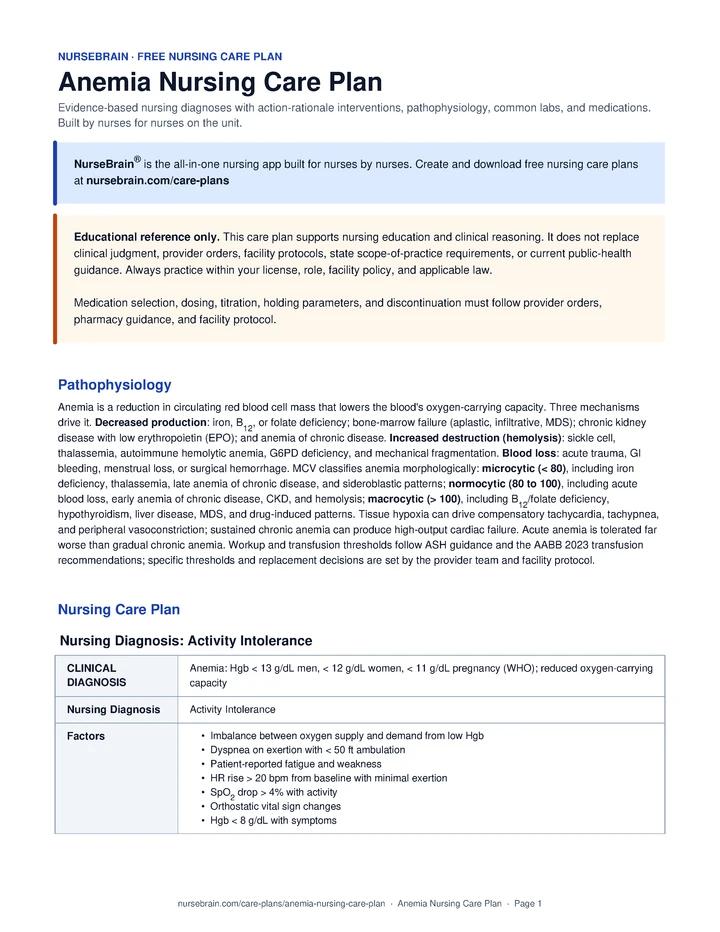
Anemia Nursing Care Plan
Anemia nursing care plan: oxygenation, activity tolerance, transfusion management, and a printable PDF.
Nursing Care Plan
Nursing Diagnosis 1: Activity Intolerance
Activity Intolerance related to Anemia: Hgb < 13 g/dL men, < 12 g/dL women, < 11 g/dL pregnancy (WHO); reduced oxygen-carrying capacity as evidenced by Imbalance between oxygen supply and demand from low Hgb; Dyspnea on exertion with < 50 ft ambulation; Patient-reported fatigue and weakness; HR rise > 20 bpm from baseline with minimal exertion; SpO2 drop > 4% with activity.
Interventions
- Monitor vital signs (HR, BP, RR, SpO2) before, during, and after activity per facility protocol.
- Obtain orthostatic vital signs (lying, sitting, standing) before first ambulation each shift when ordered or per facility protocol.
- Assess patient-reported dyspnea and fatigue on a 0 to 10 scale before and after activity.
- Observe for signs of overexertion: pallor, diaphoresis, chest pain, palpitations, or syncope.
- Trend Hgb, Hct, and reticulocyte count per provider order.
- Assist with ADLs as needed; cluster cares to allow uninterrupted rest periods.
- Coordinate with physical therapy on a progressive mobility plan per provider order and facility protocol.
- Pause activity and reassess for SBP drop > 20 mmHg, HR rise > 20% above resting, SpO2 fall < 92%, new chest pain, or new dyspnea; escalate per facility protocol.
- Administer supplemental oxygen as ordered when SpO2 falls below ordered parameters during activity.
- Keep call light, water, and frequently used items within reach.
- Educate on energy-conservation techniques: pace activities, prioritize tasks, sit while performing tasks when possible.
- Teach the patient to recognize their dyspnea threshold and pause to rest before reaching it.
- Reinforce that prolonged bed rest can accelerate deconditioning; encourage consistent low-level activity within ordered parameters.
- Teach signs requiring 911: chest pain, syncope, severe new dyspnea, confusion, or palpitations.
- Notify the provider for Hgb drop, new chest pain, syncope, or persistent tachycardia at rest.
- Coordinate cardiac evaluation per provider order if symptoms persist after Hgb correction.
Outcome: Patient ambulates within ordered activity parameters without significant dyspnea; HR returns toward baseline within a reasonable interval after activity, per facility protocol; SpO2 remains within ordered parameters during ambulation.
Nursing Diagnosis 2: Fatigue
Fatigue related to Anemia: Hgb < 13 g/dL men, < 12 g/dL women, < 11 g/dL pregnancy (WHO); reduced oxygen-carrying capacity as evidenced by Patient-reported persistent tiredness unrelieved by rest; Hgb < 10 g/dL; Decreased participation in ADLs; Sleep disturbance (poor sleep quality, daytime somnolence); Verbal reports of being ‘wiped out’ after minimal activity.
Interventions
- Assess fatigue severity using a 0 to 10 scale at the start of every shift and PRN.
- Identify contributing factors: pain, poor sleep, depression, medication side effects, ongoing blood loss.
- Assess sleep quality and duration daily; identify environmental or symptomatic disruptors.
- Review diet history for iron-, B12-, and folate-rich food intake when appropriate to the cause.
- Monitor labs trend (Hgb, Hct, reticulocyte count, iron studies, B12, folate) per provider order.
- Cluster nursing care to allow uninterrupted rest blocks when clinical state allows.
- Administer ordered iron, B12, folate, ESA, or blood products as ordered per provider direction, pharmacy guidance, and facility protocol.
- Coordinate registered-dietitian consult per provider order or facility protocol.
- Limit nonessential nighttime stimuli (overhead lights, loud conversations, unnecessary alarms) per facility protocol.
- Teach iron-rich foods (e.g., lean red meat, organ meats, beans, lentils, dark leafy greens, fortified cereals) per dietary preference and any provider-directed restrictions.
- Teach to pair iron-rich foods with a vitamin C source (e.g., citrus, peppers, strawberries, tomatoes) when consistent with the patient’s diet.
- Teach to separate iron intake from tea, coffee, milk, and calcium-rich foods by an interval consistent with provider direction.
- Teach B12 sources (e.g., meat, fish, eggs, dairy, fortified foods) and folate sources (e.g., leafy greens, legumes, fortified grains) per diet pattern.
- Teach energy-conservation: pacing, prioritization, rest before fatigue peaks, delegation of nonessential tasks.
- Notify the provider for worsening fatigue despite ordered therapy, new neurologic symptoms (e.g., paresthesia, ataxia), or signs of bleeding.
- Coordinate follow-up CBC at the interval ordered by the provider team.
Outcome: Patient reports decreased fatigue on a 0 to 10 scale; Patient participates in ADLs with appropriate assistance; Patient reports improved sleep quality.
Nursing Diagnosis 3: Risk For Haemorrhaging
Bleeding Risk related to Anemia: Hgb < 13 g/dL men, < 12 g/dL women, < 11 g/dL pregnancy (WHO); reduced oxygen-carrying capacity as evidenced by Known or suspected active bleeding source (GI, GU, surgical, menstrual); Anticoagulant or antiplatelet therapy; Thrombocytopenia (platelets < 100 K/µL); Coagulopathy (INR > 1.5, prolonged PTT); History of recurrent bleeding.
Interventions
- Assess for overt bleeding each shift: gums, nose, IV sites, surgical sites, stool, urine, emesis, and menstrual flow.
- Monitor vital signs per facility protocol; obtain orthostatic vitals before first ambulation when ordered.
- Inspect skin for petechiae, ecchymoses, and hematomas; note any new or expanding bruising.
- Test stool and emesis for occult blood per facility protocol and provider order.
- Trend Hgb and Hct on the interval ordered by the provider team when active bleeding is suspected.
- Monitor PT/INR, PTT, platelet count, and fibrinogen per provider order.
- Implement bleeding precautions per facility protocol: soft toothbrush, electric razor, avoidance of rectal temps or suppositories when feasible, and minimization of IM injections.
- Apply prolonged manual pressure to venipuncture and injection sites per facility protocol.
- Hold anticoagulants and antiplatelets only when ordered; document the hold and the provider’s rationale.
- Maintain large-bore IV access when ordered for possible volume or blood product resuscitation.
- Coordinate with blood bank for type & screen or type & cross per provider order; prepare blood products per facility protocol.
- Administer ordered reversal agents (e.g., vitamin K, FFP, prothrombin complex concentrate, platelets) as ordered per provider direction, pharmacy guidance, and facility protocol.
- Teach the patient and family bleeding precautions: avoid OTC NSAIDs and aspirin unless prescribed, use a soft toothbrush, and avoid contact sports.
- Teach when to seek emergency care: vomiting blood or coffee-ground material, black or bloody stools, heavy menstrual flow soaking pads quickly, severe headache, or syncope.
- Notify the provider promptly for SBP drop, sustained tachycardia, falling Hgb, or any new overt bleeding.
- Coordinate GI, GU, or surgical consultation per provider order based on the suspected bleeding source.
Outcome: No new or worsening bleeding identified during shift; Hgb and Hct stable or trending up on serial labs; Vital signs monitored and reported within ordered parameters.
Nursing Diagnosis 4: Impaired Self Feeding
Body Nutrition Deficit Risk related to Anemia: Hgb < 13 g/dL men, < 12 g/dL women, < 11 g/dL pregnancy (WHO); reduced oxygen-carrying capacity as evidenced by Iron, B12, or folate intake below recommended daily allowance; Restrictive diet (vegan, vegetarian without supplementation); Malabsorption (celiac, IBD, gastric bypass, atrophic gastritis); Increased demand (pregnancy, lactation, growth); Chronic alcohol use.
Interventions
- Obtain a 24-hour diet recall and a typical-week diet history.
- Assess for nutrition-related risk factors: vegetarian or vegan diet, gastric bypass, celiac or IBD, alcohol use, age > 65, pregnancy.
- Screen for food insecurity using a standardized screening tool per facility protocol.
- Monitor weight, BMI, and albumin/prealbumin trends as available.
- Trend serial iron studies, B12, folate, and reticulocyte count per provider order.
- Administer oral or parenteral iron, B12, and folate as ordered per provider direction, pharmacy guidance, and facility protocol.
- Support oral-iron timing per provider direction (commonly 1 hour before or 2 hours after meals, paired with a vitamin C source when ordered).
- Coordinate registered-dietitian consult per provider order or facility protocol.
- Coordinate referrals to food-assistance programs (e.g., SNAP, WIC, food banks) when food insecurity is identified, per facility social-work workflow.
- Teach iron-rich foods appropriate to the patient’s diet (e.g., lean red meat, liver, poultry, fish, beans, lentils, tofu, fortified cereals, spinach, pumpkin seeds).
- Teach to pair non-heme iron with a vitamin C source (e.g., bell peppers, citrus, strawberries, tomatoes, broccoli) when consistent with the patient’s diet.
- Teach to separate oral iron from coffee, tea, milk, calcium supplements, and antacids by an interval consistent with provider direction.
- Teach B12 sources (e.g., animal products, fortified plant milks, nutritional yeast) and folate sources (e.g., leafy greens, legumes, fortified grains, citrus) appropriate to the patient’s diet.
- Teach common side effects of oral iron and self-management strategies (e.g., constipation, dark stools, GI upset).
- Reinforce that lab improvement can be gradual (reticulocytes commonly rise within 7 to 10 days, Hgb within 2 to 4 weeks, ferritin over months).
- Notify the provider for limited response to oral iron after 4 weeks of therapy or for new neurologic symptoms that may suggest B12 deficiency.
- Coordinate follow-up CBC, ferritin, B12, and folate on the interval ordered by the provider team.
Outcome: Patient verbalizes iron-rich foods and B12/folate sources appropriate to their diet before discharge; Patient demonstrates oral-iron timing with a vitamin C source and separation from calcium/tea/coffee when consistent with provider direction; Hgb, ferritin, B12, and folate are monitored and trended on follow-up labs per provider order.
Nursing Diagnosis 5: Risk For Fall
Fall Risk related to Anemia: Hgb < 13 g/dL men, < 12 g/dL women, < 11 g/dL pregnancy (WHO); reduced oxygen-carrying capacity as evidenced by Orthostatic hypotension from anemia and volume status; Fatigue and generalized weakness; Tachycardia and reduced oxygen delivery to brain; Age > 65; Polypharmacy (sedatives, antihypertensives, diuretics).
Interventions
- Complete a fall-risk assessment (e.g., Morse or equivalent) on admission and at intervals matched to facility protocol.
- Obtain orthostatic vital signs before first ambulation each shift when ordered or per facility protocol.
- Assess gait, balance, and lower-extremity strength.
- Review the medication list for fall-risk drugs (e.g., sedatives, antihypertensives, diuretics, opioids).
- Implement the facility fall-prevention bundle: bed in low position, brakes locked, call light within reach, non-skid socks, adequate lighting.
- Place a high-fall-risk identifier (e.g., band, signage) per facility policy.
- Implement scheduled toileting (e.g., every 2 hours) for patients with urinary urgency, per facility protocol.
- Provide standby or contact-guard assistance for transfers and ambulation until activity tolerance is established, per facility protocol.
- Teach the patient to dangle on the edge of the bed for an interval (commonly at least 1 minute) before standing, per facility protocol.
- Teach the patient to call for help before getting out of bed, even for the bathroom.
- Teach home fall-prevention strategies: remove loose rugs, install grab bars when feasible, use night-lights, keep walkways clear.
- Educate the family on safe transfer and supervision techniques.
- Notify the provider for any fall (witnessed or unwitnessed); complete a post-fall assessment and incident report per facility protocol.
- Coordinate PT/OT consult per provider order for gait, balance, and home-safety evaluation.
Outcome: No falls during admission; Patient uses call light before getting out of bed; Patient demonstrates safe position-change technique (e.g., dangle before standing).
Nursing Diagnosis 6: Lack Of Knowledge
Knowledge Deficit related to Anemia: Hgb < 13 g/dL men, < 12 g/dL women, < 11 g/dL pregnancy (WHO); reduced oxygen-carrying capacity as evidenced by New diagnosis of anemia or new chronic-anemia management plan; Unfamiliarity with iron, B12, or folate replacement and expected timeline; Limited prior teaching on transfusion or ESA therapy; Language, literacy, or cultural barriers to standard teaching materials; Patient or family request for additional information.
Interventions
- Assess the patient’s current understanding of their anemia, including their understanding of the cause and the plan of care.
- Assess preferred language, literacy level, and learning style.
- Assess cultural, religious, and dietary considerations that may affect the teaching plan.
- Identify potential teaching barriers: pain, fatigue, anxiety, cognitive impairment, sensory deficits.
- Use teach-back to confirm understanding of each major teaching point.
- Provide written, picture-based, or video teaching materials at an appropriate reading level, in the patient’s preferred language per facility resources.
- Coordinate interpreter services per facility protocol for patients with limited English proficiency.
- Reinforce teaching at each interaction, in small segments matched to the patient’s stamina.
- Teach the patient about their specific type of anemia in plain language, using the cause and plan their provider team has shared.
- Teach the role, expected effect, and common side effects of each ordered therapy (e.g., oral iron, IV iron, B12, folate, ESA, transfusion), in coordination with the provider team and pharmacy.
- Reinforce realistic timelines for improvement (reticulocytes commonly rise within 7 to 10 days, Hgb within 2 to 4 weeks, and iron stores over months).
- Teach when to call the clinic vs. when to seek emergency care: black or bloody stools, vomiting blood, heavy bleeding, chest pain, syncope, severe new dyspnea.
- Reinforce the importance of follow-up labs and clinic visits per the provider team’s plan.
- Notify the provider when the patient or family verbalizes a significant misunderstanding or a barrier the nurse cannot resolve at the bedside.
- Coordinate referrals to diabetes education, dietitian, pharmacist, or chronic-disease management programs when ordered or available per facility protocol.
Outcome: Patient and family verbalize the cause of the patient’s anemia in their own words; Patient verbalizes the role of any ordered therapy (e.g., oral iron, IV iron, B12, folate, ESA, transfusion) per provider teaching; Patient verbalizes signs that should prompt a call to the clinic or emergency care.
Pathophysiology
Anemia is a reduction in circulating red blood cell mass that lowers the blood’s oxygen-carrying capacity. Three mechanisms drive it. Decreased production: iron, B12, or folate deficiency; bone-marrow failure (aplastic, infiltrative, MDS); chronic kidney disease with low erythropoietin (EPO); and anemia of chronic disease. Increased destruction (hemolysis): sickle cell, thalassemia, autoimmune hemolytic anemia, G6PD deficiency, and mechanical fragmentation. Blood loss: acute trauma, GI bleeding, menstrual loss, or surgical hemorrhage.
MCV classifies anemia morphologically: microcytic (< 80), including iron deficiency, thalassemia, late anemia of chronic disease, and sideroblastic patterns; normocytic (80 to 100), including acute blood loss, early anemia of chronic disease, CKD, and hemolysis; macrocytic (> 100), including B12/folate deficiency, hypothyroidism, liver disease, MDS, and drug-induced patterns. Tissue hypoxia can drive compensatory tachycardia, tachypnea, and peripheral vasoconstriction; sustained chronic anemia can produce high-output cardiac failure. Acute anemia is tolerated far worse than gradual chronic anemia. Workup and transfusion thresholds follow ASH guidance and the AABB 2023 transfusion recommendations; specific thresholds and replacement decisions are set by the provider team and facility protocol.
Quick Reference
- Transfusion threshold (AABB 2023): Hgb < 7 non-bleeding stable; < 8 cardiac/symptomatic
- Ferritin (iron deficiency): < 30 ng/mL diagnostic; < 100 with inflammation
- Reticulocyte %: > 2% can support appropriate response; < 2% can suggest production failure
- MCV classification: < 80 micro · 80 to 100 normo · > 100 macro
- Acute vs chronic: Chronic Hgb 7 may be asymptomatic; acute drop can be dangerous
Common Labs
| Lab | Normal range | Significance in Anemia |
|---|---|---|
| CBC with Hgb & Hct | Hgb ≥ 13 (M) / 12 (F) g/dL | Defines anemia; severity helps the provider team weigh transfusion decisions per AABB 2023 and facility protocol. |
| MCV / MCH / MCHC / RDW | MCV 80 to 100 fL | Helps classify micro/normo/macrocytic patterns; an elevated RDW can suggest mixed deficiency. Nurses report trend and flag values outside reference range. |
| Reticulocyte count (corrected) | 0.5 to 2.5% (corrected for Hct) | > 2% can support appropriate marrow response; < 2% can suggest a production problem. Nurses trend serial values. |
| Iron studies (ferritin, TIBC, Fe, TSAT) | Ferritin > 30 ng/mL | Ferritin < 30 can support iron deficiency; rising TIBC with falling TSAT helps confirm. Specific repletion route and target are set by the provider team. |
| Vitamin B12 + MMA | B12 > 200 pg/mL | Low B12 with elevated MMA can support deficiency. Replacement route (IM vs high-dose oral) is selected by the provider team. |
| Folate (RBC folate preferred) | > 4 ng/mL | Best checked alongside B12; folate replacement without B12 assessment can mask B12-related neurologic deficits. |
| Hemolysis panel (LDH, indirect bili, haptoglobin, Coombs) | Haptoglobin 30 to 200 mg/dL | Elevated LDH, elevated indirect bilirubin, and low haptoglobin together can support hemolysis. Nurses report the pattern to the provider team. |
| Peripheral smear | Normal RBC morphology | Schistocytes, sickled cells, spherocytes, or hypersegmented neutrophils can help the provider team narrow the etiology. |
| Type & screen / Type & cross | Compatible units identified | Obtained on admission per provider order when transfusion may be needed; cross-match window follows facility blood-bank policy. |
| BUN / Cr | 7 to 20 / 0.6 to 1.2 mg/dL | Helps the provider team consider CKD as a contributor to low EPO and informs ESA decisions per facility protocol. |
Common Medications
| Class | Examples | Mechanism of action | Key side effects | Nursing considerations |
|---|---|---|---|---|
| Oral iron | Ferrous sulfate 325 mg (≈ 65 mg elemental), ferrous gluconate, ferrous fumarate | Repletes iron stores. Per Stoffel 2017 and Camaschella 2019, alternate-day dosing of elemental iron (commonly 60 to 120 mg every other day) can improve fractional absorption and reduce GI side effects compared with daily dosing. | Constipation, dark stools, nausea, abdominal pain, metallic taste. | Administer as ordered per provider direction, pharmacy guidance, and facility protocol. Dosing, route, frequency, and duration are set by the provider team; nurses commonly support timing 1 hour before or 2 hours after meals, pair with a vitamin C source when ordered, and separate from tea, coffee, calcium, and antacids at dose time. Monitor for adherence, GI tolerance, and Hgb/retic response. |
| IV iron | Iron sucrose, ferric carboxymaltose, ferric gluconate | Repletes iron when oral therapy is not appropriate or not tolerated. Commonly considered by the provider team in malabsorption, CKD, IBD, post-bariatric surgery, intolerance to PO iron, or iron deficiency with heart failure (FAIR-HF, AFFIRM-AHF). | Hypotension, anaphylaxis (rare), hypophosphatemia (notably with ferric carboxymaltose), injection-site reaction. | Administer as ordered per provider direction, pharmacy guidance, and facility protocol. Nurses verify IV patency, monitor for infusion reaction during and after administration per the ordered observation window, and confirm emergency medications and equipment are available. Report new hypotension, urticaria, dyspnea, or chest tightness promptly and escalate per facility protocol. |
| Vitamin B12 | Cyanocobalamin (IM or oral high-dose) | Repletes B12 in pernicious anemia, gastrectomy, ileal disease, or dietary deficiency. The route (IM vs high-dose oral) and duration are selected by the provider team based on cause and absorption. | Rare hypokalemia in the first week of repletion; injection-site discomfort. | Administer as ordered per provider direction, pharmacy guidance, and facility protocol. Monitor potassium during early repletion, reinforce that therapy is commonly long-term when pernicious anemia is the cause, and report new or worsening neurologic symptoms to the provider team. |
| Folate (folic acid) | Folic acid 1 to 5 mg PO daily | Repletes folate stores; folate is required for DNA synthesis in erythropoiesis. Dose and duration are set by the provider team. | Generally well tolerated. Folate replacement without B12 assessment can correct anemia while leaving B12-related neurologic deficits unaddressed. | Administer as ordered per provider direction. Nurses support B12 status assessment before independent folate teaching and reinforce concurrent B12 follow-up when indicated by the provider team. |
| Erythropoiesis-stimulating agent (ESA) | Epoetin alfa, darbepoetin alfa | Stimulates RBC production via the EPO receptor; commonly used in CKD-related anemia and chemotherapy-induced anemia per provider direction and facility protocol. | Black-box warning: thrombosis, MI, stroke, and tumor progression; hypertension; rare pure red-cell aplasia. | Administer as ordered per provider direction, pharmacy guidance, and facility protocol. The Hgb target (commonly in the 10 to 11 g/dL range rather than normalization) is set by the provider team. Nurses monitor blood pressure, support iron-store assessment before and during therapy per orders, and report new hypertension, thromboembolic symptoms, or rising Hgb beyond ordered parameters. |
| Hydroxyurea | Hydroxyurea (provider-directed dosing, commonly 15 to 35 mg/kg/day PO) | Can increase fetal hemoglobin (HbF) in sickle cell disease, which may reduce pain crises and acute chest episodes. Dose, titration, and monitoring schedule are set by the provider team. | Myelosuppression (neutropenia, thrombocytopenia), GI upset, teratogenicity. | Administer as ordered per provider direction, pharmacy guidance, and facility protocol. Nurses support serial CBC monitoring on the schedule ordered (commonly every 2 weeks during titration), reinforce contraception teaching per provider direction, and set realistic expectations that full effect can take several months. |
| PRBC transfusion | Leukoreduced packed red blood cells | Can correct symptomatic anemia in acute settings. One unit can raise Hgb by roughly 1 g/dL and Hct by roughly 3% in an average adult. | Febrile non-hemolytic reaction, allergic reaction, TRALI, TACO, acute hemolytic reaction, and (rare) transfusion-transmitted infection. | Administer as ordered per provider direction and facility transfusion protocol. Per AABB 2023, a restrictive threshold of Hgb < 7 g/dL is commonly used in non-bleeding hospitalized patients, and Hgb < 8 g/dL in cardiac or symptomatic patients; the specific threshold and product selection are provider-team decisions. Nurses verify identification with a second RN per policy, document baseline vital signs, run the first 15 minutes per facility protocol, reassess vital signs at facility-defined intervals, and stop the infusion and notify the provider for any signs of a reaction. |
| Iron chelator | Deferoxamine, deferasirox, deferiprone | Binds excess iron in transfusion-dependent overload (e.g., thalassemia, sickle cell disease, MDS). Selection and dosing are set by the provider team. | Hearing or visual changes, renal or hepatic toxicity, GI upset (notably with deferasirox). | Administer as ordered per provider direction, pharmacy guidance, and facility protocol. Nurses support baseline and serial audiology and ophthalmology monitoring per orders, monitor LFTs and renal function trends, and reinforce that the patient should report new visual, auditory, or GI symptoms promptly. |
References
- Makic, M. B. F., & Martinez-Kratz, M. R. (Eds.). (2023). Ackley and Ladwig’s Nursing Diagnosis Handbook: An Evidence-Based Guide to Planning Care (13th ed.). Elsevier.
- Carson, J. L., Stanworth, S. J., Guyatt, G., et al. (2023). Red Blood Cell Transfusion: 2023 AABB International Clinical Practice Guidelines. JAMA, 330(19), 1892–1902.
- Camaschella, C. (2019). Iron Deficiency. Blood, 133(1), 30–39.
- Stoffel, N. U., Cercamondi, C. I., Brittenham, G., et al. (2017). Iron absorption from oral iron supplements given on consecutive versus alternate days and as single morning doses versus twice-daily split dosing in iron-depleted women: two open-label, randomised controlled trials. The Lancet Haematology, 4(11), e524–e533.
Frequently Asked Questions
What is the nursing care plan for Anemia?
A Anemia nursing care plan organizes the assessment, nursing diagnoses, goals, interventions, and evaluation criteria for a patient with Anemia. Diagnoses are ordered by what is currently most destabilizing for the patient.
What are the priority nursing diagnoses for Anemia?
Priority diagnoses for Anemia appear in the Nursing Diagnoses section above, ordered by clinical acuity. The top diagnosis should reflect what is currently most destabilizing for this specific patient.
What is the priority nursing intervention for Anemia?
Priority interventions for Anemia are listed in the care plan above, organized by diagnosis. The most critical actions address airway, circulation, and the highest-acuity problem first.
What complications should the nurse monitor for in Anemia?
Complications to monitor for in Anemia are listed within each diagnosis section above. Trend vitals, mental status, and the condition-specific red flags described in the assessment section.
Learn how NurseBrain Synapse uses the Clinical Care Classification System for nursing care plans.