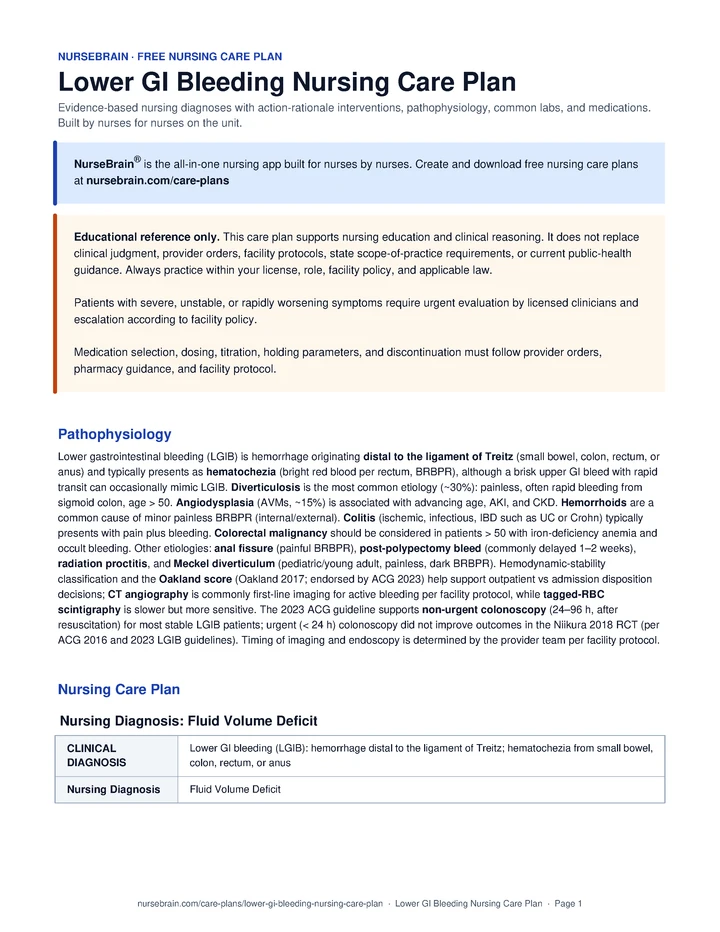
Lower Gastrointestinal Bleeding Nursing Care Plan
Lower GI bleed nursing care plan with prioritized diagnoses, fluid resuscitation, hemodynamic monitoring, and a printable PDF.
Nursing Care Plan
Nursing Diagnosis 1: Hypovolaemia
Fluid Volume Deficit related to Lower GI bleeding (LGIB): hemorrhage distal to the ligament of Treitz; hematochezia from small bowel, colon, rectum, or anus as evidenced by Acute blood loss per rectum (hematochezia / BRBPR); Hypotension (SBP < 90 mmHg or below ordered parameters) or orthostatic changes; Tachycardia (HR > 100 bpm or above ordered parameters); Hemoglobin drop > 2 g/dL on serial CBC; Urine output < 0.5 mL/kg/hr.
Interventions
- Monitor vital signs at intervals matched to clinical acuity and facility protocol (commonly q15min during active bleeding, q1h once stable); maintain continuous telemetry as ordered.
- Assess for orthostatic changes (SBP drop > 20 mmHg or HR rise > 20 bpm sitting to standing) when clinical state supports the maneuver and per facility protocol.
- Document stool output: volume, color (bright red vs maroon vs melena), frequency, and presence of clots.
- Trend serial CBC per provider order during active bleed; report Hgb drop > 2 g/dL or values outside ordered parameters.
- Track strict hourly intake and output; report UOP < 0.5 mL/kg/hr for 2 consecutive hours.
- Trend lactate, base deficit, and ABG/VBG per provider order.
- Establish two large-bore (commonly 16–18 G) peripheral IVs early in presentation per facility protocol.
- Administer ordered IV crystalloid (NS or LR) per provider direction; reassess MAP, urine output, lung exam, and lactate after each bolus.
- Send type and crossmatch per provider order; coordinate availability of PRBC units per facility protocol. Massive transfusion protocol activation is a provider-team decision per facility criteria.
- Administer ordered PRBCs per facility transfusion policy. A restrictive transfusion strategy (commonly Hgb 7–8 g/dL) is preferred in many stable patients per current evidence; the threshold is a provider-team decision.
- Position the patient supine during active hypotension. A brief passive leg raise can support fluid-responsiveness assessment when ordered; reposition lateral for stool and perianal assessment as needed.
- Explain to the patient and family the rationale for frequent vital signs, IV fluids, and blood draws.
- Educate on blood-product transfusion: process, expected duration, and signs of reaction to report.
- Teach the patient to report new lightheadedness, syncope, or sense of impending faintness immediately.
- Notify the provider for SBP below ordered parameters unresponsive to bolus, Hgb drop > 2 g/dL, persistent UOP < 0.5 mL/kg/hr, or any rapid clinical change.
- Coordinate with GI, interventional radiology, and surgery per facility protocol. CT angiography is commonly first-line for hemodynamically unstable or ongoing bleeding; non-urgent colonoscopy (24–96 h after resuscitation) is supported for many stable patients per ACG 2023.
Outcome: MAP, HR, urine output, and lactate trend are monitored and reported within ordered parameters; Hemoglobin trend is documented and reported per facility protocol; Perfusion indicators (skin temperature, color, capillary refill) are monitored and changes are reported.
Nursing Diagnosis 2: Impaired Cardiovascular System
Cardiovascular Alteration related to Lower GI bleeding (LGIB): hemorrhage distal to the ligament of Treitz; hematochezia from small bowel, colon, rectum, or anus as evidenced by Acute hemorrhage with estimated blood loss > 1500 mL or ongoing brisk BRBPR; Sustained hypotension despite ordered crystalloid resuscitation; Tachycardia > 120 bpm with narrowed pulse pressure; Cool, mottled extremities and delayed capillary refill; Decreased level of consciousness or new confusion.
Interventions
- Continuously monitor cardiac rhythm; document any new arrhythmias (sinus tachycardia, AFib with RVR, ectopy).
- Assess apical and peripheral pulses for rate, rhythm, quality, and pulse deficit at intervals matched to clinical acuity.
- Check capillary refill, skin temperature, and peripheral color hourly during active bleeding.
- Assess level of consciousness, orientation, and behavior every 1–2 hours.
- Monitor for chest pain, dyspnea, or new ECG changes (ST depression, T-wave inversion).
- Trend lactate, base deficit, and mixed venous saturation when available per provider order.
- Maintain two patent large-bore IVs. Central line placement and vasopressor support are provider-team decisions per facility protocol; nurses prepare for assist as ordered.
- Administer ordered fluid and blood products per resuscitation orders and facility protocol. Crystalloid volumes > 2 L before blood are commonly avoided per current resuscitation practice; product strategy is a provider-team decision.
- Administer anticoagulation reversal agents as ordered (vitamin K + 4F-PCC for warfarin; andexanet alfa for factor Xa inhibitors; idarucizumab for dabigatran) per provider direction, pharmacy guidance, and facility protocol.
- Cluster cares to support rest periods and reduce myocardial oxygen demand.
- Hold or reduce home antihypertensives, beta-blockers, and diuretics as ordered during active bleeding.
- Teach the patient to report new chest pain, palpitations, lightheadedness, or shortness of breath immediately.
- Explain the rationale for holding home cardiac medications and the plan for restart once the provider team determines the patient is stable.
- Notify the provider for persistent SBP below ordered parameters, MAP < 65 mmHg, new mottling, decreased LOC, or UOP < 0.5 mL/kg/hr.
- Coordinate cardiology consultation for new ischemic ECG changes, troponin rise, or arrhythmia when ordered by the provider.
Outcome: MAP and perfusion indicators are monitored and reported within ordered parameters; Mental status is assessed and changes are communicated promptly; Lactate trend is documented and reported to the provider team.
Nursing Diagnosis 3: Impaired Cardiac Output
Cardiac Output Alteration related to Lower GI bleeding (LGIB): hemorrhage distal to the ligament of Treitz; hematochezia from small bowel, colon, rectum, or anus as evidenced by Sustained hypotension (MAP below ordered parameters) despite ordered resuscitation; Tachycardia disproportionate to clinical state and volume status; Cool, mottled, or pale extremities with capillary refill > 3 seconds; Decreased urine output (< 0.5 mL/kg/hr); Lactic acidosis (lactate > 2 mmol/L) failing to clear.
Interventions
- Monitor arterial line or noninvasive blood pressure per facility protocol and document MAP at intervals matched to clinical acuity.
- Monitor cardiac rhythm continuously; document new arrhythmias.
- Assess skin color, temperature, mottling, and capillary refill at intervals matched to clinical acuity.
- Monitor hourly urine output via indwelling catheter when ordered; report UOP < 0.5 mL/kg/hr for 2 consecutive hours.
- Trend serial lactate per provider order during resuscitation; report values > 4 mmol/L.
- Review echocardiogram findings when ordered; report new wall-motion abnormalities or reduced ejection fraction.
- Establish reliable IV access. Central venous access and vasopressor support are provider-team decisions per facility protocol; nurses prepare for and assist with placement as ordered.
- Administer ordered vasoactive medications per provider direction and facility protocol; monitor MAP, rhythm, urine output, peripheral perfusion, and signs of extravasation.
- Administer ordered crystalloid and blood products per provider direction; monitor MAP, lung exam, urine output, and lactate after each ordered bolus.
- Maintain strict hourly intake and output. Calculate and document net 24-hour balance per facility protocol.
- When the patient is alert, explain in plain language what the lines, drips, and monitors are doing.
- Educate the family on the goals of resuscitation and what improvement looks like (warm extremities, urine output, falling lactate).
- Notify the provider for rising lactate, decreasing urine output, hypotension, new mental-status change, or new ischemic ECG changes.
- Coordinate with cardiology and critical care for refractory hypotension, ongoing arrhythmia, or signs of demand ischemia when ordered by the provider.
Outcome: MAP, urine output, and perfusion indicators are monitored and reported within ordered parameters; Mental status is assessed and changes are reported promptly; Lactate clearance is monitored and communicated to the provider team.
Nursing Diagnosis 4: Risk For Haemorrhaging
Bleeding Risk related to Lower GI bleeding (LGIB): hemorrhage distal to the ligament of Treitz; hematochezia from small bowel, colon, rectum, or anus as evidenced by Active or recent hematochezia from any LGIB source; Anticoagulation (warfarin, DOAC, heparin) or antiplatelet therapy on admission; Coagulopathy (INR > 1.5, aPTT prolonged, platelets < 50); Hepatic dysfunction with impaired clotting-factor synthesis; Recent endoscopic intervention (polypectomy, banding, sclerotherapy) with risk for delayed bleeding.
Interventions
- Inspect every stool and any output for fresh blood, clots, or melena; document volume, color, and frequency.
- Trend Hgb, INR, aPTT, fibrinogen, and platelets per provider order.
- Review the medication list on admission for anticoagulants, antiplatelets, NSAIDs, and SSRIs; document last dose and timing.
- Inspect IV sites, gums, and skin for new oozing, bruising, or petechiae each shift.
- Monitor for delayed post-procedure bleeding signs (1–2 weeks post-polypectomy) when relevant.
- Administer ordered anticoagulation reversal (vitamin K + 4F-PCC for warfarin; andexanet alfa for factor Xa inhibitors; idarucizumab for dabigatran) per provider direction, pharmacy guidance, and facility protocol.
- Verify the reversal agent matches the offending anticoagulant before administration; recheck INR or anti-Xa per provider order.
- Hold home anticoagulants and antiplatelets per provider order. Document hold rationale and reassess daily for ordered resumption.
- Coordinate platelet and FFP administration as ordered for thresholds set by the provider team (commonly platelets < 50 or INR > 1.5 with active bleeding).
- Avoid IM injections, rectal temperatures, and unnecessary venipuncture when active bleeding or significant coagulopathy is present.
- Teach the patient and family to avoid NSAIDs (ibuprofen, naproxen, ketorolac, non-cardioprotective aspirin) and review acetaminophen as an alternative when ordered.
- Educate post-polypectomy patients that delayed bleeding can occur 1–2 weeks after the procedure; provide a 24/7 contact number per facility protocol.
- Review anticoagulant resumption instructions before discharge, including the provider-determined restart date and warning signs of re-bleed.
- Notify the provider for new or recurrent hematochezia, rising heart rate, falling blood pressure, or coagulation values outside ordered parameters.
- Coordinate with GI, interventional radiology, and surgery for source control as ordered by the provider team.
Outcome: Hgb, INR, aPTT, and platelets are monitored and reported per facility protocol; Active bleeding is identified early and communicated to the provider team; Anticoagulation reversal, when ordered, is administered safely with monitoring for therapeutic and adverse response.
Nursing Diagnosis 5: Anxiety
Anxiety related to Lower GI bleeding (LGIB): hemorrhage distal to the ligament of Treitz; hematochezia from small bowel, colon, rectum, or anus as evidenced by Patient verbalization of fear about active bleeding or possible recurrence; Visible blood in stool, on linens, or on the patient’s body; Restlessness, hypervigilance, or tachycardia disproportionate to clinical state; Unfamiliarity with the hospital environment, bowel prep, or colonoscopy; Sleep disturbance from monitor alarms and frequent interventions.
Interventions
- Assess anxiety level using a 0–10 scale at the start of every shift and PRN.
- Identify the patient’s stated triggers (visible blood, fear of dying, fear of colonoscopy, monitor alarms, pain).
- Observe for physical signs of anxiety: tachycardia disproportionate to clinical state, restlessness, hand-wringing, hypervigilance.
- Assess sleep quality and contributors (alarms, lighting, frequent interventions, pain, anxiety) daily.
- Provide a calm, reassuring presence; speak clearly and at a measured pace.
- Explain procedures and findings in plain, patient-friendly terms before performing them.
- Remove soiled linens and clean the patient promptly after each bleeding episode; preserve dignity throughout.
- Cluster cares to support uninterrupted rest periods when clinical state allows.
- Limit non-essential nighttime stimuli (overhead lights, loud conversations, unnecessary alarms) per facility protocol.
- Facilitate family visits and contact within facility policy.
- Teach diaphragmatic breathing and grounding techniques the patient can use independently.
- Educate the patient and family on LGIB: common causes, what the workup looks like, and why painless bleeding does not necessarily mean a worse prognosis.
- Teach the family what ICU or step-down alarms mean and what is routine versus concerning.
- Coordinate chaplaincy, social work, or psych services when anxiety persists or worsens despite non-pharmacologic measures, per facility protocol.
- Notify the provider for severe or persistent anxiety unresponsive to non-pharmacologic measures.
Outcome: Patient verbalizes decreased anxiety; Patient demonstrates at least one coping strategy (diaphragmatic breathing, grounding, music); Patient sleeps in extended blocks when clinical state allows.
Nursing Diagnosis 6: Lack Of Knowledge
Knowledge Deficit related to Lower GI bleeding (LGIB): hemorrhage distal to the ligament of Treitz; hematochezia from small bowel, colon, rectum, or anus as evidenced by Patient or family asks questions about cause of bleeding; First episode of LGIB with no prior workup; Verbalized confusion about bowel prep, colonoscopy, or follow-up plan; Cultural, language, or health-literacy barriers; Limited understanding of high-fiber diet, NSAID avoidance, or hemorrhoid care.
Interventions
- Assess baseline understanding of LGIB, its likely etiology, and the planned workup.
- Identify learning style preferences (visual, written, demonstration) and any cultural or language barriers.
- Assess patient anxiety, readiness to learn, and presence of a family member or caregiver.
- Provide written materials at ≤ 6th-grade reading level in the patient’s preferred language when available.
- Use teach-back methodology for every major teaching point.
- Reinforce the ordered bowel-prep regimen with the patient (commonly 4–6 L PEG over 4–6 hours, clear-liquid diet day prior, NPO from midnight per facility protocol).
- Educate on a high-fiber diet (commonly 25–35 g/day) and fluid intake (commonly 2 L/day when no contraindication) for diverticular disease prevention.
- Teach NSAID avoidance (ibuprofen, naproxen, ketorolac, non-cardioprotective aspirin) and review acetaminophen as a preferred alternative when ordered.
- Educate on signs warranting ED return: large-volume BRBPR, dizziness, syncope, chest pain, or persistent abdominal pain.
- Teach post-polypectomy patients that delayed bleeding can occur 1–2 weeks after the procedure; provide a 24/7 contact number per facility protocol.
- Educate on perianal and hemorrhoidal care: sitz baths, fiber, stool softeners, and avoiding straining.
- Review the medication reconciliation list, especially anticoagulant or antiplatelet restart instructions per provider direction.
- Confirm the date and location of follow-up colonoscopy, GI clinic, and primary care visits before discharge.
- Coordinate referrals to GI, colorectal surgery, or dietitian as indicated by etiology and provider order.
- Document teach-back completion in the chart and communicate any remaining gaps to the outpatient team.
Outcome: Patient verbalizes the most likely cause of their LGIB and the planned workup in plain language; Patient describes the bowel-prep regimen ordered for them (commonly 4–6 L PEG over 4–6 h per facility protocol); Patient verbalizes dietary fiber goal (commonly 25–35 g/day) and adequate fluid intake when no contraindication.
Pathophysiology
Lower gastrointestinal bleeding (LGIB) is hemorrhage originating distal to the ligament of Treitz (small bowel, colon, rectum, or anus) and typically presents as hematochezia (bright red blood per rectum, BRBPR), although a brisk upper GI bleed with rapid transit can occasionally mimic LGIB. Diverticulosis is the most common etiology (~30%): painless, often rapid bleeding from sigmoid colon, age > 50. Angiodysplasia (AVMs, ~15%) is associated with advancing age, AKI, and CKD.
Hemorrhoids are a common cause of minor painless BRBPR (internal/external). Colitis (ischemic, infectious, IBD such as UC or Crohn) typically presents with pain plus bleeding. Colorectal malignancy should be considered in patients > 50 with iron-deficiency anemia and occult bleeding. Other etiologies: anal fissure (painful BRBPR), post-polypectomy bleed (commonly delayed 1–2 weeks), radiation proctitis, and Meckel diverticulum (pediatric/young adult, painless, dark BRBPR).
Hemodynamic-stability classification and the Oakland score (Oakland 2017; endorsed by ACG 2023) help support outpatient vs admission disposition decisions; CT angiography is commonly first-line imaging for active bleeding per facility protocol, while tagged-RBC scintigraphy is slower but more sensitive. The 2023 ACG guideline supports non-urgent colonoscopy (24–96 h, after resuscitation) for most stable LGIB patients; urgent (< 24 h) colonoscopy did not improve outcomes in the Niikura 2018 RCT (per ACG 2016 and 2023 LGIB guidelines). Timing of imaging and endoscopy is determined by the provider team per facility protocol.
Quick Reference
- Oakland score: ≤ 8 may support outpatient disposition
- CT angiography: Detects ~0.5 mL/min bleed (commonly first-line)
- Tagged RBC scan: Detects ~0.1 mL/min (more sensitive, slower)
- Colonoscopy timing: 24–96 h after stabilization (non-urgent, ACG 2023)
- Endoscopic success: > 90% initial hemostasis when stigmata identified
Common Labs
| Lab | Normal range | Significance in Lower GI Bleed |
|---|---|---|
| CBC (serial Hgb) | Hgb 12–17 g/dL | Trend per provider order during active bleed; a drop > 2 g/dL can support ongoing loss. Nurses report values outside ordered parameters. |
| Type & Cross | ABO/Rh + antibody screen | Obtain on admission per provider order. Coordinate availability of PRBCs per facility protocol. Massive transfusion protocol activation is a provider-team decision per facility criteria. |
| PT / INR | INR 0.8–1.2 | Elevated on warfarin/DOAC or hepatic dysfunction. Reversal thresholds and agent selection are provider-team decisions per facility protocol; nurses administer as ordered. |
| aPTT | 25–35 sec | Elevated on heparin. Reversal with protamine is ordered by the provider team per facility protocol. |
| Platelets | 150–400 × 109/L | Transfusion thresholds (commonly < 50 with active bleed or < 30 baseline) are provider-team decisions per facility protocol. |
| BUN / Cr | 7–20 / 0.6–1.2 mg/dL | Unlike UGIB, LGIB does not predictably elevate BUN:Cr. Baseline renal function supports contrast-imaging and medication decisions by the provider team. |
| Lactate | < 2 mmol/L | Elevated values can reflect hypoperfusion. Nurses trend lactate during resuscitation and report findings to support escalation discussions with the provider team. |
| CEA | < 3 ng/mL (nonsmoker) | Ordered by the provider when colorectal malignancy is suspected. Nurses do not independently order tumor markers. |
| Stool studies | C. difficile, calprotectin, FOBT | Workup for infectious/IBD etiology when ordered by the provider. FOBT/FIT is a screening test and adds limited value in overt hematochezia. |
| LFTs / Electrolytes | ALT/AST/Alb, Na/K/Cl/CO2 | Baseline hepatic synthesis and electrolytes; replacement of K+/Mg2+ before procedures is a provider-team decision per facility protocol. |
Common Medications
| Class | Examples | Mechanism of action | Key side effects | Nursing considerations |
|---|---|---|---|---|
| IV crystalloid | Normal saline (NS), Lactated Ringer’s (LR) | Volume expansion to support intravascular volume and perfusion. | Volume overload, dilutional coagulopathy, hyperchloremic acidosis with large-volume NaCl. | Administer as ordered. Two large-bore (16–18 G) IVs are commonly placed in active bleeding. Nurses monitor MAP, urine output, lung exam, and lactate trend after each ordered bolus and escalate worsening pulmonary findings per facility protocol. |
| PRBC transfusion | Packed red blood cells | Supports oxygen-carrying capacity. Restrictive transfusion strategy (Hgb 7–8 g/dL) is commonly preferred in stable patients per current evidence; threshold is a provider-team decision. | Transfusion reaction, TRALI, TACO, citrate toxicity in massive transfusion. | Administer as ordered per provider direction and facility transfusion policy. Verify two-RN check per facility protocol. Baseline vital signs then per facility protocol (commonly q15min × 1 h). Monitor for febrile, allergic, and hemolytic reactions; escalate per policy. |
| FFP + Platelets | Fresh frozen plasma, platelet concentrate | Replaces clotting factors and platelets in coagulopathic active bleeding. | Volume overload, TRALI, allergic reaction, alloimmunization. | Administer as ordered. Transfusion thresholds (commonly INR > 1.5 with active bleed or platelets < 50 × 109/L) are provider-team decisions per facility protocol. Nurses verify product, monitor for reaction, and escalate per policy. |
| Antiplatelet/anticoagulant hold | Aspirin, clopidogrel, warfarin, DOACs | Reduces pharmacologic bleeding driver; thrombotic risk (DAPT post-stent, mechanical valve) is weighed against bleeding risk by the provider team. | Stent thrombosis, stroke, valve thrombosis when held inappropriately. | Hold per provider order. Decisions are commonly case-by-case with cardiology or hematology input per facility protocol. Nurses document hold rationale per chart, reassess daily for ordered resumption, and clarify any unclear orders with the provider team. |
| Reversal agents | Vitamin K, 4-factor PCC, andexanet alfa, idarucizumab | Reverses warfarin (vitamin K + PCC), factor Xa inhibitors (andexanet), or dabigatran (idarucizumab) per agent-specific indication. | Thromboembolism (PCC, andexanet), anaphylaxis, volume load. | Administer as ordered per provider direction, pharmacy guidance, and facility protocol. Verify the agent matches the offending anticoagulant before administration. Monitor for rebound bleeding and thromboembolic events; recheck INR or anti-Xa post-dose per provider order. |
| Iron supplementation | Ferrous sulfate PO, iron sucrose IV | Replaces iron stores in chronic LGIB / iron-deficiency anemia (commonly outpatient management). | GI upset, constipation, dark stools (PO); infusion reaction (IV). | Administer as ordered. Nurses teach that PO iron is commonly taken on an empty stomach with vitamin C when tolerated, and that dark stools can be expected and may mask FOBT. |
| Local etiology-specific Tx | Hemorrhoidal banding, sclerotherapy, topical nitrates/CCB for fissure | Targets the local bleeding source: ligation or sclerosis for hemorrhoids; sphincter relaxation for fissures. | Pain, ulceration, infection, anal stenosis with over-banding. | Procedural therapies are performed by the provider team. Nurses support with sitz baths, stool softeners as ordered, and a high-fiber diet recommendation; assess pain per facility protocol. |
| Selective IR embolization / IA vasopressin | Microcoil or gelfoam embolization (commonly preferred); IA vasopressin (salvage, rarely used) | Targeted occlusion of the bleeding vessel at an angiographically localized source. | Bowel ischemia or infarction, contrast nephropathy, access-site complications. | Coordination with interventional radiology is a provider-team decision per facility protocol. Nurses monitor for new abdominal pain post-procedure, trend lactate, and assess the access site per facility protocol (commonly q1h × 4 then q4h). |
References
- Makic, M. B. F., & Martinez-Kratz, M. R. (Eds.). (2023). Ackley and Ladwig’s Nursing Diagnosis Handbook: An Evidence-Based Guide to Planning Care (13th ed.). Elsevier.
- Sengupta, N., Feuerstein, J. D., Jairath, V., Shergill, A. K., Strate, L. L., Wong, R. J., & Wan, D. (2023). 2023 ACG Clinical Guideline: Diagnosis and Management of Acute Lower Gastrointestinal Bleeding. American Journal of Gastroenterology, 118(2), 208–231.
- Strate, L. L., & Gralnek, I. M. (2016). ACG Clinical Guideline: Management of Patients with Acute Lower Gastrointestinal Bleeding. American Journal of Gastroenterology, 111(4), 459–474.
- Niikura, R., Nagata, N., Yamada, A., Honda, T., Hasatani, K., Ishii, N., et al. (2018). Efficacy and Safety of Early vs Elective Colonoscopy for Acute Lower Gastrointestinal Bleeding. Gastroenterology, 158(1), 168–175.
- Oakland, K., Jairath, V., Uberoi, R., Guy, R., Ayaru, L., Mortensen, N., Murphy, M. F., & Collins, G. S. (2017). Derivation and validation of a novel risk score for safe discharge after acute lower gastrointestinal bleeding: a modelling study. The Lancet Gastroenterology & Hepatology, 2(9), 635–643.
Frequently Asked Questions
What is the nursing care plan for Lower GI Bleed?
A Lower GI Bleed nursing care plan organizes the assessment, nursing diagnoses, goals, interventions, and evaluation criteria for a patient with Lower Gastrointestinal Bleeding. Diagnoses are ordered by what is currently most destabilizing for the patient.
What are the priority nursing diagnoses for Lower GI Bleed?
Priority diagnoses for Lower GI Bleed appear in the Nursing Diagnoses section above, ordered by clinical acuity. The top diagnosis should reflect what is currently most destabilizing for this specific patient.
What is the priority nursing intervention for Lower GI Bleed?
Priority interventions for Lower GI Bleed are listed in the care plan above, organized by diagnosis. The most critical actions address airway, circulation, and the highest-acuity problem first.
What complications should the nurse monitor for in Lower GI Bleed?
Complications to monitor for in Lower GI Bleed are listed within each diagnosis section above. Trend vitals, mental status, and the condition-specific red flags described in the assessment section.
Learn how NurseBrain Synapse uses the Clinical Care Classification System for nursing care plans.