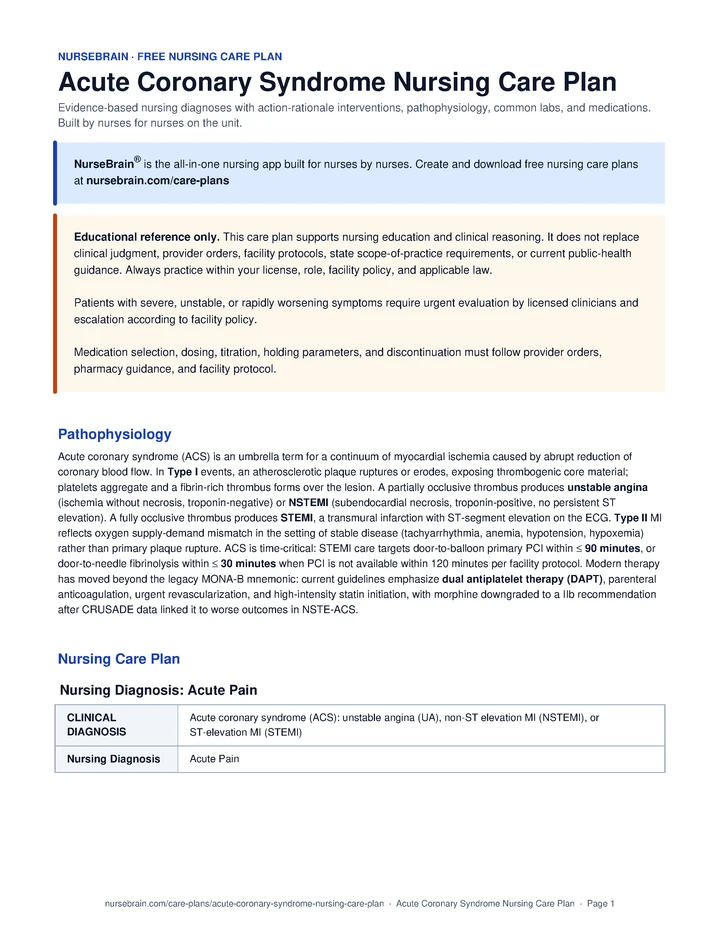
Acute Coronary Syndrome Nursing Care Plan
ACS (unstable angina/NSTEMI/STEMI) nursing care plan with prioritized diagnoses, interventions, and a printable PDF. Built by nurses for nurses.
Nursing Care Plan
Nursing Diagnosis 1: Acute Pain
Acute Pain related to Acute coronary syndrome (ACS): unstable angina (UA), non-ST elevation MI (NSTEMI), or ST-elevation MI (STEMI) as evidenced by Substernal chest pain > 10 minutes, not relieved by rest; Pain radiating to left arm, jaw, neck, or back; Pain rated ≥ 7/10 on 0–10 numeric scale; Diaphoresis, pallor, nausea or vomiting; Autonomic symptoms: anxiety, sense of impending doom.
Interventions
- Assess pain using PQRST (Provocation, Quality, Radiation, Severity, Timing) on arrival and with every report of pain.
- Obtain a 12-lead ECG within 10 minutes of arrival and with every recurrence of chest pain per facility protocol.
- Monitor cardiac rhythm continuously; document and report new arrhythmias, ST changes, or T-wave inversions.
- Assess vital signs (HR, BP, RR, SpO2) at intervals matched to clinical acuity and facility protocol; closer attention during active pain.
- Reassess pain after each ordered intervention (sublingual nitro, IV nitro titration per provider parameters, morphine).
- Auscultate heart sounds for new S3, S4, or murmur (possible papillary muscle rupture or VSD).
- Administer sublingual nitroglycerin as ordered for ongoing chest pain; hold for SBP < 90 per provider parameters.
- Administer aspirin 162–325 mg chewed (not swallowed) on arrival as ordered unless contraindicated.
- Initiate or titrate IV nitroglycerin as ordered per provider parameters and facility protocol for refractory pain or hypertension.
- Administer supplemental oxygen as ordered when SpO2 < 90% or with respiratory distress, per current 2013 STEMI / 2014 NSTE-ACS guidance.
- Administer IV morphine as ordered for chest pain refractory to maximal ordered nitrate therapy.
- Maintain bed rest with HOB 30–45 degrees during active pain; cluster cares to support reduced O2 demand.
- Teach the patient to report any new or returning chest pain immediately, even if mild.
- Educate on the home nitroglycerin protocol per current AHA guidance: one SL tablet, wait 5 minutes; if pain persists, call 911 and take a second dose.
- Teach patient to recognize atypical presentations (jaw or arm pain, dyspnea, nausea), which are commonly described in women, older adults, and patients with diabetes.
- Notify the provider and support activation of the facility STEMI protocol per provider order for ST elevation ≥ 1 mm in ≥ 2 contiguous leads (with sex- and age-specific V2–V3 thresholds), suspected posterior MI (V7–V9), suspected RV MI (V4R), or new LBBB with Sgarbossa-positive findings; coordinate cath-lab notification per facility workflow and request right-sided and posterior leads when posterior or inferior MI is suspected.
- Notify the provider for pain unresponsive to maximal ordered nitrate therapy, hemodynamic instability, or new arrhythmia.
Outcome: Patient reports chest pain within ordered parameters within 30 minutes of intervention; Patient reports resolution or sustained improvement of chest pain within 60 minutes; Autonomic symptoms (diaphoresis, nausea, pallor) are monitored and reported as they resolve.
Nursing Diagnosis 2: Impaired Cardiac Output
Cardiac Output Alteration related to Acute coronary syndrome (ACS): unstable angina (UA), non-ST elevation MI (NSTEMI), or ST-elevation MI (STEMI) as evidenced by Reduced LVEF on echocardiogram (< 40%); S3 gallop on auscultation; Cool, mottled extremities; capillary refill > 3 seconds; Urine output < 0.5 mL/kg/hr; Altered mental status (restlessness, confusion).
Interventions
- Monitor continuous cardiac rhythm; document and report new ST changes, arrhythmias, or conduction blocks.
- Assess hemodynamics (HR, BP and MAP, RR, SpO2, temperature) at intervals matched to clinical acuity and facility protocol, with closer attention during the first 24 hours.
- Check capillary refill, skin temperature, peripheral pulses, and mottling at intervals matched to clinical acuity.
- Monitor urine output hourly; notify the provider for < 30 mL/hr or < 0.5 mL/kg/hr for 2 consecutive hours per facility protocol.
- Assess mental status, orientation, and behavior at intervals matched to clinical acuity.
- Auscultate heart sounds each shift for new S3, S4, or murmur.
- Monitor troponin trend, BNP, and serial ECGs as ordered.
- Administer prescribed beta-blocker (metoprolol, carvedilol, bisoprolol) on schedule as ordered once the patient is hemodynamically stable.
- Recheck HR and BP before each dose; hold beta-blocker for HR < 50 or SBP < 90 per provider parameters and notify the provider.
- Administer ordered ACE-I or ARB within 24 hours as ordered for LVEF < 40%, HTN, DM, or anterior MI.
- Maintain two patent IV access sites per facility protocol for fluids, vasoactive medications, and emergency drugs.
- Provide adequate rest periods between care activities and limit non-essential interruptions.
- Teach the patient and family to recognize possible signs of worsening cardiac function: fatigue, dyspnea, lightheadedness, palpitations, decreased UOP.
- Educate that beta-blockers should not be stopped without provider guidance because of the potential for rebound tachycardia and ischemia.
- Findings such as sustained SBP < 90 mmHg, MAP < 65, mottling, decreased LOC, or UOP < 0.5 mL/kg/hr should prompt urgent reassessment and provider notification; coordinate ICU-level care per facility protocol.
- Coordinate cardiology consultation for echocardiogram, post-MI risk stratification, and ICD or CRT evaluation if LVEF ≤ 35% at 40 days, per facility protocol.
Outcome: MAP, urine output, and perfusion indicators are monitored and reported within ordered parameters; Heart rate and rhythm are within ordered parameters (commonly 60–80 bpm on beta-blocker); Capillary refill and extremity warmth are monitored and changes reported promptly.
Nursing Diagnosis 3: Impaired Urinary System Function
Anxiety related to Acute coronary syndrome (ACS): unstable angina (UA), non-ST elevation MI (NSTEMI), or ST-elevation MI (STEMI) as evidenced by Patient verbalization of fear of dying; Restlessness, hypervigilance, inability to sit still; Tachycardia disproportionate to clinical state and beta-blocker dose; Hyperventilation; Patient asking repeated questions about prognosis.
Interventions
- Assess anxiety level using a 0–10 scale at the start of every shift and PRN.
- Identify the patient’s stated triggers (fear of dying, fear of future MI, financial worry, family concerns).
- Observe for physical signs: tachycardia disproportionate to clinical state, restlessness, diaphoresis, hyperventilation.
- Assess sleep quality, nightmares, and intrusive thoughts daily; consider early PTSD screening after a life-threatening event per facility protocol.
- Provide a calm, reassuring presence; speak clearly and at a measured pace.
- Explain procedures, alarms, and tests in patient-friendly terms before performing them.
- Facilitate family presence during stable periods and during procedures where facility policy permits.
- Cluster cares to allow uninterrupted rest periods of at least 30 minutes when clinical state permits, especially overnight.
- Limit non-essential stimuli at night (overhead lights, loud conversations, non-critical alarms) per facility protocol.
- Teach diaphragmatic breathing and 5-4-3-2-1 grounding techniques the patient can use independently.
- Educate the patient and family on what monitor alarms mean and which findings are clinically concerning.
- Provide written, plain-language information on ACS, PCI, medications, and recovery expectations.
- Teach progressive muscle relaxation as a non-pharmacologic sleep-onset aid.
- Coordinate referral to cardiac rehabilitation; structured programs have been associated with reduced anxiety, depression, and recurrent events.
- Coordinate chaplaincy, social work, or psych services if anxiety persists, depression emerges, or PTSD symptoms develop.
- Notify the provider for severe or persistent anxiety unresponsive to non-pharmacologic measures.
Outcome: Patient verbalizes decreased anxiety; Patient demonstrates at least one coping strategy (breathing, grounding); Heart rate consistent with clinical state and beta-blocker dosing.
Nursing Diagnosis 4: Risk For Haemorrhaging
Bleeding Risk related to Acute coronary syndrome (ACS): unstable angina (UA), non-ST elevation MI (NSTEMI), or ST-elevation MI (STEMI) as evidenced by Dual antiplatelet therapy (ASA + P2Y12 inhibitor); Concurrent parenteral anticoagulation (UFH, LMWH, or bivalirudin); Recent PCI with arterial access (groin or wrist); Recent or planned fibrinolytic therapy; Advanced age, low body weight, or reduced renal function.
Interventions
- Confirm or document TIMI and/or GRACE risk score on admission for NSTE-ACS patients per provider order; review the planned strategy (immediate < 2 h, early invasive < 24 h, delayed invasive < 72 h, or ischemia-guided) with the provider team.
- Inspect the cath access site (groin or wrist) for hematoma, bleeding, bruit, or pulsatile mass per facility protocol (commonly every 15 minutes × 4, then per protocol).
- Assess peripheral pulses (radial, dorsalis pedis, posterior tibial) for presence, symmetry, and strength each shift, with closer attention to the access limb post-cath.
- Monitor for signs of GI bleeding (melena, hematemesis, falling Hgb) given DAPT plus anticoagulation.
- Perform a focused neurologic assessment at intervals matched to clinical acuity (LOC, orientation, motor and sensory symmetry, speech).
- Monitor renal function (BUN, Cr, eGFR, UOP) for 48–72 hours after contrast exposure per provider order.
- Monitor platelet count during UFH or LMWH therapy and report a drop > 50% from baseline or new thrombocytopenia.
- Administer prescribed antiplatelet (ASA + P2Y12) and anticoagulant therapy as ordered per provider direction and facility protocol.
- Administer high-intensity statin (atorvastatin 80 mg or rosuvastatin 40 mg) as ordered as soon as feasible.
- Encourage adequate oral hydration unless restricted; coordinate IV hydration pre- or post-cath per facility protocol and provider order.
- Position the cath access limb straight per facility protocol; reinforce bed rest for the prescribed duration.
- Implement fall precautions while the patient is on DAPT plus anticoagulation; keep floors clear and the call light within reach per facility protocol.
- Teach the patient signs of bleeding to report immediately: black stools, blood in urine, severe headache, easy bruising, prolonged bleeding from cuts.
- Teach the patient to recognize possible signs of stroke (FAST: Face droop, Arm weakness, Speech difficulty, Time to call 911).
- Reinforce that DAPT should continue uninterrupted for the prescribed duration (commonly ≥ 12 months post-PCI; individualized using DAPT and PRECISE-DAPT scores), and that changes should be coordinated with cardiology.
- Educate on lifestyle modification: smoking cessation, Mediterranean-style or DASH-style diet, ≥ 150 minutes per week of aerobic activity post-rehab per provider clearance.
- Notify the provider for new neurologic deficits, new chest pain, decreased UOP, rising Cr, drop in Hgb, or active bleeding from any site.
- Coordinate cardiac rehabilitation referral before discharge (Class I, commonly ≥ 36 sessions over 12 weeks).
Outcome: Cath access site (groin or wrist) is monitored and bleeding or hematoma is reported per facility protocol; Hgb, platelet count, and coagulation values are monitored and reported within ordered parameters; Signs of GI bleeding (melena, hematemesis, falling Hgb) are monitored and reported promptly.
Nursing Diagnosis 5: Lack Of Knowledge
Knowledge Deficit related to Acute coronary syndrome (ACS): unstable angina (UA), non-ST elevation MI (NSTEMI), or ST-elevation MI (STEMI) as evidenced by First-time ACS presentation; Patient or family verbalizes uncertainty about diagnosis, medications, or follow-up; Health literacy concerns; Multiple new medications (DAPT, statin, beta-blocker, ACE-I or ARB); Recommended lifestyle changes (diet, smoking cessation, activity).
Interventions
- Assess baseline knowledge of ACS, prior cardiac history, and previous education on heart disease.
- Assess health literacy using the teach-back method; ask the patient to explain in their own words.
- Identify learning preferences and barriers: vision, hearing, language, cognition, cultural beliefs, motivation.
- Assess medication-management capacity: ability to read labels, manage a multi-drug regimen, and afford prescriptions.
- Provide structured, written discharge teaching covering diagnosis, medications, lifestyle, and follow-up.
- Demonstrate sublingual nitroglycerin administration and have the patient teach-back the protocol.
- Review each medication: name, purpose, dose, schedule, key side effects, and what to do if a dose is missed.
- Coordinate dietitian consult for Mediterranean-style or DASH-style diet education before discharge per facility protocol.
- Coordinate pharmacy review of the discharge medication list with focus on duplications, interactions, and cost.
- Teach signs and symptoms warranting 911 activation: chest pain > 5 minutes, syncope, severe dyspnea, signs of stroke.
- Educate on smoking cessation: pharmacotherapy options (NRT, varenicline, bupropion), quit lines, and behavioral support per provider order.
- Teach a graded activity progression: short daily walks, advancing per cardiac rehab plan, and avoiding heavy lifting until cleared by the provider team.
- Educate on DAPT adherence: changes are coordinated with cardiology; plan ahead for refills; hold per protocol before surgery only with cardiology input.
- Review sexual activity guidance: resumption is commonly considered safe when the patient can climb 2 flights of stairs without symptoms; nitrates are contraindicated with PDE-5 inhibitors for 24–48 hours.
- Schedule cardiology follow-up within 7–14 days and primary care follow-up within 30 days before discharge per facility protocol.
- Coordinate cardiac rehabilitation referral before discharge; provide the phone number and verify enrollment.
- Coordinate social work for transportation, medication cost, and home support if barriers are identified.
Outcome: Patient and family verbalize understanding of the ACS diagnosis and the role of each medication; Patient demonstrates the home nitroglycerin protocol (one SL, wait 5 minutes, call 911 if pain persists); Patient verbalizes signs and symptoms warranting 911 activation.
Pathophysiology
Acute coronary syndrome (ACS) is an umbrella term for a continuum of myocardial ischemia caused by abrupt reduction of coronary blood flow. In Type I events, an atherosclerotic plaque ruptures or erodes, exposing thrombogenic core material; platelets aggregate and a fibrin-rich thrombus forms over the lesion. A partially occlusive thrombus produces unstable angina (ischemia without necrosis, troponin-negative) or NSTEMI (subendocardial necrosis, troponin-positive, no persistent ST elevation). A fully occlusive thrombus produces STEMI, a transmural infarction with ST-segment elevation on the ECG.
Type II MI reflects oxygen supply-demand mismatch in the setting of stable disease (tachyarrhythmia, anemia, hypotension, hypoxemia) rather than primary plaque rupture. ACS is time-critical: STEMI care targets door-to-balloon primary PCI within ≤ 90 minutes, or door-to-needle fibrinolysis within ≤ 30 minutes when PCI is not available within 120 minutes per facility protocol. Modern therapy has moved beyond the legacy MONA-B mnemonic: current guidelines emphasize dual antiplatelet therapy (DAPT), parenteral anticoagulation, urgent revascularization, and high-intensity statin initiation, with morphine downgraded to a IIb recommendation after CRUSADE data linked it to worse outcomes in NSTE-ACS.
Quick Reference
- Door-to-balloon (STEMI PCI): ≤ 90 min
- Door-to-needle (fibrinolytic): ≤ 30 min
- Sublingual nitro (home): 0.4 mg; call 911 if pain persists after first dose
- Aspirin loading dose: 162–325 mg chewed
- HR target on beta-blocker: 60–80 bpm
Common Labs
| Lab | Normal range | Significance in ACS |
|---|---|---|
| Troponin (I or T, hs) | < 99th percentile URL | Per provider order, the ESC 0/1-h or 0/2-h hs-cTn algorithm is commonly used (0/3-h is an acceptable alternative); a rising or falling pattern with ≥ 1 value above the URL supports an MI diagnosis. Nurses report results promptly. |
| CK-MB | 0–3 ng/mL | Falls faster than troponin; historically used to detect re-infarction within 72 hours. Largely superseded by hs-cTn delta (≥ 20% rise from post-MI baseline can support re-infarction); ordered at provider discretion. |
| BNP / NT-proBNP | < 100 / < 300 pg/mL | Elevated values can support HF risk and 30-day mortality stratification post-MI; trend supports provider-team decisions. |
| CBC (Hgb) | 12–17 g/dL | Baseline before anticoagulation; anemia can worsen supply-demand mismatch. Nurses report results to the provider team. |
| BMP (K+) | 3.5–5.0 mEq/L | Per current cardiology practice, K+ is commonly kept > 4.0 post-MI to support reduced ventricular arrhythmia risk; replacement is per provider order and facility protocol. |
| Creatinine / eGFR | 0.6–1.2 mg/dL | Pre-cath baseline; supports identification of contrast-induced nephropathy risk. |
| Lipid panel | LDL < 70 mg/dL post-ACS | Drawn on admission per provider order (fasting status is not required for statin initiation per current guidelines). |
| Hemoglobin A1c | < 7% | Supports screening for undiagnosed diabetes; informs long-term CV risk modification. |
| 12-lead ECG | Serial | STEMI = ≥ 1 mm STE in ≥ 2 contiguous leads, with sex- and age-specific V2–V3 thresholds (≥ 2 mm in men ≥ 40 y; ≥ 2.5 mm men < 40 y; ≥ 1.5 mm women). Posterior MI (ST depression V1–V3 with tall R; confirm with V7–V9) and RV MI (V4R) are STEMI equivalents. New LBBB warrants evaluation against Sgarbossa criteria for STEMI activation per facility protocol. |
| Echocardiogram | LVEF ≥ 50% | Post-event LVEF supports ACE-I or ARB, beta-blocker, and ICD-eligibility decisions by the provider team. |
Common Medications
| Class | Examples | Mechanism of action | Key side effects | Nursing considerations |
|---|---|---|---|---|
| Aspirin | ASA 162–325 mg chewed (loading), then 81 mg PO daily (maintenance) | Irreversibly inhibits COX-1 and blocks thromboxane A2, reducing platelet aggregation. | GI bleeding, dyspepsia, bronchospasm, allergic reaction. | Administer as ordered. Per provider direction and facility protocol, the loading dose is chewed (not swallowed) to support faster absorption; maintenance is commonly continued long-term post-MI unless contraindicated. Nurses monitor for bleeding, GI symptoms, allergic response, and hold per provider parameters. |
| P2Y12 inhibitor | Ticagrelor or prasugrel commonly preferred over clopidogrel in PCI-treated ACS | Blocks ADP-mediated P2Y12 receptor and supports sustained platelet inhibition (DAPT with ASA). | Bleeding, dyspnea (ticagrelor), bradyarrhythmia (ticagrelor), TTP (clopidogrel; rare). | Administer as ordered per provider direction, pharmacy guidance, and facility protocol. Standard DAPT duration is commonly ≥ 12 months post-PCI for ACS, individualized by the provider team using DAPT and PRECISE-DAPT scoring. Prasugrel is contraindicated with prior stroke or TIA, and is used with caution if ≥ 75 y or < 60 kg. Clopidogrel is commonly preferred when fibrinolysis is used or when ticagrelor or prasugrel is contraindicated. Duration may be extended in high ischemic / low bleeding risk patients or shortened (1–6 months) followed by P2Y12 monotherapy in high bleeding risk (PRECISE-DAPT ≥ 25). DAPT changes should be coordinated with cardiology. |
| Anticoagulant | UFH IV, enoxaparin (LMWH), bivalirudin | Inhibits thrombin generation or activity, supporting reduction of ongoing thrombus propagation. | Bleeding, HIT (UFH > LMWH), retroperitoneal hematoma post-cath. | Administer as ordered per provider direction and facility protocol. UFH is titrated to aPTT or anti-Xa per facility protocol; nurses monitor platelets for HIT. LMWH is commonly avoided when cath is imminent; UFH or bivalirudin is commonly preferred for an invasive strategy. Hold per cath-lab protocol and provider order. |
| Fibrinolytic (STEMI, no PCI) | Tenecteplase (weight-based IV bolus) commonly preferred; alteplase or reteplase as alternatives | Activates plasminogen, degrades fibrin, and supports restoration of coronary flow. | Intracranial hemorrhage (~1%), major bleeding, allergic reaction. | Administer prescribed fibrinolytic as ordered per provider direction and facility protocol. Door-to-needle ≤ 30 minutes is the common target when PCI is not available within 120 minutes. Absolute contraindications screened before administration commonly include prior ICH, ischemic stroke < 3 months, active bleeding, suspected aortic dissection, intracranial neoplasm or AVM, head or facial trauma < 3 months, and severe hypertension unresponsive to therapy. Nurses verify the checklist with the provider team and monitor for bleeding throughout. |
| Beta-blocker | Metoprolol tartrate or succinate, carvedilol, bisoprolol | Blocks β1 and supports reduced HR, contractility, and myocardial O2 demand. | Bradycardia, hypotension, bronchospasm, heart block, fatigue. | Administer as ordered. Per current guidelines, beta-blocker initiation within 24 hours is common if there is no shock, acute HF, or contraindication. Nurses hold for HR < 50 or SBP < 90 per provider parameters and facility protocol, and notify the provider. |
| High-intensity statin | Atorvastatin 80 mg, rosuvastatin 40 mg | HMG-CoA reductase inhibition supports LDL reduction, plaque stabilization, and anti-inflammatory effect. | Myalgia or myopathy, rhabdomyolysis (rare), ↑ LFTs, new-onset diabetes. | Administer as ordered as soon as feasible (fasting lipids are not required to start). Nurses support follow-up LFT and lipid checks at 4–12 weeks per provider order. |
| ACE-I or ARB | Lisinopril, enalapril / losartan, valsartan | Blocks angiotensin II and supports vasodilation, afterload reduction, and reverse remodeling. | Dry cough (ACE-I), ↑ K+, hypotension, angioedema, ↑ Cr. | Administer as ordered. Initiation within 24 hours is common if LVEF < 40%, HTN, DM, or anterior MI; nurses check BP and K+ or Cr pre-dose per provider parameters. |
| Nitroglycerin | SL 0.4 mg per provider parameters; IV gtt 5–200 mcg/min | Releases NO and supports venous > arterial vasodilation, reducing preload and ischemic pain. | Headache, hypotension, reflex tachycardia, tolerance. | Administer as ordered. Hold for SBP < 90, HR < 50 or > 100, suspected RV infarct, or recent PDE-5 inhibitor (24–48 hours) per provider parameters and facility protocol; notify the provider. |
| Morphine | 2–4 mg IV per provider parameters PRN | Mu-receptor agonist supports analgesia and venodilation, reducing preload. | Hypotension, respiratory depression, nausea, decreased absorption of oral P2Y12 inhibitors. | Administer as ordered for chest pain refractory to maximal nitrate therapy. Morphine carries a IIb recommendation; CRUSADE registry data have linked routine use to worse outcomes in NSTE-ACS via decreased oral antiplatelet absorption. Nurses monitor pain, respiratory status, and BP. |
References
- Makic, M. B. F., & Martinez-Kratz, M. R. (Eds.). (2023). Ackley and Ladwig’s Nursing Diagnosis Handbook: An Evidence-Based Guide to Planning Care (13th ed.). Elsevier.
- Rao, S. V., O’Donoghue, M. L., Ruel, M., et al. (2025). 2025 ACC/AHA/ACEP/NAEMSP/SCAI Guideline for the Management of Patients With Acute Coronary Syndromes. Circulation / Journal of the American College of Cardiology.
- Virani, S. S., Newby, L. K., Arnold, S. V., et al. (2023). 2023 AHA/ACC/ACCP/ASPC/NLA/PCNA Guideline for the Management of Patients With Chronic Coronary Disease. Circulation, 148(9), e9–e119.
- Amsterdam, E. A., Wenger, N. K., Brindis, R. G., et al. (2014). 2014 AHA/ACC Guideline for the Management of Patients With Non-ST-Elevation Acute Coronary Syndromes. Circulation, 130(25), e344–e426.
- O’Gara, P. T., Kushner, F. G., Ascheim, D. D., et al. (2013). 2013 ACCF/AHA Guideline for the Management of ST-Elevation Myocardial Infarction. Circulation, 127(4), e362–e425.
Frequently Asked Questions
What is the nursing care plan for ACS?
A ACS nursing care plan organizes the assessment, nursing diagnoses, goals, interventions, and evaluation criteria for a patient with Acute Coronary Syndrome. Diagnoses are ordered by what is currently most destabilizing for the patient.
What are the priority nursing diagnoses for ACS?
Priority diagnoses for ACS appear in the Nursing Diagnoses section above, ordered by clinical acuity. The top diagnosis should reflect what is currently most destabilizing for this specific patient.
What is the priority nursing intervention for ACS?
Priority interventions for ACS are listed in the care plan above, organized by diagnosis. The most critical actions address airway, circulation, and the highest-acuity problem first.
What complications should the nurse monitor for in ACS?
Complications to monitor for in ACS are listed within each diagnosis section above. Trend vitals, mental status, and the condition-specific red flags described in the assessment section.
A report sheet built for this patient
This is exactly the kind of patient the report sheet templates in NurseBrain® Synapse are built for. Keep everything you track on one page, all shift.
Learn how NurseBrain Synapse uses the Clinical Care Classification System for nursing care plans.