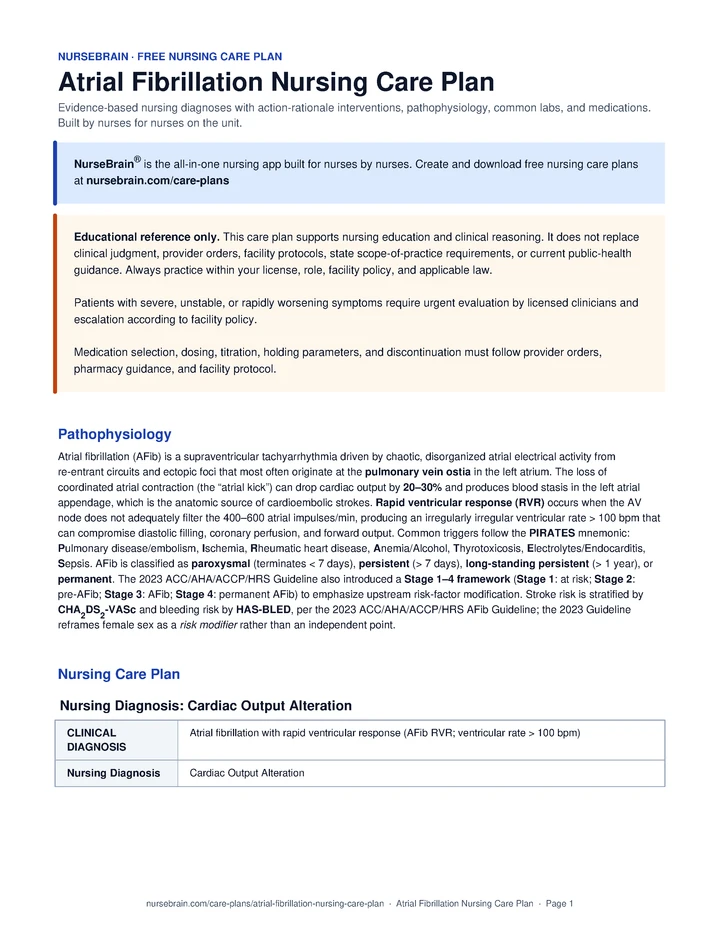
Atrial Fibrillation with RVR Nursing Care Plan
Complete A-fib with RVR nursing care plan with prioritized diagnoses, interventions, assessment, and a free printable PDF. Built by nurses for nurses.
Nursing Care Plan
Nursing Diagnosis 1: Impaired Cardiac Output
Cardiac Output Alteration related to Atrial fibrillation with rapid ventricular response (AFib RVR; ventricular rate > 100 bpm) as evidenced by Irregularly irregular ventricular rate 130–160 bpm; Loss of organized atrial contraction (no “atrial kick”); Hypotension with SBP 88–96 mmHg; Patient-reported palpitations, lightheadedness, dyspnea; Pulse deficit (apical > radial) on simultaneous auscultation/palpation.
Interventions
- Maintain continuous cardiac telemetry per facility protocol; document a rhythm strip each shift and with any rate change beyond ordered parameters.
- Auscultate apical pulse for a full 60 seconds and palpate radial pulse simultaneously each shift to identify pulse deficit.
- Monitor blood pressure at intervals matched to clinical acuity (commonly every 15 minutes during IV rate-control titration and every 1 hour once stable), per provider order and facility protocol.
- Assess for signs that may reflect low cardiac output: cool or mottled extremities, capillary refill > 3 sec, decreased urine output, altered LOC.
- Obtain a 12-lead ECG on admission and with any new chest pain or rate change beyond ordered parameters; report findings to the provider team.
- Monitor electrolytes (K+, Mg2+), TSH, troponin, and BNP per provider order and report findings.
- Administer ordered IV rate-control agent (commonly diltiazem or metoprolol) per provider direction and facility protocol; titrate within provider-set parameters and report response.
- Administer ordered potassium and magnesium repletion (commonly to K+ 4.0–4.5 mEq/L and Mg2+ > 2.0 mg/dL) per provider direction and facility protocol.
- Have defibrillator and sedation supplies at the bedside and verify the synchronized cardioversion workflow per ACLS and facility protocol when hemodynamic instability is a concern.
- Maintain IV access (commonly two lines) and confirm normal saline is available per facility protocol for fluid support during titration.
- Position the patient in semi-Fowler’s when tolerated; promote rest and limit unnecessary stimulation.
- Teach the patient to report palpitations, chest pain, dizziness, near-syncope, or shortness of breath promptly.
- Educate the patient on radial pulse self-checks (rate and regularity) and the role of consumer ECG devices when used.
- Review AFib triggers (PIRATES) and lifestyle modifications: limiting alcohol and caffeine, treating OSA, and weight reduction when BMI > 27.
- Notify the provider for HR sustained beyond ordered parameters despite rate control, SBP below ordered parameters, new chest pain, or decreased LOC.
- Coordinate cardiology consultation per facility protocol for rhythm-control strategy (cardioversion, antiarrhythmic, or catheter ablation) when the patient remains symptomatic despite rate control.
Outcome: Ventricular rate is monitored and reported within ordered parameters (commonly < 110 bpm lenient or < 80 bpm strict per provider goal); SBP and MAP are monitored and reported within ordered parameters; Palpitations and dyspnea are reassessed and changes are reported to the provider team.
Nursing Diagnosis 2: Ineffective Tissue Perfusion
Tissue Perfusion Alteration related to Atrial fibrillation with rapid ventricular response (AFib RVR; ventricular rate > 100 bpm) as evidenced by Blood stasis in the left atrial appendage from loss of organized atrial contraction; CHA2DS2-VASc score ≥ 2 (men) or ≥ 3 (women) — note the 2023 Guideline reframes female sex as a risk modifier rather than an independent point; Not currently on therapeutic anticoagulation; AFib duration > 48 hours or unknown duration; History of prior TIA or CVA.
Interventions
- Calculate and document the CHA2DS2-VASc score on admission and communicate it to the provider team.
- Calculate and document the HAS-BLED bleeding-risk score and the modifiable factors (HTN, labile INR, alcohol, NSAIDs).
- Perform focused neurological assessment at intervals matched to clinical acuity and facility protocol (pupils, motor strength, speech, facial symmetry, gait).
- Clarify the AFib onset window with the patient and document the time of last known normal rhythm.
- Monitor INR daily when the patient is on warfarin; review anti-Xa or aPTT trends when on a heparin bridge.
- Assess for signs of bleeding each shift: gums, stool (guaiac per provider order), urine, skin (bruising, petechiae), and any surgical or access sites.
- Administer ordered anticoagulant (apixaban, rivaroxaban, dabigatran, edoxaban, or warfarin) on schedule per provider direction, pharmacy guidance, and facility protocol.
- Coordinate the heparin bridge per provider order and facility protocol when cardioversion is planned and chronic anticoagulation has not been established.
- Coordinate TEE per facility protocol when AFib duration is > 48 hours or unknown and anticoagulation has been < 3 weeks, per provider order.
- Implement bleeding precautions per facility protocol: soft toothbrush, electric razor, fall-prevention measures, and avoidance of IM injections when feasible.
- Teach BE FAST: Balance, Eyes, Face droop, Arm weakness, Speech, Time to call 911.
- Educate on signs of major bleeding that warrant 911: severe headache, bloody or black stools, hematuria, hemoptysis, or prolonged bleeding from cuts.
- When the patient is on warfarin: educate on consistent vitamin K intake (leafy greens), the INR monitoring schedule, and common drug/food/herb interactions.
- When the patient is on a DOAC: emphasize same-time daily dosing, not doubling doses, not abruptly discontinuing, and timely refills.
- Educate on AFib stroke risk and the rationale for continuing anticoagulation after rhythm conversion.
- Notify the provider promptly for any new neurological finding, severe headache, or signs of major bleeding.
- Coordinate LAA occlusion (Watchman) referral per facility protocol when long-term anticoagulation is not tolerated (recurrent bleeding, falls, or intolerance).
Outcome: Ordered anticoagulation is administered as scheduled and response is monitored; INR (when on warfarin) is monitored and reported within ordered parameters; Focused neurological assessment is performed at intervals matched to clinical acuity, and changes are reported promptly.
Nursing Diagnosis 3: Activity Intolerance
Activity Intolerance related to Atrial fibrillation with rapid ventricular response (AFib RVR; ventricular rate > 100 bpm) as evidenced by Reduced cardiac output from loss of atrial kick plus tachycardia; Dyspnea with exertion (e.g., climbing one flight of stairs); Patient-reported fatigue and weakness; HR rise from baseline 110 to 150 bpm with minimal exertion; SpO2 drop with ambulation.
Interventions
- Obtain baseline vital signs (HR, BP, SpO2, RR, and perceived dyspnea on a 0–10 scale) before activity.
- Monitor HR, BP, and SpO2 during and immediately after activity; assess recovery time.
- Assess for symptoms during activity: palpitations, chest pain, lightheadedness, or near-syncope.
- Assess sleep quality, nutrition, and hydration status daily.
- Coordinate with physical therapy per facility protocol for a graded mobility plan (dangling at bedside, sitting in chair, ambulation).
- Pause activity and reassess when HR exceeds ordered parameters, SBP drops > 20 mmHg from baseline, SpO2 falls below ordered parameters, or new symptoms emerge.
- Cluster nursing care and provide rest periods (commonly at least 30 minutes) between activities per facility protocol.
- Administer rate-control medications on schedule per provider order; coordinate activity with peak medication effect when feasible.
- Teach energy-conservation techniques: sitting while showering or dressing, organizing tasks to limit trips, and prioritizing meaningful activity.
- Teach diaphragmatic and pursed-lip breathing for use during dyspneic episodes.
- Educate the patient on staying active at tolerated levels rather than defaulting to bed rest at home.
- Teach palpation of radial pulse for rate and regularity before, during, and after activity.
- Coordinate referral to outpatient cardiac rehabilitation per facility protocol when eligible.
- Notify the provider when activity-induced HR repeatedly exceeds ordered parameters despite optimized rate control.
Outcome: Patient ambulates progressively per the plan of care with no more than mild dyspnea; HR is monitored and reported within ordered activity parameters; SpO2 is monitored and reported within ordered parameters during and after ambulation.
Nursing Diagnosis 4: Impaired Urinary System Function
Anxiety related to Atrial fibrillation with rapid ventricular response (AFib RVR; ventricular rate > 100 bpm) as evidenced by Patient verbalization of fear of stroke or sudden death; Conscious awareness of irregular heartbeat (palpitations); Restlessness, hypervigilance toward the monitor and pulse; Sleep disturbance from nocturnal palpitations; Tachycardia that can worsen with anxiety (sympathetic feedback loop).
Interventions
- Assess anxiety level using a 0–10 scale at the start of every shift and PRN.
- Identify the patient’s stated fears (stroke, sudden death, recurrence, anticoagulant bleeding).
- Observe for physical signs: tachycardia disproportionate to clinical state, restlessness, tremor, or diaphoresis.
- Assess sleep quality nightly; identify nocturnal palpitations or anxiety as contributors.
- Provide a calm, reassuring presence; speak clearly and at a measured pace; minimize alarm fatigue per facility protocol.
- Explain procedures (cardioversion, TEE, ablation) in patient-friendly terms before they occur.
- Cluster cares to allow uninterrupted rest blocks (commonly at least 90 minutes at night) when clinical state allows.
- Limit nonessential nighttime stimuli (overhead lights, loud conversations, unnecessary alarms) per facility protocol.
- Teach diaphragmatic breathing and grounding (5-4-3-2-1) for use during palpitations or anxiety surges.
- Provide accurate information about AFib: it is common, treatable, and stroke risk can be substantially reduced with anticoagulation.
- Educate the patient and family on what monitor alarms mean and what is and is not concerning.
- Teach progressive muscle relaxation and sleep-hygiene strategies as non-pharmacologic anxiety tools.
- Coordinate with chaplaincy, social work, or psych services per facility protocol when anxiety persists or worsens.
- Notify the provider for severe or persistent anxiety that does not respond to non-pharmacologic measures.
Outcome: Patient verbalizes decreased anxiety on a 0–10 scale; Patient demonstrates use of at least one coping strategy; HR is consistent with clinical state and the ordered rate-control regimen.
Nursing Diagnosis 5: Lack Of Knowledge
Knowledge Deficit related to Atrial fibrillation with rapid ventricular response (AFib RVR; ventricular rate > 100 bpm) as evidenced by Newly diagnosed AFib (no prior education); Patient verbalizes uncertainty about medications, especially anticoagulation; Patient unfamiliar with bleeding precautions and INR monitoring (when on warfarin); Patient unable to verbalize stroke warning signs or sick-day rules; Multiple new medications with overlapping side-effect profiles.
Interventions
- Assess baseline knowledge of AFib, its consequences, and current treatments.
- Assess preferred learning style (verbal, written, video, demonstration) and primary language.
- Assess literacy, numeracy, and any cognitive or sensory deficits that may affect learning.
- Identify the family member or caregiver who will support post-discharge medication management.
- Provide written education materials at a 6th-grade reading level in the patient’s preferred language, per facility protocol.
- Use the teach-back method after each educational session.
- Break education into short sessions (commonly 15–20 minutes) over multiple shifts.
- Provide a printed medication list with names, doses, times, indications, and key side effects per facility protocol.
- Teach the pathophysiology of AFib in plain language: ‘the top chambers quiver instead of squeezing.’
- Teach BE FAST stroke recognition and when to call 911 versus the provider.
- Teach bleeding precautions: soft toothbrush, electric razor, avoiding NSAIDs when possible, and reporting black stools or unexpected bruising.
- Teach sick-day guidance: do not abruptly discontinue beta-blockers or anticoagulants; call the provider for vomiting or diarrhea that may affect absorption.
- Teach lifestyle modifications: alcohol ≤ 1–2 drinks/week, weight reduction when BMI > 27, CPAP adherence when OSA is present, and caffeine moderation.
- Confirm follow-up appointments and (when on warfarin) the INR clinic schedule before discharge.
- Coordinate referral to an AFib clinic, anticoagulation clinic, or pharmacist-led service per facility protocol when available.
- Notify the provider when the patient is unable to manage medications safely (e.g., cognitive decline, social barriers).
Outcome: Patient and family verbalize the diagnosis, contributing factors, and the treatment plan in plain language; Patient demonstrates correct medication self-administration and timing via teach-back; Patient verbalizes stroke warning signs (BE FAST) and bleeding precautions.
Pathophysiology
Atrial fibrillation (AFib) is a supraventricular tachyarrhythmia driven by chaotic, disorganized atrial electrical activity from re-entrant circuits and ectopic foci that most often originate at the pulmonary vein ostia in the left atrium. The loss of coordinated atrial contraction (the “atrial kick”) can drop cardiac output by 20–30% and produces blood stasis in the left atrial appendage, which is the anatomic source of cardioembolic strokes. Rapid ventricular response (RVR) occurs when the AV node does not adequately filter the 400–600 atrial impulses/min, producing an irregularly irregular ventricular rate > 100 bpm that can compromise diastolic filling, coronary perfusion, and forward output.
Common triggers follow the PIRATES mnemonic: Pulmonary disease/embolism, Ischemia, Rheumatic heart disease, Anemia/Alcohol, Thyrotoxicosis, Electrolytes/Endocarditis, Sepsis. AFib is classified as paroxysmal (terminates < 7 days), persistent (> 7 days), long-standing persistent (> 1 year), or permanent. The 2023 ACC/AHA/ACCP/HRS Guideline also introduced a Stage 1–4 framework (Stage 1: at risk; Stage 2: pre-AFib; Stage 3: AFib; Stage 4: permanent AFib) to emphasize upstream risk-factor modification. Stroke risk is stratified by CHA2DS2-VASc and bleeding risk by HAS-BLED, per the 2023 ACC/AHA/ACCP/HRS AFib Guideline; the 2023 Guideline reframes female sex as a risk modifier rather than an independent point.
Quick Reference
- HR target: < 110 lenient / < 80 strict, per provider order
- Anticoag threshold: CHA2DS2-VASc ≥ 2 men / ≥ 3 women (2023 Guideline: female sex now a risk modifier, not an independent point)
- Cardioversion window: > 48 h: 3 wk pre-anticoag or TEE first; 4 wk anticoag post-cardioversion per facility protocol
- INR target (warfarin): 2.0–3.0
- Unstable AFib: Prepare defib pads; synchronized cardioversion per ACLS and facility protocol if shock criteria are met
Common Labs
| Lab | Normal range | Significance in AFib |
|---|---|---|
| TSH | 0.4–4.0 mIU/L | Helps the provider team evaluate hyperthyroidism, which is the trigger in 5–10% of new AFib (the “T” in PIRATES). Nurses monitor and report the result. |
| K+ | 3.5–5.0 mEq/L | Hypokalemia can perpetuate ectopy. Per facility protocol, repletion to high-normal (4.0–4.5) is commonly ordered; nurses administer as ordered and recheck per protocol. |
| Mg2+ | 1.7–2.2 mg/dL | Hypomagnesemia can perpetuate ectopy. Per facility protocol, repletion to > 2.0 is commonly ordered; IV magnesium may be ordered as an adjunct to rate control or peri-conversion. |
| Troponin | < 0.04 ng/mL | Supports the provider team in evaluating ischemia as a trigger (the “I” in PIRATES). Nurses trend serial values per provider order. |
| BNP / NT-proBNP | < 100 / < 300 pg/mL | Elevated values can suggest concurrent HF or atrial stretch. Nurses report the trend to the provider team. |
| INR | 2.0–3.0 (on warfarin) | Subtherapeutic INR can increase stroke risk; supratherapeutic INR can increase bleeding risk. Nurses monitor and report values; dose adjustments are provider decisions per facility protocol. |
| CBC | Hgb 12–17 g/dL | Anemia can worsen RVR. CBC is commonly obtained before cardioversion or invasive procedures per facility protocol. |
| BMP | BUN/Cr WNL | Renal function informs DOAC dose selection (apixaban, dabigatran). Nurses monitor and report; dose decisions are provider-led per pharmacy guidance and facility protocol. |
| Digoxin level | 0.5–0.9 ng/mL | Narrow therapeutic window; toxicity is commonly seen at > 2.0. When digoxin is ordered, nurses monitor the level along with K+ and renal function and report concerning values. |
| TTE / TEE | LVEF & LA size | Echocardiographic findings (LVEF, LA size, valve status) help the provider team choose between rate-control agents and screen for LAA thrombus before cardioversion. Nurses coordinate the study and report findings. |
Common Medications
| Class | Examples | Mechanism of action | Key side effects | Nursing considerations |
|---|---|---|---|---|
| Beta-blocker (rate control) | Metoprolol tartrate IV/PO, Esmolol gtt | Blocks β1 at AV node, slowing conduction and ventricular rate. | Bradycardia, hypotension, bronchospasm, fatigue, heart block. | Administer as ordered per provider direction and facility protocol. Check HR and BP pre-dose; hold parameters (e.g., HR < 55 or SBP < 90) are set by the provider. Beta-blockers are commonly preferred over non-dihydropyridine CCBs in HFrEF; agent selection is a provider decision. |
| Calcium channel blocker (rate control) | Diltiazem IV bolus + gtt, Verapamil | Non-dihydropyridine CCB; blocks AV node calcium channels and slows conduction. | Hypotension, bradycardia, heart block, peripheral edema. | Administer as ordered per provider direction and facility protocol. Per the 2023 Guideline, non-dihydropyridine CCBs are commonly preferred in HFpEF and reactive airways and are typically avoided in HFrEF due to negative inotropic effect. Agent selection is a provider decision. |
| Digoxin (rate control adjunct) | Digoxin IV/PO | Increases vagal tone at the AV node; mild positive inotrope; narrow therapeutic window. | N/V, anorexia, visual halos, arrhythmias, AV block. | Administer as ordered. Per the 2023 Guideline, digoxin is commonly reserved as an adjunct when beta-blocker or CCB rate control is inadequate or contraindicated. Nurses monitor the level (target 0.5–0.9 ng/mL), K+, Mg2+, and renal function; dose adjustments are provider decisions per facility protocol. |
| Amiodarone (rhythm + rate) | Amiodarone IV load 150 mg, then gtt | Class III antiarrhythmic; prolongs repolarization; multi-channel blocker. | Thyroid dysfunction (hypo/hyper), pulmonary fibrosis, hepatotoxicity, QT prolongation, blue skin discoloration, corneal deposits. | Administer as ordered per provider direction and facility protocol. Baseline TSH, LFTs, CXR, and ECG are commonly obtained before initiation; central access is commonly preferred for infusion due to phlebitis risk. Nurses monitor for key interactions: amiodarone can potentiate warfarin (warfarin dose reduction of roughly 30–50% may be ordered) and digoxin (digoxin dose reduction of roughly 50% may be ordered), and rhabdomyolysis risk can increase with simvastatin co-administration. |
| DOAC (anticoagulation) | Apixaban, Rivaroxaban, Dabigatran, Edoxaban | Direct Xa or thrombin inhibitor; reduces stroke risk in non-valvular AFib. | Bleeding (GI, intracranial), dyspepsia (dabigatran). | Administer as ordered per provider direction, pharmacy guidance, and facility protocol. DOACs are typically not used for mechanical valves or moderate-severe MS; warfarin is commonly preferred in those settings. Dose adjustment for apixaban may be ordered when ≥ 2 of: age ≥ 80, weight ≤ 60 kg, or Cr ≥ 1.5 mg/dL are present. Nurses confirm renal function, age, and weight on the chart and clarify with the provider as needed. |
| Warfarin (anticoagulation) | Warfarin (Coumadin) | Vitamin K antagonist; inhibits factors II, VII, IX, and X. | Bleeding, skin necrosis, teratogenicity, many drug/food interactions. | Administer as ordered per provider direction and facility protocol. Target INR is commonly 2.0–3.0. Warfarin is typically preferred for mechanical valves and moderate-severe MS; bridging with heparin may be ordered. Nurses monitor INR, screen for interacting medications and supplements, and report values to the provider team. |
| Heparin (peri-cardioversion bridge) | UFH gtt or LMWH (enoxaparin) | Activates antithrombin III, inhibiting thrombin and Xa. | Bleeding, HIT (more common with UFH than LMWH), osteoporosis with long-term use. | Administer as ordered per provider direction and facility protocol when peri-cardioversion bridging is indicated. Nurses monitor aPTT (UFH) or anti-Xa (LMWH) per facility protocol and report values; dose adjustments are provider decisions. |
| Class IC antiarrhythmic | Flecainide, Propafenone (“pill-in-pocket”) | Sodium-channel blockade; slows conduction; used for rhythm control. | Proarrhythmia, dizziness, blurred vision, metallic taste. | Administer as ordered per provider direction. Class IC agents are typically reserved for patients with structurally normal hearts and are commonly avoided in CAD, HFrEF, and LVH; an AV nodal blocker is commonly co-administered. Patient selection is a provider decision per facility protocol. |
References
- Makic, M. B. F., & Martinez-Kratz, M. R. (Eds.). (2023). Ackley and Ladwig’s Nursing Diagnosis Handbook: An Evidence-Based Guide to Planning Care (13th ed.). Elsevier.
- Joglar, J. A., Chung, M. K., Armbruster, A. L., et al. (2023). 2023 ACC/AHA/ACCP/HRS Guideline for the Diagnosis and Management of Atrial Fibrillation. Circulation, 149(1), e1–e156.
- January, C. T., Wann, L. S., Calkins, H., et al. (2019). 2019 AHA/ACC/HRS Focused Update of the 2014 AHA/ACC/HRS Guideline for the Management of Patients With Atrial Fibrillation. Circulation, 140(2), e125–e151.
Frequently Asked Questions
What is the nursing care plan for Afib RVR?
A Afib RVR nursing care plan organizes the assessment, nursing diagnoses, goals, interventions, and evaluation criteria for a patient with Atrial Fibrillation with RVR. Diagnoses are ordered by what is currently most destabilizing for the patient.
What are the priority nursing diagnoses for Afib RVR?
Priority diagnoses for Afib RVR appear in the Nursing Diagnoses section above, ordered by clinical acuity. The top diagnosis should reflect what is currently most destabilizing for this specific patient.
What is the priority nursing intervention for Afib RVR?
Priority interventions for Afib RVR are listed in the care plan above, organized by diagnosis. The most critical actions address airway, circulation, and the highest-acuity problem first.
What complications should the nurse monitor for in Afib RVR?
Complications to monitor for in Afib RVR are listed within each diagnosis section above. Trend vitals, mental status, and the condition-specific red flags described in the assessment section.
A report sheet built for this patient
This is exactly the kind of patient the report sheet templates in NurseBrain® Synapse are built for. Keep everything you track on one page, all shift.
Learn how NurseBrain Synapse uses the Clinical Care Classification System for nursing care plans.