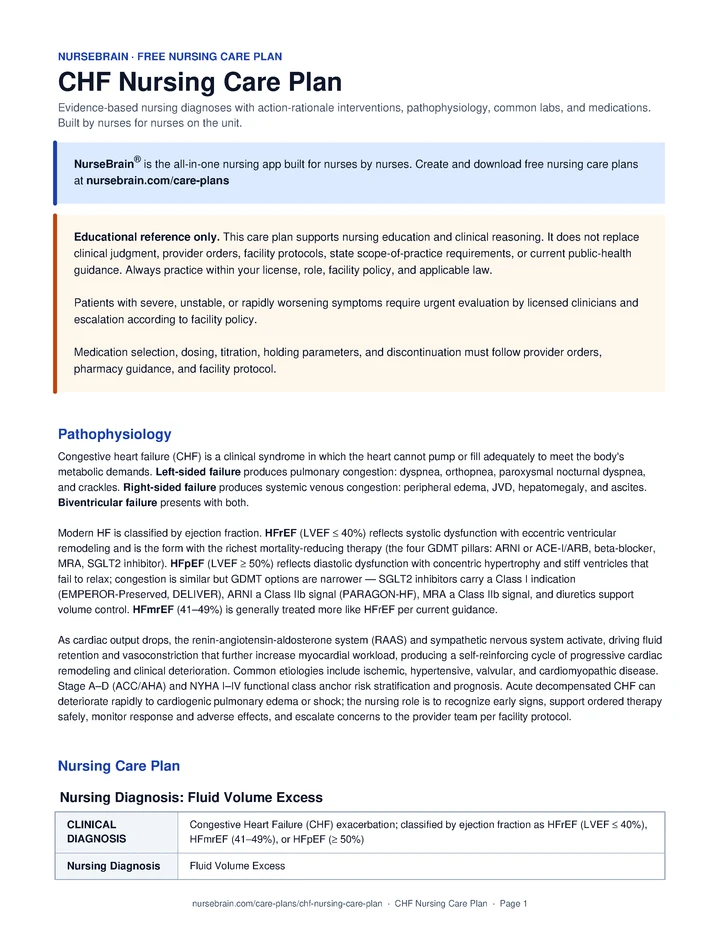
CHF Nursing Care Plan
Complete CHF nursing care plan with nursing diagnoses, prioritized interventions, and a free printable PDF. Built by nurses for nurses on the unit.
Nursing Care Plan
Nursing Diagnosis 1: Hypervolaemia
Fluid Volume Excess related to Congestive Heart Failure (CHF) exacerbation; classified by ejection fraction as HFrEF (LVEF ≤ 40%), HFmrEF (41–49%), or HFpEF (≥ 50%) as evidenced by Bilateral 2+ pitting lower-extremity edema; Worsening shortness of breath at rest; Bibasilar crackles on auscultation; Elevated BNP > 400 pg/mL; Weight gain > 2 kg in 48 hours.
Interventions
- Monitor and document daily weights at the same time, on the same scale, in the same garments.
- Auscultate breath sounds in all lung fields at intervals matched to clinical acuity and facility protocol; document presence and distribution of crackles.
- Assess peripheral edema location, pitting grade (1–4+), and symmetry per facility protocol.
- Maintain strict intake and output (I&O); calculate net 24-hour balance per facility protocol.
- Monitor BNP, electrolytes (K+, Mg2+, Na+), and renal function (BUN, Cr) per provider order.
- Assess for JVD with head of bed at 30–45° per facility protocol.
- Administer prescribed loop diuretics as ordered per provider direction, pharmacy guidance, and facility protocol.
- Position the patient in semi-Fowler’s to high-Fowler’s as tolerated and per facility protocol.
- Support the ordered fluid restriction (commonly 1.5–2 L/day in decompensation) per provider order and facility protocol.
- Administer ordered K+ and Mg2+ replacement per provider direction and facility protocol when levels are below ordered parameters.
- Coordinate with the dietitian for a low-sodium diet (commonly ≤ 2 g/day) per provider order and facility protocol.
- Teach the patient daily weights at home (same time, same scale, same garments); contact the provider for a gain of > 2 lb (1 kg) overnight or > 5 lb in a week, or as instructed by the provider.
- Educate the patient and family on reading food labels for sodium content per provider direction.
- Teach the importance of consistent diuretic dosing per provider direction (commonly in the morning) and using a marked container to track fluid intake.
- Notify the provider for UOP < 30 mL/hr for 2 consecutive hours, weight gain > 2 kg in 48 hours, new orthopnea, or any rapid clinical change.
- Coordinate referral to home health for post-discharge weight and medication monitoring per facility protocol.
Outcome: Weight, I&O, and perfusion indicators are monitored and reported within ordered parameters; Peripheral edema, lung sounds, and JVD are reassessed and trended per facility protocol; BNP trend (when ordered) is documented and reported to the provider team.
Nursing Diagnosis 2: Impaired Gas Exchange
Gas Exchange Impairment related to Congestive Heart Failure (CHF) exacerbation; classified by ejection fraction as HFrEF (LVEF ≤ 40%), HFmrEF (41–49%), or HFpEF (≥ 50%) as evidenced by Dyspnea with minimal exertion; Orthopnea; Bibasilar crackles; SpO2 below ordered parameters on room air; Increasing supplemental oxygen requirement.
Interventions
- Monitor SpO2 continuously and document the trend per facility protocol.
- Assess respiratory rate, depth, effort, accessory-muscle use, and breath sounds at intervals matched to clinical acuity and facility protocol.
- Auscultate breath sounds in all lung fields per facility protocol.
- Monitor and report ABG values per provider order; flag pH < 7.30, PaO2 < 60 mmHg, or rising PaCO2.
- Observe for signs that may reflect worsening cerebral hypoxia: restlessness, confusion, behavioral change, cyanosis, tachycardia, or tachypnea.
- Administer supplemental oxygen as ordered and titrate within provider parameters to support SpO2 within the ordered range; escalate stepwise (NC, high-flow NC, non-rebreather, BiPAP, intubation) per facility protocol.
- Position the patient in high-Fowler’s or with HOB elevated 30–45° as tolerated and per facility protocol.
- Coach diaphragmatic and pursed-lip breathing techniques when the patient is alert and able to participate.
- Encourage incentive spirometry per facility protocol when the patient is alert and able to participate.
- Suction the airway as needed and per facility protocol when secretions are excessive and the patient’s cough is ineffective.
- Anticipate and prepare for non-invasive ventilation (BiPAP) or intubation per facility protocol when work of breathing or oxygenation is worsening despite optimized therapy.
- Teach pursed-lip and diaphragmatic breathing techniques the patient can use independently when dyspneic.
- Educate the patient on activity pacing and energy-conservation techniques.
- Educate the patient and family on early signs of worsening dyspnea that should prompt 911 or emergency evaluation: severe SOB at rest, chest pain, new confusion, cyanosis, or pink frothy sputum.
- Notify the provider for SpO2 below ordered parameters despite oxygen titration, new orthopnea at < 30° HOB, pink frothy sputum, or any rapid clinical change.
- Coordinate with respiratory therapy for advanced airway and ventilation support per facility protocol when non-invasive measures are not maintaining ordered parameters.
Outcome: Patient maintains SpO2 within ordered parameters with the lowest support that meets the goal; Respiratory rate stays within ordered parameters with no accessory-muscle use; ABG findings are monitored and reported per facility protocol.
Nursing Diagnosis 3: Activity Intolerance
Activity Intolerance related to Congestive Heart Failure (CHF) exacerbation; classified by ejection fraction as HFrEF (LVEF ≤ 40%), HFmrEF (41–49%), or HFpEF (≥ 50%) as evidenced by Dyspnea with minimal exertion (commonly < 10 ft ambulation); Patient-reported fatigue and weakness; Requires standby assist with ambulation; HR rise disproportionate to clinical state with minimal exertion; Poor sleep due to orthopnea or nocturnal diuresis.
Interventions
- Monitor vital signs (HR, BP, RR, SpO2) before, during, and after activity per facility protocol.
- Assess patient-reported dyspnea on a 0–10 scale before and after activity.
- Assess sleep quality and duration daily; identify orthopnea or nocturnal awakening as contributors.
- Observe for signs of overexertion: pallor, diaphoresis, chest pain, syncope, palpitations.
- Assist with ADLs as needed; cluster cares to allow uninterrupted rest periods.
- Collaborate with physical therapy on a progressive mobility plan per facility protocol, starting with short supervised activity.
- Pause activity per facility protocol when vital signs cross ordered thresholds (commonly SBP drop > 20 mmHg, HR rise > 20% above resting, SpO2 falling below ordered parameters, new chest pain, new dysrhythmia, or syncope) and notify the provider.
- Provide rest periods between activities and after ADLs per facility protocol.
- Educate on energy-conservation techniques: pace activities, prioritize tasks, sit while performing tasks when possible.
- Teach the patient to recognize their personal dyspnea threshold and to rest before reaching it.
- Educate on the value of consistent activity at tolerated levels rather than prolonged bed rest.
- Coordinate with physical therapy and occupational therapy for outpatient cardiac rehabilitation referral per provider order.
- Notify the provider for new or worsening exertional dyspnea, chest pain, or syncope.
Outcome: Patient reports decreased fatigue when clinical state permits; Patient ambulates within ordered parameters with the appropriate level of assistance; HR and BP return toward baseline within the expected window after activity per facility protocol.
Nursing Diagnosis 4: Impaired Cardiac Output
Cardiac Output Alteration related to Congestive Heart Failure (CHF) exacerbation; classified by ejection fraction as HFrEF (LVEF ≤ 40%), HFmrEF (41–49%), or HFpEF (≥ 50%) as evidenced by Jugular venous distention (JVD); S3 gallop on auscultation; Decreased peripheral perfusion (cool extremities, capillary refill > 3 sec); Urine output < 0.5 mL/kg/hr; Patient-reported fatigue and dyspnea.
Interventions
- Monitor cardiac rhythm continuously and document any new arrhythmias.
- Assess apical and peripheral pulses for rate, rhythm, and quality per facility protocol.
- Check capillary refill, skin temperature, and color per facility protocol.
- Monitor urine output hourly via Foley catheter when ordered; notify the provider for UOP < 30 mL/hr (or < 0.5 mL/kg/hr) for 2 consecutive hours.
- Assess level of consciousness, orientation, and behavior per facility protocol.
- Auscultate heart sounds for a new S3 or S4 gallop per facility protocol.
- Administer prescribed cardiac medications (loop diuretic, beta-blocker, ACE-I/ARB/ARNI, MRA, SGLT2 inhibitor) as ordered per provider direction, pharmacy guidance, and facility protocol.
- Recheck HR and BP before each cardiac medication dose; hold and notify the provider per facility hold parameters (commonly HR below ordered parameters or SBP < 90 mmHg).
- Maintain reliable IV access per facility protocol for potential vasoactive medication administration.
- Administer ordered vasoactive support (e.g., norepinephrine, dobutamine) as ordered per provider direction and facility protocol when initiated; monitor MAP, rhythm, urine output, peripheral perfusion, and signs of extravasation.
- Provide adequate rest periods between care activities.
- Teach the patient to recognize and report signs of worsening cardiac output: increased fatigue, new confusion, decreased UOP, dizziness, or syncope.
- Educate on medication adherence and on contacting the provider before stopping any cardiac medication, including HF-indicated beta-blockers.
- Escalate per facility protocol for findings consistent with cardiogenic shock (e.g., persistent SBP < 90 mmHg or below ordered parameters, mottling, new confusion, UOP < 0.5 mL/kg/hr) and notify the provider team and rapid response per facility policy.
- Coordinate cardiology consultation per provider order for evaluation of advanced HF therapies when symptoms are refractory.
Outcome: Urine output, perfusion, and vital signs are monitored and reported within ordered parameters; Extremities are reassessed for warmth, color, and capillary refill per facility protocol; Mental status is reassessed and changes are reported promptly.
Nursing Diagnosis 5: Anxiety
Anxiety related to Congestive Heart Failure (CHF) exacerbation; classified by ejection fraction as HFrEF (LVEF ≤ 40%), HFmrEF (41–49%), or HFpEF (≥ 50%) as evidenced by Patient verbalization of fear of dying or worsening; Restlessness, inability to sit still; Tachycardia disproportionate to clinical state; Orthopnea and the felt experience of breathlessness; Sleep disturbance.
Interventions
- Assess anxiety level using a 0–10 scale at the start of every shift and PRN.
- Identify the patient’s stated triggers (breathlessness, monitor alarms, fear of dying, sleep disturbance).
- Observe for physical signs of anxiety: tachycardia out of proportion to clinical state, restlessness, hand-wringing, hypervigilance.
- Assess sleep quality and contributors (alarms, lighting, frequent interventions, orthopnea, anxiety) daily.
- Provide a calm, reassuring presence; speak clearly and at a measured pace.
- Explain procedures and findings in plain, patient-friendly terms before performing them.
- Cluster cares to allow uninterrupted rest periods when clinical state permits.
- Limit non-essential nighttime stimuli (overhead lights, loud conversations, unnecessary alarms) per facility protocol.
- Facilitate family presence per facility policy.
- Teach diaphragmatic breathing and grounding techniques the patient can use independently.
- Educate the patient and family on what the alarms mean and what is and is not clinically concerning.
- Teach progressive muscle relaxation as a sleep-onset aid.
- Coordinate with chaplaincy, social work, or psych services per facility protocol when anxiety persists or worsens despite non-pharmacologic measures.
- Notify the provider for severe or persistent anxiety unresponsive to non-pharmacologic measures.
Outcome: Patient verbalizes decreased anxiety; Patient demonstrates use of at least one coping strategy; HR consistent with clinical state.
Pathophysiology
Congestive heart failure (CHF) is a clinical syndrome in which the heart cannot pump or fill adequately to meet the body’s metabolic demands. Left-sided failure produces pulmonary congestion: dyspnea, orthopnea, paroxysmal nocturnal dyspnea, and crackles. Right-sided failure produces systemic venous congestion: peripheral edema, JVD, hepatomegaly, and ascites. Biventricular failure presents with both.
Modern HF is classified by ejection fraction. HFrEF (LVEF ≤ 40%) reflects systolic dysfunction with eccentric ventricular remodeling and is the form with the richest mortality-reducing therapy (the four GDMT pillars: ARNI or ACE-I/ARB, beta-blocker, MRA, SGLT2 inhibitor). HFpEF (LVEF ≥ 50%) reflects diastolic dysfunction with concentric hypertrophy and stiff ventricles that fail to relax; congestion is similar but GDMT options are narrower — SGLT2 inhibitors carry a Class I indication (EMPEROR-Preserved, DELIVER), ARNI a Class IIb signal (PARAGON-HF), MRA a Class IIb signal, and diuretics support volume control. HFmrEF (41–49%) is generally treated more like HFrEF per current guidance.
As cardiac output drops, the renin-angiotensin-aldosterone system (RAAS) and sympathetic nervous system activate, driving fluid retention and vasoconstriction that further increase myocardial workload, producing a self-reinforcing cycle of progressive cardiac remodeling and clinical deterioration. Common etiologies include ischemic, hypertensive, valvular, and cardiomyopathic disease. Stage A–D (ACC/AHA) and NYHA I–IV functional class anchor risk stratification and prognosis. Acute decompensated CHF can deteriorate rapidly to cardiogenic pulmonary edema or shock; the nursing role is to recognize early signs, support ordered therapy safely, monitor response and adverse effects, and escalate concerns to the provider team per facility protocol.
Quick Reference
- EF classification: HFrEF ≤ 40 / HFmrEF 41–49 / HFpEF ≥ 50
- SpO2 target: Within ordered parameters (commonly ≥ 92% on RA)
- Daily weights: Same time, same scale, same garments
- Fluid limit: Per provider order (commonly ≤ 2 L/day in decompensation)
- Sodium limit: Per provider order (commonly ≤ 2 g/day)
Common Labs
| Lab | Normal range | Significance in CHF |
|---|---|---|
| BNP | < 100 pg/mL | Values > 400 pg/mL can support a clinical picture of HF; trend response to ordered diuresis. Nurses report values outside reference range to the provider team. |
| NT-proBNP | < 300 pg/mL | Age-adjusted cutoffs apply and remain useful in renal disease. Interpret in context of the full clinical picture; nurses report values outside reference range. |
| Troponin | < 0.04 ng/mL | Helps support assessment of concurrent acute MI; mild elevation can be seen in CHF decompensation. Nurses report new or rising values to the provider team. |
| Na+ | 135–145 mEq/L | Hyponatremia is common in advanced HF and is associated with poorer prognosis. Nurses report values outside ordered parameters. |
| K+ | 3.5–5.0 mEq/L | Loop diuretics can lower K+; ACE-I, ARB, ARNI, and MRA can raise it. Nurses monitor serial values and report findings outside ordered parameters. |
| Mg2+ | 1.7–2.2 mg/dL | Loop diuretics can deplete Mg2+; low values can increase arrhythmia risk. Nurses report low values and prepare to administer ordered replacement. |
| BUN / Cr | BUN 7–20 mg/dL / Cr 0.6–1.2 mg/dL | Rising values can reflect reduced renal perfusion (cardiorenal physiology). Nurses trend serial values during diuresis and report worsening renal function to the provider team. |
| Hemoglobin | 12–17 g/dL | Anemia can worsen HF symptoms; transfusion thresholds vary by clinical context and follow provider order and facility protocol. |
| ABG | pH 7.35–7.45 / PaO2 80–100 mmHg / PaCO2 35–45 mmHg | Respiratory acidosis can develop with hypoventilation in acute pulmonary edema. Findings such as pH < 7.30 or PaO2 < 60 mmHg should prompt urgent reassessment and discussion with the provider team per facility protocol. |
Common Medications
| Class | Examples | Mechanism of action | Key side effects | Nursing considerations |
|---|---|---|---|---|
| Loop diuretic | Furosemide (Lasix), Bumetanide | Inhibits Na+/K+/2Cl− co-transporter in the loop of Henle, producing brisk natriuresis and water loss. | Hypokalemia, hypomagnesemia, dehydration, ototoxicity (with rapid IV push), hyperuricemia. | Administer as ordered per provider direction; IV route is commonly preferred in acute decompensation when gut absorption may be impaired. Monitor daily weights, strict I&O, K+, Mg2+, and Cr per facility protocol (commonly recheck 4–6 hours after an IV dose). Escalate to the provider for UOP < 30 mL/hr for 2 consecutive hours, rising Cr, or symptomatic hypotension. |
| ACE inhibitor | Lisinopril, Enalapril | Blocks angiotensin-converting enzyme, lowering angiotensin II; produces vasodilation and decreases aldosterone, supporting reverse remodeling in HFrEF. | Dry cough, hyperkalemia, hypotension, angioedema, rising Cr. | Administer as ordered. Verify BP and recent K+/Cr per facility hold parameters before each dose. Escalate to the provider for SBP below ordered parameters, K+ above ordered parameters, new cough, or facial swelling. ACE-I and ARB are not co-administered; therapy choice belongs to the provider team. |
| ARB | Losartan, Valsartan | Blocks the AT1 receptor downstream of ACE; produces similar hemodynamic and neurohormonal effects without bradykinin-mediated cough. | Hyperkalemia, hypotension; cough is uncommon compared with ACE-I. | Administer as ordered. Monitoring mirrors ACE-I (BP, K+, Cr); substitution between ACE-I and ARB is a provider-team decision. |
| ARNI | Sacubitril/valsartan | Combines a neprilysin inhibitor with an ARB; raises beneficial natriuretic peptides while blocking AT1. Class I for chronic HFrEF and IIb in HFpEF (PARAGON-HF) per current guidance. | Hypotension, hyperkalemia, rising Cr, angioedema (especially with prior ACE-I exposure within 36 hours). | Administer as ordered per provider direction. Verify a documented 36-hour washout from any ACE-I per facility protocol before the first dose. Monitor BP, K+, and Cr; escalate hypotension or angioedema concerns promptly. |
| Beta-blocker (HF-indicated) | Carvedilol, Metoprolol succinate, Bisoprolol | Blocks β1 (and β2 with carvedilol); lowers HR and contractility, and supports neurohormonal blockade and reverse remodeling in HFrEF. | Bradycardia, hypotension, fatigue, bronchospasm (less with cardioselective agents), AV block. | Administer as ordered. Verify HR and BP against facility hold parameters (commonly hold for HR below ordered parameters or SBP < 90 mmHg) and escalate to the provider. Educate the patient and family that HF-indicated beta-blockers should not be stopped abruptly without provider direction, as abrupt discontinuation can be associated with rebound tachycardia, hypertension, or ischemia. |
| Aldosterone antagonist (MRA) | Spironolactone, Eplerenone | Blocks aldosterone at the distal nephron and produces K+-sparing diuresis; supports reverse remodeling and reduces mortality in HFrEF. | Hyperkalemia, gynecomastia (spironolactone), renal impairment. | Administer as ordered per provider direction. Monitor K+ and Cr per facility protocol (commonly weekly during the first month and after dose changes), especially when used with ACE-I, ARB, or ARNI. Escalate hyperkalemia concerns promptly. |
| SGLT2 inhibitor | Dapagliflozin, Empagliflozin | Inhibits renal glucose reabsorption and produces mild osmotic diuresis. Class I across the EF spectrum per current guidance — HFrEF (DAPA-HF, EMPEROR-Reduced) and HFmrEF/HFpEF (EMPEROR-Preserved, DELIVER) — with reductions in HF hospitalization and CV mortality. | Genitourinary infections, euglycemic DKA, volume depletion. | Administer as ordered. Encourage adequate oral hydration when clinical state permits; the drug may be held around surgery or acute illness per provider order. Teach the patient and family the signs of DKA. Benefit is documented regardless of diabetes status. |
References
- Makic, M. B. F., & Martinez-Kratz, M. R. (Eds.). (2023). Ackley and Ladwig’s Nursing Diagnosis Handbook: An Evidence-Based Guide to Planning Care (13th ed.). Elsevier.
- Heidenreich, P. A., Bozkurt, B., Aguilar, D., et al. (2022). 2022 AHA/ACC/HFSA Guideline for the Management of Heart Failure. Circulation, 145(18), e895–e1032.
Frequently Asked Questions
What is the nursing care plan for CHF?
A CHF nursing care plan organizes the assessment, nursing diagnoses, goals, interventions, and evaluation criteria for a patient with congestive heart failure. The two anchor problems are reduced cardiac output and volume overload; everything else hangs off those.
What are the nursing diagnoses for CHF?
The most clinically relevant nursing diagnoses for CHF are Cardiac Output Alteration, Fluid Volume Excess, Activity Intolerance, Gas Exchange Impairment, and Anxiety. Order them by what is currently most destabilizing for the patient — fluid overload usually leads in acute decompensation.
What is the priority nursing intervention for CHF?
Maintaining adequate cardiac output is the priority — administer diuretics on time, monitor for hypokalemia, position the patient semi-Fowler to reduce preload on the right heart, and watch for signs of worsening pulmonary congestion. Daily weights at the same time of day are the most reliable bedside indicator of fluid trend.
What complications should the nurse monitor for in CHF?
Watch for pulmonary edema (sudden worsening dyspnea, pink frothy sputum), cardiogenic shock (hypotension, mottling, decreased LOC), arrhythmias (especially in the setting of diuresis-induced hypokalemia), and acute kidney injury from over-diuresis.
A report sheet built for this patient
This is exactly the kind of patient the report sheet templates in NurseBrain® Synapse are built for. Keep everything you track on one page, all shift.
Learn how NurseBrain Synapse uses the Clinical Care Classification System for nursing care plans.