Clostridium difficile (C. diff) Nursing Care Plan
C. diff (Clostridium difficile) nursing care plan: contact precautions, fluid balance, pain management, and a printable PDF.
Nursing Care Plan
Nursing Diagnosis 1: Rape Trauma Response
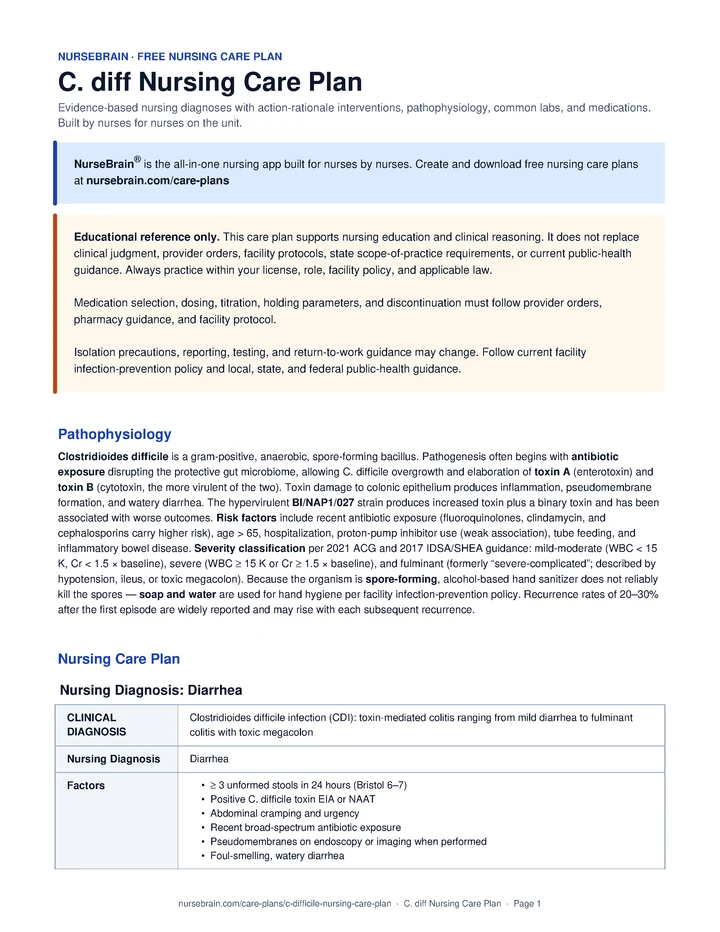
Diarrhea related to Clostridioides difficile infection (CDI): toxin-mediated colitis ranging from mild diarrhea to fulminant colitis with toxic megacolon as evidenced by ≥ 3 unformed stools in 24 hours (Bristol 6–7); Positive C. difficile toxin EIA or NAAT; Abdominal cramping and urgency; Recent broad-spectrum antibiotic exposure; Pseudomembranes on endoscopy or imaging when performed.
Interventions
- Document every stool: frequency, volume, consistency (Bristol scale), color, and presence of blood or mucus per facility documentation standard.
- Auscultate bowel sounds and assess the abdomen for distention, tenderness, and rigidity at intervals matched to clinical acuity and facility protocol.
- Monitor temperature at intervals matched to clinical acuity; report new fever or fever above ordered parameters.
- Review WBC, creatinine, lactate, and albumin as ordered and trend serial values.
- Inspect perianal skin each shift and after stooling episodes.
- Administer ordered antibiotic therapy (commonly oral vancomycin or fidaxomicin) on schedule per provider direction, pharmacy guidance, and facility protocol; confirm a reliable PO route.
- Do not administer antimotility agents (loperamide, diphenoxylate, anticholinergic agents) for CDI unless explicitly ordered by the provider team after risk/benefit review.
- Provide a skin-protective barrier (commonly zinc-based or dimethicone product) to the perianal area after stooling per facility skin-care protocol.
- Offer a bedside commode and place the call light within reach; respond promptly to urgency.
- Maintain IV access and administer ordered crystalloid and electrolyte replacement per provider direction and facility protocol.
- Educate the patient and family on completing the full ordered antibiotic course as directed by the provider, even when symptoms improve early.
- Teach the patient and family to perform hand hygiene with soap and water after every bathroom use, per facility infection-prevention policy.
- Reinforce provider recommendations regarding probiotic use rather than initiating probiotic therapy independently.
- Notify the provider for stool counts above ordered parameters, new bloody stool, abdominal distention or rigidity, or rising lactate.
- Coordinate GI consultation per provider direction when symptoms are not improving by the timeframe ordered by the provider team or when recurrence is suspected.
Outcome: Stool frequency and consistency are monitored and reported within ordered parameters; Bristol scale trend is documented through the ordered treatment course; Patient verbalizes understanding of the ordered antibiotic course and adherence plan.
Nursing Diagnosis 2: Hypovolaemia
Fluid Volume Deficit related to Clostridioides difficile infection (CDI): toxin-mediated colitis ranging from mild diarrhea to fulminant colitis with toxic megacolon as evidenced by Multiple large-volume watery stools per 24 hours; Decreased oral intake due to nausea or anorexia; Dry mucous membranes, decreased skin turgor; Urine output below ordered parameters; Tachycardia, orthostatic blood-pressure changes.
Interventions
- Monitor heart rate, blood pressure (including orthostatics when ordered), and SpO2 at intervals matched to clinical acuity and facility protocol.
- Maintain strict intake and output; calculate net 24-hour balance per facility protocol.
- Assess mucous membranes, skin turgor, and capillary refill each shift.
- Trend BUN/Cr, electrolytes, and lactate as ordered.
- Weigh the patient daily on the same scale, same garments, same time when clinical status allows.
- Administer ordered IV crystalloid (commonly NS or LR) per provider direction; monitor urine output, mean arterial pressure, and hemodynamic indicators per facility protocol.
- Administer ordered electrolyte replacement (commonly K+ and Mg2+) per facility electrolyte-replacement protocol when values are below threshold.
- Offer ordered oral fluids or oral rehydration solution at small, frequent intervals when nausea allows and an oral intake order is in place.
- Administer ordered antiemetics to support oral intake.
- Educate the patient on rehydration with ordered oral rehydration solutions or broth rather than plain water alone when the provider supports oral intake.
- Teach the patient signs of dehydration to report at home: dizziness on standing, dark urine, decreased urine frequency, dry mouth.
- Notify the provider for urine output, heart rate, or blood pressure outside ordered parameters or for new mental-status changes.
- Escalate per facility rapid-response criteria for hypotension that does not respond to ordered fluid resuscitation or for rising lactate.
Outcome: Urine output is monitored and reported within ordered parameters; Heart rate and blood pressure are monitored and reported within ordered parameters; Mucous membranes and skin turgor are assessed and changes are reported.
Nursing Diagnosis 3: Skin Integrity Impairment (perianal)
Skin Integrity Impairment (perianal) related to Clostridioides difficile infection (CDI): toxin-mediated colitis ranging from mild diarrhea to fulminant colitis with toxic megacolon as evidenced by Multiple unformed stools per 24 hours; Moisture-associated perianal erythema or denudation; Patient report of perianal burning or stinging; Decreased mobility or self-care limiting timely cleansing; Concurrent fecal incontinence in older or debilitated adults.
Interventions
- Inspect perianal and surrounding skin each shift and after stooling episodes; document findings per facility skin-assessment standard.
- Assess for perianal pain, burning, or itching using a 0–10 scale or facility-approved comfort tool when the patient is able to report.
- Identify mobility and self-care limitations that may delay cleansing after stooling.
- Cleanse the perianal area with a no-rinse perineal cleanser or soft, pH-balanced wipes after each stool per facility skin-care protocol; avoid vigorous scrubbing.
- Apply ordered skin-protective barrier (commonly zinc-based or dimethicone) after cleansing per facility protocol.
- Consider a moisture-wicking pad system per facility protocol when appropriate.
- Coordinate with the wound or skin-care nurse per facility consult criteria when breakdown is present or progressing.
- When the patient is able, teach skin-care steps, including gentle cleansing and barrier-product reapplication after each stool.
- Educate the family on cleansing technique, barrier-product use, and the importance of avoiding alcohol-based skin products on broken skin.
- Notify the provider for open lesions, increasing redness or pain, new bleeding from the perianal area, or signs that may suggest infection (warmth, purulence).
- Coordinate with the provider team and pharmacy if the patient is on a medication regimen that may delay healing (e.g., chronic steroids).
Outcome: Perianal skin is assessed each shift and findings are documented per facility protocol; Skin barrier products are applied as ordered and per facility skin-care protocol; Patient verbalizes a comfort improvement or reports decreased perianal pain when able.
Nursing Diagnosis 4: Infection Risk (Transmission)
Infection Risk (Transmission) related to Clostridioides difficile infection (CDI): toxin-mediated colitis ranging from mild diarrhea to fulminant colitis with toxic megacolon as evidenced by Confirmed CDI (positive toxin EIA or NAAT); Active diarrhea with high spore burden; Shared bathroom or roommate environment; Spore-forming organism not reliably killed by alcohol-based sanitizers; Multiple staff and visitor contacts per day.
Interventions
- Verify isolation signage, PPE supplies, and dedicated equipment are in place each shift per facility infection-prevention policy.
- Monitor stool pattern and track time since the last unformed stool per facility documentation standard.
- Observe staff, family, and patient hand-hygiene technique each shift per facility audit practice.
- Implement CONTACT precautions (gown and gloves on entry, dedicated room when possible, dedicated equipment) per facility infection-prevention policy for the duration determined by infection prevention.
- Perform hand hygiene with soap and water before and after patient contact per facility infection-prevention policy; reinforce this practice with the team rather than relying on alcohol-based sanitizer.
- Coordinate with infection prevention and bed management on room placement (commonly a private room or a CDI cohort) and a dedicated toilet or commode per facility policy.
- Coordinate with environmental services for daily cleaning with a sporicidal agent (commonly bleach-based) per facility infection-prevention policy.
- Dedicate equipment (stethoscope, BP cuff, thermometer) to the patient and disinfect with the facility-designated sporicidal product between uses.
- Educate the family on PPE donning and doffing and on soap-and-water hand hygiene before leaving the room per facility policy.
- Teach the patient to use the assigned toilet or commode and to notify staff before leaving the room per facility infection-prevention policy.
- Educate the patient and household on home cleaning of high-touch surfaces with a diluted bleach solution after discharge per facility discharge education.
- Notify infection prevention for any suspected secondary case or precaution breach per facility infection-prevention policy.
- Coordinate antibiotic stewardship review with the provider team and pharmacy to narrow, shorten, or discontinue unnecessary antibiotics per facility stewardship protocol.
- Coordinate documentation of precaution discontinuation criteria with infection prevention per facility policy.
Outcome: CONTACT precautions are implemented and maintained per facility infection-prevention policy; Soap-and-water hand hygiene is observed for patient, family, and staff per facility policy; Environmental cleaning with a sporicidal agent is documented per facility protocol.
Nursing Diagnosis 5: Acute Pain
Acute Pain related to Clostridioides difficile infection (CDI): toxin-mediated colitis ranging from mild diarrhea to fulminant colitis with toxic megacolon as evidenced by Patient reports cramping abdominal pain; Guarding with palpation of the lower abdomen; Facial grimacing with stooling episodes; Restlessness or inability to find a comfortable position; Diaphoresis and tachycardia during pain peaks.
Interventions
- Assess pain intensity, location, character, and timing using the facility-approved tool at intervals matched to clinical acuity and PRN.
- Differentiate cramping or colicky pain from constant severe pain or rebound tenderness; report changes to the provider team.
- Monitor vital signs during pain peaks; document tachycardia or diaphoresis when present.
- Administer ordered analgesics per provider direction, pharmacy guidance, and facility protocol.
- Coordinate with the provider team to limit opioid use when possible; reinforce non-opioid and non-pharmacologic options per provider direction.
- Coordinate with the provider team to avoid antimotility and anticholinergic agents for diarrhea or pain unless explicitly ordered after risk/benefit review.
- Apply a warm pack to the abdomen during cramping when ordered or supported by facility protocol.
- Position the patient for comfort (side-lying with knees flexed when tolerated) and cluster cares around peak pain windows when feasible.
- Provide a calm environment with dimmed lights and limited stimuli at night per facility sleep-hygiene practice.
- Teach diaphragmatic breathing and guided imagery the patient can use during cramping episodes.
- Educate the patient to report new severe pain, sudden relief, or worsening distention promptly.
- Notify the provider for pain unrelieved by ordered analgesics, new rebound tenderness, or rigidity.
- Coordinate with the prescriber on opioid-sparing analgesic strategies when feasible per facility analgesia protocol.
Outcome: Pain is assessed and reassessed per facility pain-management standard; Patient verbalizes acceptable pain control on the facility-approved scale; Patient demonstrates at least one non-pharmacologic comfort strategy when appropriate.
Nursing Diagnosis 6: Lack Of Knowledge
Knowledge Deficit related to Clostridioides difficile infection (CDI): toxin-mediated colitis ranging from mild diarrhea to fulminant colitis with toxic megacolon as evidenced by First episode of CDI for the patient or family; Recent broad-spectrum antibiotic exposure with limited understanding of the connection; Unfamiliarity with CONTACT precautions and soap-and-water hand hygiene; Multiple medication and follow-up steps in the discharge plan; Anxiety about recurrence (widely reported 20–30% after the first episode).
Interventions
- Assess baseline understanding of CDI, recent antibiotic exposure, hand hygiene, and the discharge plan using teach-back per facility education standard.
- Identify learning barriers (language, literacy, cognition, sensory, cultural) and coordinate interpreter or accessibility resources per facility policy.
- Identify the household decision-maker and primary caregiver, especially for older or debilitated adults.
- Provide facility-approved CDI education materials in the patient’s preferred language and reading level per facility patient-education protocol.
- Coordinate medication education with pharmacy on the ordered antibiotic course and follow-up steps per facility protocol.
- Reinforce that soap and water are used for hand hygiene at home per facility infection-prevention discharge education, rather than alcohol-based sanitizer alone.
- Teach the patient and family what CDI is, that it is often related to antibiotic exposure, and why the team has implemented the current plan, using plain language.
- Teach the importance of completing the full ordered antibiotic course as directed by the provider, even when symptoms improve.
- Teach warning signs that should prompt contact with the provider or return to care: fever, worsening pain or distention, blood in stool, dehydration symptoms, or return of diarrhea after improvement.
- Teach household cleaning with a diluted bleach solution for high-touch surfaces after discharge per facility discharge education.
- Educate the patient and family on the recurrence rate (commonly cited as 20–30% after the first episode) and the plan to discuss further options (e.g., fidaxomicin, bezlotoxumab, fecal microbiota therapy) with the provider team if recurrence occurs.
- Coordinate discharge planning with case management, pharmacy, and the provider team per facility protocol.
- Notify the provider when patient understanding remains incomplete after structured teach-back and reinforcement.
Outcome: Patient and family verbalize what CDI is, why precautions are in place, and how the ordered antibiotics work; Patient verbalizes the importance of completing the full ordered antibiotic course; Patient and family demonstrate soap-and-water hand hygiene.
Pathophysiology
Clostridioides difficile is a gram-positive, anaerobic, spore-forming bacillus. Pathogenesis often begins with antibiotic exposure disrupting the protective gut microbiome, allowing C. difficile overgrowth and elaboration of toxin A (enterotoxin) and toxin B (cytotoxin, the more virulent of the two). Toxin damage to colonic epithelium produces inflammation, pseudomembrane formation, and watery diarrhea. The hypervirulent BI/NAP1/027 strain produces increased toxin plus a binary toxin and has been associated with worse outcomes. Risk factors include recent antibiotic exposure (fluoroquinolones, clindamycin, and cephalosporins carry higher risk), age > 65, hospitalization, proton-pump inhibitor use (weak association), tube feeding, and inflammatory bowel disease.
Severity classification per 2021 ACG and 2017 IDSA/SHEA guidance: mild-moderate (WBC < 15 K, Cr < 1.5 × baseline), severe (WBC ≥ 15 K or Cr ≥ 1.5 × baseline), and fulminant (formerly “severe-complicated”; described by hypotension, ileus, or toxic megacolon). Because the organism is spore-forming, alcohol-based hand sanitizer does not reliably kill the spores — soap and water are used for hand hygiene per facility infection-prevention policy. Recurrence rates of 20–30% after the first episode are widely reported and may rise with each subsequent recurrence.
Quick Reference
- Hand hygiene: Soap & water per facility policy (alcohol gel does not kill spores)
- Testing algorithm: 2-step (commonly): GDH + toxin EIA with NAAT as tiebreaker per lab protocol
- Severity marker: WBC ≥ 15 K or Cr ≥ 1.5 × baseline (per ACG/IDSA)
- First-line PO vanco: Commonly 125 mg PO QID × 10 days (per IDSA 2021)
- Recurrence rate: 20–30% after the first episode (widely reported)
Common Labs
| Lab | Normal range | Significance in C. diff |
|---|---|---|
| C. difficile PCR (NAAT) | Negative | Sensitive screen; a positive NAAT alone may reflect colonization. Pairing with a toxin EIA is common per facility lab and infection-prevention protocols. Nurses confirm specimen collection per facility procedure. |
| C. difficile toxin EIA | Negative | Higher specificity than NAAT alone; a positive result can support active toxin-producing disease. Interpretation and treatment decisions are made by the provider team in the clinical context. |
| GDH antigen | Negative | High-sensitivity screen; a positive result commonly triggers a reflex toxin EIA or NAAT per facility lab protocol. |
| WBC | 4–11 K/µL | ≥ 15 K/µL can support a severe CDI classification per ACG 2021 and IDSA 2017/2021 guidance. Nurses trend serial values and report findings to the provider team. |
| Creatinine | 0.6–1.2 mg/dL | ≥ 1.5 × baseline can support a severe CDI classification per ACG/IDSA and may reflect volume status. Nurses trend and report; severity classification is a provider-team decision. |
| Albumin | 3.5–5.0 g/dL | Low albumin has been associated with severe disease and poorer outcomes in CDI. Nurses report values outside reference range to the provider team. |
| Lactate | < 2.0 mmol/L | Elevation can raise concern for ischemic or fulminant colitis or sepsis physiology. Nurses trend lactate and escalate per facility protocol when values are rising or not clearing. |
| K+ | 3.5–5.0 mEq/L | Often depleted with high-volume diarrhea; arrhythmia risk if low. Nurses report out-of-range values and administer ordered replacement per facility electrolyte-replacement protocol. |
| Electrolytes / Mg2+ | WNL | Diarrhea-driven losses are common. Nurses trend values and administer ordered replacement per facility protocol. |
| Abdominal CT | No wall thickening, no ascites | In severe or fulminant disease, imaging may show colon wall thickening, ascites, or megacolon (colonic diameter > 6 cm), which can prompt provider-team discussion with surgery. Nurses report new or worsening findings communicated by the imaging team and escalate per facility protocol. |
Common Medications
| Class | Examples | Mechanism of action | Key side effects | Nursing considerations |
|---|---|---|---|---|
| Oral vancomycin (commonly first-line per IDSA 2021) | Vancocin (oral capsule or compounded oral solution); commonly 125 mg PO QID × 10 days | Bactericidal against vegetative C. difficile in the colonic lumen; does not eradicate spores, which contributes to the widely reported 20–30% recurrence rate; minimal systemic absorption when given orally. | Nausea, abdominal pain; systemic effects are uncommon with the oral form. | Administer as ordered per provider direction, pharmacy guidance, and facility protocol. Per the 2021 IDSA focused update, oral vancomycin is a first-line option for initial CDI. Nurses confirm PO route, assess swallow, monitor stool frequency and consistency response, and reinforce completion of the full ordered course. |
| Fidaxomicin (commonly preferred per IDSA 2021) | Dificid; commonly 200 mg PO BID × 10 days | Macrocyclic antibiotic with a narrow spectrum; has been associated with lower recurrence rates compared with vancomycin in clinical trials. | Nausea, vomiting, abdominal pain; high acquisition cost. | Administer as ordered. Per the 2021 IDSA focused update, fidaxomicin is conditionally preferred (moderate certainty) over vancomycin for an initial episode and first recurrence. ACG 2021 lists either as a first-line option. Selection, formulary, and prior authorization are provider-team and pharmacy decisions; nurses support administration and monitor response. |
| Metronidazole (commonly limited role per IDSA 2017+) | Flagyl; commonly 500 mg PO TID × 10 days when used | Prodrug; reactive intermediates damage bacterial DNA. | Metallic taste, nausea, peripheral neuropathy, disulfiram-like reaction with alcohol. | Administer as ordered. Per IDSA 2017 and the 2021 focused update, metronidazole is no longer a first-line option for CDI; it may be considered when neither vancomycin nor fidaxomicin is available, per provider direction and facility protocol. Nurses verify the indication with the provider team when ordered. |
| Vancomycin enema (rectal route) | Commonly vancomycin 500 mg in 100 mL NS PR Q6H when ordered | Delivers drug directly to the colonic lumen when the oral route is unreliable. | Local irritation; perforation risk has been described with severe colitis. | Administer as ordered per provider direction and facility protocol in patients with ileus or megacolon where oral delivery is unreliable. Nurses coordinate administration timing, monitor tolerance, and escalate concerns per facility protocol. |
| Bezlotoxumab | Zinplava; commonly 10 mg/kg IV × 1 dose when ordered | Monoclonal antibody that binds and neutralizes toxin B; used for recurrence prevention. | Infusion reactions; heart-failure exacerbations have been reported in patients with CHF (caution with the fluid load). | Administer as ordered as an adjunct alongside standard antibiotic therapy. Per the 2021 IDSA focused update, bezlotoxumab is suggested for patients at high risk of recurrence (commonly defined as age ≥ 65, immunocompromised, prior CDI within 6 months, or severe presentation); patient selection is a provider-team decision. Nurses screen for known heart failure on the chart, monitor for infusion reactions per facility protocol, and verify pharmacy and insurance workflow is in place. |
| Fecal microbiota therapy | Per protocol (capsule, NG, or colonoscopy delivery) | Aims to restore a diverse gut microbiome that can outcompete C. difficile. | Transient GI symptoms; rare transmissible-pathogen risk has been described. | Administer as ordered per provider direction and facility protocol. Per ACG 2021 and IDSA 2021, fecal microbiota therapy is commonly considered after ≥ 2 recurrences (i.e., a third or later episode) and after appropriate antibiotic therapy has not produced sustained response. Patient selection, route, and product are provider-team and GI decisions; nurses coordinate consent workflow and monitor for adverse effects. |
| Volume and electrolyte replacement | Commonly IV NS or LR; PO or IV K+ and Mg2+ per order | Supports replacement of diarrhea-related losses and renal perfusion. | Volume overload if over-resuscitated; cardiac and renal status guide the order set. | Administer as ordered. Nurses maintain strict I&O, trend BMP, and monitor urine output and perfusion indicators per facility protocol; resuscitation endpoints are provider-team decisions. |
| Inciting antibiotic management | Discontinue, narrow, or shorten when feasible per provider direction | Removing the trigger that disrupted the microbiome is part of the treatment strategy in CDI. | Risk of under-treating the original infection if the inciting antibiotic is needed. | Coordinate with the provider team and pharmacy for antibiotic stewardship review. Nurses do not independently discontinue antibiotics; they surface the question, document the rationale once decided, and implement the revised order per facility protocol. |
References
- Makic, M. B. F., & Martinez-Kratz, M. R. (Eds.). (2023). Ackley and Ladwig’s Nursing Diagnosis Handbook: An Evidence-Based Guide to Planning Care (13th ed.). Elsevier.
- Kelly, C. R., Fischer, M., Allegretti, J. R., et al. (2021). ACG Clinical Guidelines: Prevention, Diagnosis, and Treatment of Clostridioides difficile Infections. American Journal of Gastroenterology, 116(6), 1124–1147.
- McDonald, L. C., Gerding, D. N., Johnson, S., et al. (2018). Clinical Practice Guidelines for Clostridium difficile Infection in Adults and Children: 2017 Update by the IDSA and SHEA. Clinical Infectious Diseases, 66(7), e1–e48.
- Johnson, S., Lavergne, V., Skinner, A. M., et al. (2021). Clinical Practice Guideline by the IDSA and SHEA: 2021 Focused Update Guidelines on Management of Clostridioides difficile Infection in Adults. Clinical Infectious Diseases, 73(5), e1029–e1044.
Frequently Asked Questions
What is the nursing care plan for C. diff?
A C. diff nursing care plan organizes the assessment, nursing diagnoses, goals, interventions, and evaluation criteria for a patient with Clostridium difficile (C. diff). Diagnoses are ordered by what is currently most destabilizing for the patient.
What are the priority nursing diagnoses for C. diff?
Priority diagnoses for C. diff appear in the Nursing Diagnoses section above, ordered by clinical acuity. The top diagnosis should reflect what is currently most destabilizing for this specific patient.
What is the priority nursing intervention for C. diff?
Priority interventions for C. diff are listed in the care plan above, organized by diagnosis. The most critical actions address airway, circulation, and the highest-acuity problem first.
What complications should the nurse monitor for in C. diff?
Complications to monitor for in C. diff are listed within each diagnosis section above. Trend vitals, mental status, and the condition-specific red flags described in the assessment section.
A report sheet built for this patient
This is exactly the kind of patient the report sheet templates in NurseBrain® Synapse are built for. Keep everything you track on one page, all shift.
Learn how NurseBrain Synapse uses the Clinical Care Classification System for nursing care plans.