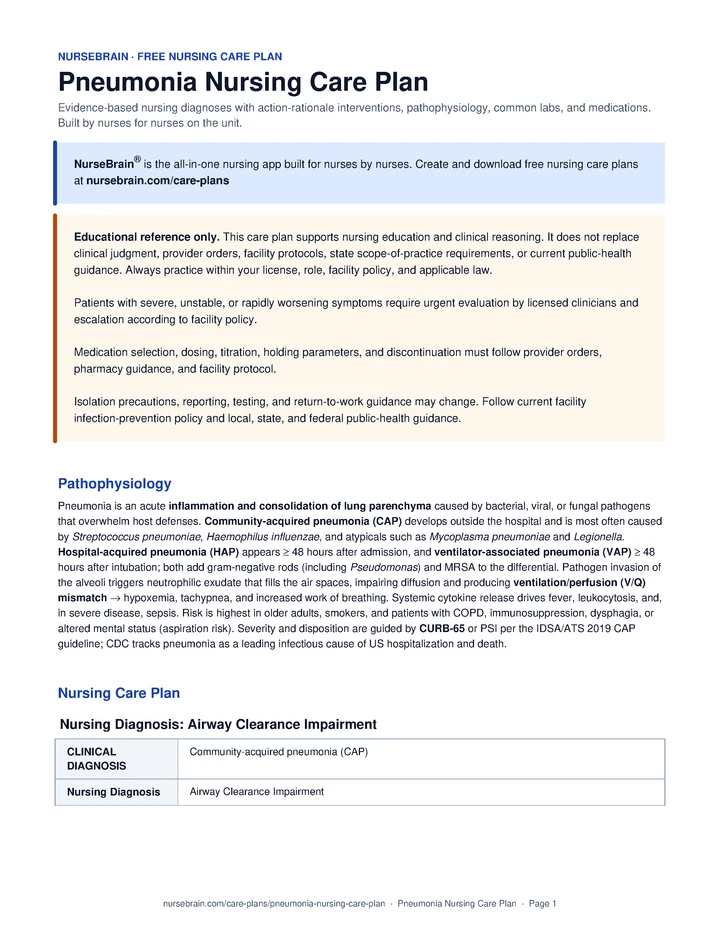
Pneumonia Nursing Care Plan
Pneumonia nursing care plan: airway clearance, oxygenation, and a printable PDF. Built by nurses for nurses.
Nursing Care Plan
Nursing Diagnosis 1: Impaired Airway Clearance
Airway Clearance Impairment related to Community-acquired pneumonia (CAP) as evidenced by Productive cough with thick, purulent sputum; Coarse crackles and rhonchi on auscultation; Diminished breath sounds over affected lobe(s); Tachypnea (RR > 24/min) with use of accessory muscles; SpO2 < 92% on room air.
Interventions
- Auscultate all lung fields (anterior, posterior, lateral) at intervals matched to clinical acuity and facility protocol; document adventitious sounds and distribution.
- Monitor respiratory rate, depth, effort, and accessory-muscle use at intervals matched to clinical acuity.
- Assess cough strength and effectiveness; document sputum quantity, color, consistency, and odor.
- Monitor SpO2 continuously or with vital signs per facility protocol.
- Review CBC, CRP, procalcitonin, sputum Gram stain and culture, and chest imaging results as available.
- Screen aspiration risk (LOC, dysphagia, gag reflex) on admission and with any change in clinical status.
- Administer prescribed antibiotics as ordered and on time per facility protocol; coordinate with pharmacy to support first-dose timing ≤ 1 hour after sepsis criteria are met per facility protocol.
- Encourage oral fluids (commonly ≥ 2 L/day) when appropriate per provider order and clinical status; offer warm fluids if preferred.
- Position the patient in high-Fowler’s or with HOB ≥ 30°; reposition at intervals matched to clinical acuity and skin assessment per facility protocol.
- Coach incentive spirometry per provider order (commonly every 1–2 hours while awake); document achieved volumes.
- Coordinate with respiratory therapy for chest physiotherapy or positive expiratory pressure (PEP) therapy when ordered.
- Suction the airway as needed when secretions are excessive and the patient is unable to clear them, per facility protocol.
- Teach the "huff cough" technique and splinted cough with a pillow over the chest when the patient is alert and able.
- Educate the patient and family on consistent incentive spirometer use during recovery (commonly hourly while awake) per provider direction.
- Teach the patient and family signs that should prompt urgent reassessment: worsening dyspnea, rising fever, hemoptysis, new confusion.
- Notify the provider for SpO2 below ordered parameters despite oxygen, new hemoptysis, or inability to clear secretions.
- Coordinate speech-language pathology (SLP) evaluation when aspiration is suspected per provider order.
Outcome: Patient supports secretion clearance with productive cough when alert and able; Breath sounds are monitored and improvement (or worsening) over affected fields is reported per facility protocol; SpO2 is monitored within ordered parameters on the lowest support that meets the goal.
Nursing Diagnosis 2: Impaired Gas Exchange
Gas Exchange Impairment related to Community-acquired pneumonia (CAP) as evidenced by SpO2 < 92% on room air; PaO2 < 60 mmHg or PaO2/FiO2 < 300; Tachypnea with accessory-muscle use; Confusion, restlessness, or new agitation; Cyanosis of lips or nail beds.
Interventions
- Monitor SpO2 continuously per facility protocol; document the trend at intervals matched to clinical acuity.
- Assess respiratory rate, depth, effort, and accessory-muscle use at intervals matched to clinical acuity.
- Monitor ABG values per provider order; report pH < 7.35, PaO2 < 60 mmHg, or PaCO2 > 50 mmHg.
- Observe for signs that may reflect cerebral hypoxia: restlessness, confusion, behavioral change, cyanosis, tachycardia, tachypnea.
- Review CURB-65 or PSI severity scoring on admission with the provider team.
- Administer supplemental oxygen as ordered and titrate within provider parameters to support SpO2 within the ordered range (commonly 92–96%, or 88–92% in known COPD per provider order).
- Position the patient in high-Fowler’s or upright leaning forward as tolerated.
- Cluster cares to allow uninterrupted rest periods when clinical state allows.
- Coordinate with respiratory therapy and the provider team for non-invasive ventilation (HFNC or BiPAP) when ordered for refractory hypoxemia per facility protocol.
- Anticipate and prepare for possible intubation: confirm airway cart at bedside, draw induction medications per provider order, and request the senior airway operator when clinical trajectory raises concern.
- Teach pursed-lip and diaphragmatic breathing for use during episodes of dyspnea when the patient is alert and able.
- Educate the patient and family on activity pacing and energy conservation to support reduced oxygen demand.
- Educate the patient and family on signs that should prompt 911 activation: severe shortness of breath at rest, chest pain, confusion, cyanosis.
- Notify the provider for SpO2 below ordered parameters despite oxygen titration, RR above ordered parameters, new confusion, or rising PaCO2.
- Coordinate critical-care consultation when severe-CAP criteria are met per facility protocol (CURB-65 ≥ 3, IDSA/ATS 2019 severe criteria, or impending failure).
Outcome: Patient maintains SpO2 within ordered parameters on the lowest support that meets the goal; Respiratory rate stays within ordered parameters with no accessory-muscle use; ABG findings, including PaO2/FiO2 trend, are monitored and reported per facility protocol.
Nursing Diagnosis 3: Hyperthermia
Hyperthermia related to Community-acquired pneumonia (CAP) as evidenced by Oral or core temperature ≥ 38.3°C (101°F); Tachycardia and tachypnea exceeding baseline; Warm, flushed, diaphoretic skin; Rigors or chills reported by the patient; Leukocytosis with left shift on CBC.
Interventions
- Measure temperature at intervals matched to clinical acuity and facility protocol, and approximately 1 hour after antipyretic administration.
- Trend HR, BP, RR, SpO2, and mental status alongside temperature.
- Screen for sepsis with qSOFA or MEWS at each set of vital signs per facility protocol.
- Monitor intake and output, skin turgor, and mucous membranes for dehydration.
- Review trends in WBC, CRP, procalcitonin, and lactate when available.
- Administer scheduled antibiotics as ordered and on time per facility protocol; coordinate with pharmacy to support first-dose timing ≤ 1 hour after sepsis criteria are met per facility protocol.
- Administer antipyretics as ordered (commonly acetaminophen); verify total daily dose stays within ordered limits.
- Provide a cool environment, light bedding, and tepid sponging when fever is high and persistent and per facility protocol.
- Encourage oral fluids when appropriate per provider order; coordinate IV fluids per order when intake is inadequate.
- Avoid aggressive external cooling that can trigger shivering.
- Educate the patient and family on completing the full antibiotic course exactly as prescribed.
- Teach signs that should prompt provider notification after discharge: fever > 38.3°C beyond 72 hours of therapy, worsening dyspnea, confusion, persistent chills.
- Educate the patient on safe acetaminophen dosing limits, especially with combination cold or flu products.
- Notify the provider for temperature > 39.5°C, rigors, new hypotension, or qSOFA ≥ 2.
- Activate the sepsis bundle per facility protocol when sepsis criteria are met: cultures, lactate, broad-spectrum antibiotics, and 30 mL/kg crystalloid for hypotension or lactate ≥ 4 per provider order.
Outcome: Temperature is monitored and the trend is reported per facility protocol; HR and RR are monitored alongside temperature and reported within ordered parameters; Patient remains hemodynamically stable with hydration supported per provider order.
Nursing Diagnosis 4: Activity Intolerance
Activity Intolerance related to Community-acquired pneumonia (CAP) as evidenced by Dyspnea with minimal exertion (< 10 ft ambulation); Patient-reported fatigue and generalized weakness; HR rise > 20% from baseline with minimal exertion; SpO2 drop > 4% with ambulation; Poor sleep due to cough and nocturnal dyspnea.
Interventions
- Monitor vital signs (HR, BP, RR, SpO2) before, during, and after activity per facility protocol.
- Assess patient-reported dyspnea on a 0–10 scale before and after activity.
- Assess sleep quality and contributors (cough, orthopnea, fever, anxiety) daily.
- Observe for signs of overexertion: pallor, diaphoresis, chest pain, syncope, palpitations.
- Assist with ADLs as needed; cluster cares to allow uninterrupted rest periods when clinical state allows.
- Collaborate with physical therapy on a progressive mobility plan per provider order, commonly starting with short supervised walks.
- Pause activity when SBP, HR, or SpO2 falls outside ordered parameters (commonly SBP drop > 20 mmHg, HR rise > 20% above resting, or SpO2 < 92%), per provider order.
- Pre-treat with a bronchodilator before therapy sessions when ordered for bronchospasm.
- Provide rest periods between activities and after ADLs per facility protocol.
- Educate the patient on energy-conservation techniques: pace activities, prioritize tasks, sit while performing tasks when possible.
- Teach the patient to recognize a personal dyspnea threshold and rest before reaching it.
- Educate the patient on the value of consistent low-level activity rather than prolonged bed rest.
- Teach a realistic return-to-activity timeline: post-pneumonia fatigue commonly persists 4–6 weeks; pacing helps support recovery.
- Coordinate with physical therapy and occupational therapy for outpatient pulmonary rehabilitation referral when ordered.
- Notify the provider for new or worsening exertional dyspnea, chest pain, or syncope.
Outcome: Patient reports decreased fatigue and improved tolerance to ADLs when clinical state permits; Patient participates in a progressive mobility plan within ordered parameters; HR returns toward baseline within a window appropriate to the activity, per provider order.
Nursing Diagnosis 5: Risk For Aspiration
Aspiration Risk related to Community-acquired pneumonia (CAP) as evidenced by Age ≥ 65 years; Decreased level of consciousness or sedation; Dysphagia or known swallowing impairment (e.g., post-stroke); Impaired gag or cough reflex; Presence of NG/OG tube or recent extubation.
Interventions
- Perform a bedside swallow screen on admission and after any change in LOC per facility protocol; refer to SLP when concern is identified.
- Assess level of consciousness, gag reflex, and ability to manage secretions at intervals matched to clinical acuity.
- Monitor for clinical signs of aspiration: new cough or choking with intake, wet voice, new fever, new infiltrate.
- Review medications that can depress LOC or impair swallowing (opioids, benzodiazepines, anticholinergics).
- Check gastric residual volume per facility protocol in patients receiving enteral feeds.
- Maintain HOB at ≥ 30° (commonly 45°) during and 30–60 minutes after meals or tube feeds, per facility protocol.
- Provide diet textures and liquid consistencies per SLP recommendations.
- Supervise meals; verify the patient is alert and upright before oral intake when feasible.
- Provide oral care at intervals matched to clinical acuity, including chlorhexidine per facility protocol when appropriate.
- Coordinate with the provider team on small-bore feeding tubes and continuous (rather than bolus) feeds for higher-risk patients per facility protocol.
- Teach the patient and family safe-swallowing strategies: chin tuck, small bites, alternate solids and liquids, no talking with food in the mouth.
- Educate the patient and family on consistent oral hygiene and positioning at home.
- Teach signs of aspiration that should prompt provider notification: new cough at meals, recurrent fever, weight loss, change in voice.
- Notify the provider for a witnessed aspiration event, new desaturation with feeds, or new infiltrate on imaging.
- Coordinate SLP, dietitian, and pharmacy for a comprehensive aspiration-reduction plan, including medication review.
Outcome: Patient remains free of documented new aspiration events during admission; Patient tolerates the diet recommended by SLP without coughing or choking when alert and able; HOB is maintained at ≥ 30° during and 30–60 minutes after meals or tube feeds per facility protocol.
Pathophysiology
Pneumonia is an acute inflammation and consolidation of lung parenchyma caused by bacterial, viral, or fungal pathogens that overwhelm host defenses. Community-acquired pneumonia (CAP) develops outside the hospital and is most often caused by Streptococcus pneumoniae, Haemophilus influenzae, and atypicals such as Mycoplasma pneumoniae and Legionella. Hospital-acquired pneumonia (HAP) appears ≥ 48 hours after admission, and ventilator-associated pneumonia (VAP) ≥ 48 hours after intubation; both add gram-negative rods (including Pseudomonas) and MRSA to the differential.
Pathogen invasion of the alveoli triggers neutrophilic exudate that fills the air spaces, impairing diffusion and producing ventilation/perfusion (V/Q) mismatch → hypoxemia, tachypnea, and increased work of breathing. Systemic cytokine release drives fever, leukocytosis, and, in severe disease, sepsis. Risk is highest in older adults, smokers, and patients with COPD, immunosuppression, dysphagia, or altered mental status (aspiration risk). Severity and disposition are guided by CURB-65 or PSI per the IDSA/ATS 2019 CAP guideline; CDC tracks pneumonia as a leading infectious cause of US hospitalization and death.
Quick Reference
- SpO2 target: ≥ 92% RA (88–92% if COPD)
- Abx timing: First dose as ordered; ≤ 1 h if sepsis criteria are met per facility protocol
- Abx duration: 5–7 days if afebrile 48 h and clinically stable per provider order (IDSA/ATS 2019)
- CURB-65: Severity score; ≥ 2 supports admission discussion with the provider team
- ICU criteria: IDSA/ATS 2019: 1 major or ≥ 3 minor; coordinate critical-care consultation per facility protocol
Common Labs
| Lab | Normal range | Significance in Pneumonia |
|---|---|---|
| WBC | 4.5–11.0 ×10⁹/L | Leukocytosis with left shift can support bacterial cause; leukopenia may signal severe disease. |
| CRP | < 10 mg/L | Nonspecific inflammation; a downward trend can support clinical response to antibiotics. |
| Procalcitonin | < 0.25 ng/mL | Per IDSA/ATS 2019 (strong recommendation), procalcitonin alone should not be used to start or stop antibiotics in suspected CAP. It may support de-escalation and duration discussions once therapy is underway; > 0.5 favors bacterial, and a downward trend can support discontinuation conversations with the provider team. |
| ABG | pH 7.35–7.45 / PaO2 80–100 mmHg | Hypoxemia (PaO2 < 60) or respiratory acidosis can indicate severe disease or impending respiratory failure and should prompt escalation per facility protocol. |
| Lactate | < 2.0 mmol/L | > 2 raises concern for sepsis or hypoperfusion; nurses trend lactate during resuscitation and report failure to clear to the provider team. |
| BUN | 7–20 mg/dL | BUN > 19 mg/dL (7 mmol/L) is the "U" component of CURB-65 and contributes to mortality risk stratification. |
| Blood cultures ×2 | No growth | Cultures are typically obtained before antibiotics in severe CAP, ICU admissions, or suspected bacteremia per provider order and facility protocol; nurses coordinate timing with first-dose administration to minimize delay. |
| Sputum Gram stain & culture | No predominant pathogen | Best yield with a quality specimen (> 25 PMNs, < 10 epithelial cells/lpf) collected before antibiotics when feasible per facility protocol. |
| Chest X-ray | Clear lung fields | A new infiltrate (lobar, interstitial, or cavitary) supports the diagnosis. The interpretation and diagnostic decision are made by the provider team. |
| Pulse oximetry | ≥ 95% RA | SpO2 < 92% RA suggests significant V/Q mismatch and may prompt supplemental oxygen per provider order and facility protocol. |
| Respiratory viral PCR (influenza, SARS-CoV-2, RSV) | Negative | IDSA/ATS 2019 strongly recommends influenza testing during circulating season (Recommendation 5); CDC supports adding SARS-CoV-2 and RSV in hospitalized adults and high-risk outpatients. Positive results can support antiviral therapy decisions and infection-prevention precautions per facility protocol. |
Common Medications
| Class | Examples | Mechanism of action | Key side effects | Nursing considerations |
|---|---|---|---|---|
| Beta-lactam (CAP first-line) | Ceftriaxone, Amoxicillin/clavulanate, Ampicillin/sulbactam | Inhibits bacterial cell-wall synthesis (PBP binding); covers S. pneumoniae and H. influenzae. | Rash, diarrhea, anaphylaxis (PCN allergy), C. difficile, transaminitis. | Administer as ordered per provider direction, pharmacy guidance, and facility protocol. Verify PCN allergy and reaction type before the first dose. Per IDSA/ATS 2019, the first dose is typically given as soon as the diagnosis is established by the provider team; administer the first dose as ordered, ≤ 1 hour after sepsis criteria are met per facility protocol. Common regimens by setting per IDSA/ATS 2019: outpatient healthy (amoxicillin or doxycycline); outpatient with comorbidity or inpatient non-ICU (beta-lactam plus macrolide or respiratory FQ monotherapy); ICU (beta-lactam plus macrolide, or beta-lactam plus FQ; FQ monotherapy is typically avoided). Standard duration is 5–7 days when the patient is afebrile 48 hours and clinically stable, per provider order. |
| Macrolide (atypical coverage) | Azithromycin, Clarithromycin | Binds the 50S ribosomal subunit → inhibits protein synthesis; covers Mycoplasma, Legionella, and Chlamydophila. | QT prolongation, GI upset, transaminitis, ototoxicity (high dose). | Administer as ordered. Nurses verify baseline ECG/QTc when ordered for cardiac-risk patients per facility protocol, screen the active medication list for other QT-prolonging agents, and escalate prolonged QTc to the provider team. Macrolides are commonly combined with a beta-lactam in inpatient CAP per IDSA/ATS 2019. |
| Respiratory fluoroquinolone | Levofloxacin, Moxifloxacin | Inhibits DNA gyrase and topoisomerase IV; can be used as monotherapy in non-ICU CAP per provider order. | Black-box warnings: tendinopathy/rupture, peripheral neuropathy, CNS effects, QT prolongation, aortic dissection risk. | Administer as ordered. Teach the patient to report new tendon pain, paresthesias, or mood changes promptly. Concurrent corticosteroid use can increase tendinopathy risk; nurses screen the medication list and escalate concerns to the provider team. Selection between FQ monotherapy and a beta-lactam plus macrolide is a provider-team decision per facility protocol. |
| Antipseudomonal ± anti-MRSA (HAP/VAP) | Piperacillin-tazobactam, Cefepime, Meropenem; Vancomycin or Linezolid for MRSA | Broad-spectrum cell-wall (or carbapenem) coverage; vancomycin or linezolid targets MRSA. | Nephrotoxicity (vancomycin), seizures (cefepime or imipenem in renal failure), serotonin syndrome (linezolid with serotonergic agents). | Administer as ordered per provider direction, pharmacy guidance, and facility protocol. Per Kalil et al. IDSA/ATS 2016 HAP/VAP, empiric coverage is informed by the local antibiogram; vancomycin trough or AUC monitoring is coordinated with pharmacy. Nurses support de-escalation discussions with the provider team once culture and sensitivity results are available. |
| Short-acting bronchodilator | Albuterol nebulized or MDI | β2-agonist → bronchial smooth-muscle relaxation. | Tachycardia, tremor, hypokalemia, palpitations. | Administer as ordered when wheezing or bronchospasm is present and the medication is ordered. Nurses monitor HR pre- and post-treatment, escalate new tachyarrhythmia to the provider team, and recognize that routine bronchodilator use is not typical in uncomplicated CAP per IDSA/ATS 2019. |
| Corticosteroid (severe CAP, ICU) | Hydrocortisone (commonly continuous infusion or scheduled IV); methylprednisolone alternative | Suppresses systemic inflammatory cytokine release. | Hyperglycemia, immunosuppression, GI bleed, mood change, secondary infection. | Administer as ordered per provider direction, pharmacy guidance, and facility protocol. Per CAPE COD (Dequin et al., NEJM 2023), hydrocortisone was associated with reduced 28-day mortality in adults with severe CAP requiring ICU; the ATS 2024 severe-CAP update supports corticosteroid consideration in this population. Selection, dose, schedule, taper, and contraindication screening (active GI bleed, uncontrolled diabetes, recent live-virus exposure) are provider-team decisions. Nurses monitor glucose per facility protocol, screen for adverse effects, and coordinate continuation of Surviving Sepsis hydrocortisone in vasopressor-dependent shock per provider order. |
| Antipyretic / analgesic | Acetaminophen | Central COX inhibition → antipyresis and analgesia. | Hepatotoxicity (> 4 g/day or with EtOH or liver disease). | Administer as ordered. Nurses verify total daily dose stays within ordered limits, screen for occult acetaminophen in combination products, and recognize a lower ceiling in chronic liver disease. Acetaminophen is commonly preferred over NSAIDs in volume-depleted or older patients per provider order. |
References
- Makic, M. B. F., & Martinez-Kratz, M. R. (Eds.). (2023). Ackley and Ladwig’s Nursing Diagnosis Handbook: An Evidence-Based Guide to Planning Care (13th ed.). Elsevier.
- Metlay, J. P., Waterer, G. W., Long, A. C., et al. (2019). Diagnosis and Treatment of Adults with Community-acquired Pneumonia. An Official Clinical Practice Guideline of the American Thoracic Society and Infectious Diseases Society of America. American Journal of Respiratory and Critical Care Medicine, 200(7), e45–e67.
- Kalil, A. C., Metersky, M. L., Klompas, M., et al. (2016). Management of Adults with Hospital-acquired and Ventilator-associated Pneumonia: 2016 Clinical Practice Guidelines by the Infectious Diseases Society of America and the American Thoracic Society. Clinical Infectious Diseases, 63(5), e61–e111.
- Dequin, P. F., Meziani, F., Quenot, J. P., et al. (2023). Hydrocortisone in Severe Community-Acquired Pneumonia (CAPE COD). New England Journal of Medicine, 388(21), 1931–1941.
- American Thoracic Society. (2024). Severe Community-Acquired Pneumonia: An Official Clinical Practice Update of the American Thoracic Society. American Journal of Respiratory and Critical Care Medicine.
- Evans, L., Rhodes, A., Alhazzani, W., et al. (2021). Surviving Sepsis Campaign: International Guidelines for Management of Sepsis and Septic Shock 2021. Critical Care Medicine, 49(11), e1063–e1143.
- Centers for Disease Control and Prevention. (2024). Pneumonia: Clinical Overview. U.S. Department of Health & Human Services. Retrieved from cdc.gov/pneumonia.
Frequently Asked Questions
What is the nursing care plan for Pneumonia?
A Pneumonia nursing care plan organizes the assessment, nursing diagnoses, goals, interventions, and evaluation criteria for a patient with Pneumonia. Diagnoses are ordered by what is currently most destabilizing for the patient.
What are the priority nursing diagnoses for Pneumonia?
Priority diagnoses for Pneumonia appear in the Nursing Diagnoses section above, ordered by clinical acuity. The top diagnosis should reflect what is currently most destabilizing for this specific patient.
What is the priority nursing intervention for Pneumonia?
Priority interventions for Pneumonia are listed in the care plan above, organized by diagnosis. The most critical actions address airway, circulation, and the highest-acuity problem first.
What complications should the nurse monitor for in Pneumonia?
Complications to monitor for in Pneumonia are listed within each diagnosis section above. Trend vitals, mental status, and the condition-specific red flags described in the assessment section.
A report sheet built for this patient
This is exactly the kind of patient the report sheet templates in NurseBrain® Synapse are built for. Keep everything you track on one page, all shift.
Learn how NurseBrain Synapse uses the Clinical Care Classification System for nursing care plans.