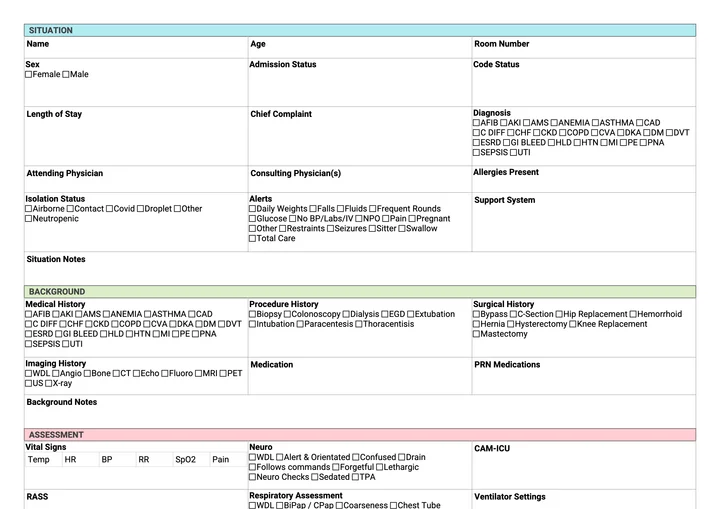
Whether your unit calls it an ICU brain sheet, a critical care report sheet, or just your paper, it's the same tool: one page per patient that holds everything your 1:2 assignment needs for the shift. Drip rates, vent settings, access, neuro checks, labs, and every overnight order. Download the free printable PDF below, or open the same template digitally in NurseBrain Synapse so it carries forward between shifts without recopying.
What is an ICU brain sheet?
ICU nurses track more per patient per hour than almost any nurse in the hospital. The brain sheet is how you keep it organized: continuous drips and their titration ranges, vent settings after the last RT adjustment, arterial line values at a glance, which family member is waiting for the 0600 attending update. It's not the chart, and it's not legal documentation. It's your working tool for the shift — dense enough to hold critical care complexity, fast enough to scan in the middle of a rapid response.
What to track on an ICU brain sheet
Critical care brain sheets typically cover: diagnosis and primary problem; neuro checks (GCS, pupils, sedation score — RASS or CPOT); respiratory (vent mode and settings, SpO2, last ABG, ETT position and last suction); hemodynamics (HR, MAP, arterial line, CVP or PA pressures); vasoactive and sedation drips (name, rate, dose, titration parameters); lines and access (PIV, CVC, arterial, Foley, NGT — insertion dates); I&O (hourly urine, fluid balance, drains, dialysis if applicable); labs (last BMP, CBC, coags, ABG); medications due; consults pending; and family updates or goals-of-care notes.
ICU brain sheet vs ICU report sheet: same thing, different name
"Brain sheet," "report sheet," "cheat sheet," and "flow sheet" are all names for the same tool in the ICU. The terminology varies by unit. Some hospitals print blank brain sheets in orientation packets; others expect nurses to bring their own. The free PDF above works on your clipboard. NurseBrain Synapse is the digital version: it carries your data forward between back-to-back shifts, keeps drip tracking organized, and builds your SBAR from what you've already entered — no recopying at 0700.
ICU Nurse FAQ
What does an ICU nurse do?
An ICU nurse manages critically ill or unstable patients who need continuous monitoring and frequent intervention. On a typical shift you're adjusting vasoactive drips to hit MAP goals, titrating sedation for comfort and ventilator synchrony, interpreting hourly labs, managing multiple IV lines, performing neuro checks, communicating with the care team, and updating family members on a patient who can't speak for themselves. Most critical care nurses carry 1:1 or 1:2 assignments depending on acuity and unit type.
What makes a good ICU brain sheet?
A good ICU brain sheet fits one patient per page and has dedicated sections for neuro (GCS, RASS, pupils), respiratory (vent settings or O2 support, last ABG), hemodynamics (HR, MAP, drip rates), lines and access with dates, I&O running total, labs by time, medications due, and a small area for calls and family updates. It should be dense enough to capture critical care complexity but scannable enough to find any data point in under five seconds.
How many patients does an ICU nurse take?
Most adult ICU nurses carry 1:2 assignments. Step-down or progressive care units may run 1:3 or 1:4. Trauma ICU, CVICU, cardiac surgery, and neuro ICU nurses are often 1:1 or 1:2 depending on acuity. ECMO patients and fresh post-operative cardiac surgery patients are almost always 1:1. California has mandated ICU ratios of 1:2.
What drips should I track on my ICU brain sheet?
Track every continuous infusion: vasopressors (norepinephrine, vasopressin, epinephrine, phenylephrine, dopamine), sedatives (propofol, dexmedetomidine, midazolam, ketamine), analgesics (fentanyl, hydromorphone, morphine), insulin drips, heparin drips (with last PTT), and any specialty infusions like amiodarone, nicardipine, or milrinone. Note the current rate, dose, and your titration parameters so any nurse covering for you can manage them safely.
Can I use a digital ICU brain sheet?
Yes. NurseBrain Synapse is designed for bedside nurses and works on your phone or tablet. It replaces paper brain sheets with a digital format that carries over between consecutive shifts, keeps drip tracking organized, and builds your SBAR handoff automatically from the shift data you enter. Available on iOS and Android.